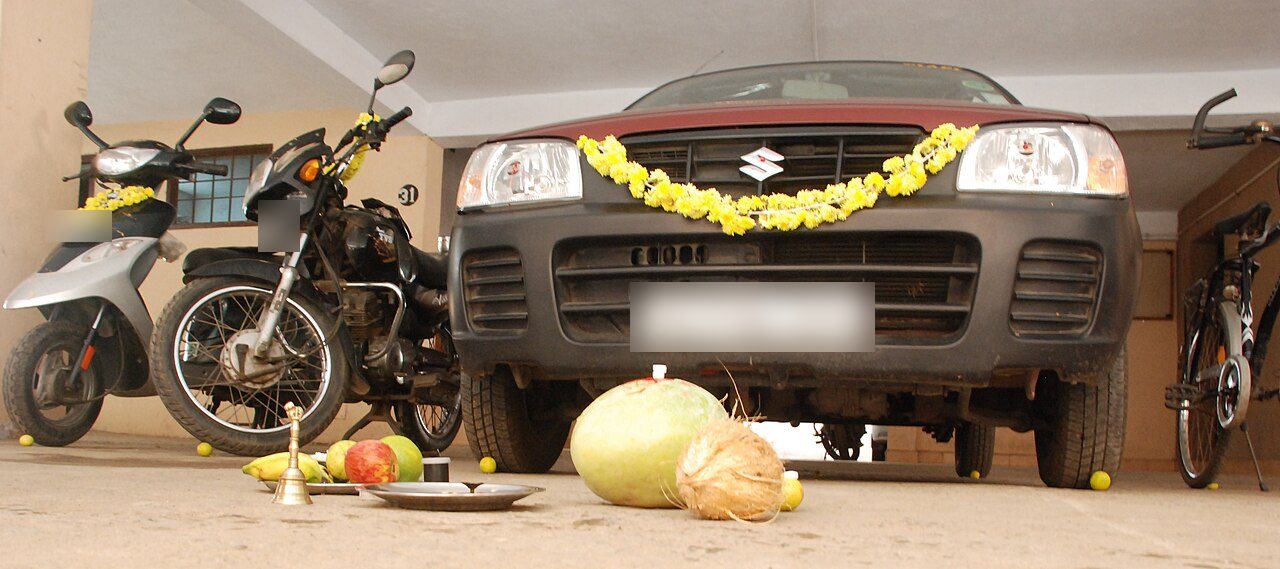
On Maha Navami, the ninth day of Sharad Navratri, a large part of south India stops work and cleans its tools. All India Radio's report from Tamil Nadu in 2024 describes what follows. Tools, books and vehicles are washed, marked with a tilak, garlanded and worshipped, and the owners of companies hand their workers sweets, puffed rice, fruit and gifts. In Mangaluru in 2018, Daijiworld found people worshipping farm tools, cameras, computers and vehicles, and called the day "a day of rest for man and machine".
The photograph at the top of this page shows a garage on the morning of Ayudha Puja. Yellow garlands hang across the grille of a hatchback and the handlebars of a motorcycle and a scooter, and an ash gourd and a coconut sit on the floor, waiting to be broken. The same scene is repeated in workshops, offices, bus depots and printing presses. It says something about tools that people who write about Indian craft, this site included, tend to overlook.
What is set down, and when
Ayudha means weapon, and the royal form of the day survives. In Mysuru the Wadiyar family still performs Ayudha Puja to the royal armoury inside the palace on Mahanavami, and the state sword, the Pattada Katti, is carried to the Kodi Someshwara temple. The household and workshop version widens "weapon" to mean whatever a person works with. Books and musical instruments are worshipped alongside, and in Tamil Nadu the same day is widely kept as Saraswati Puja.
The ninth lunar day falls across two calendar dates this year, and the states have split over it. A workshop you plan to visit on either day is likely to be shut.
Dates in 2026
The Navami tithi runs from 2:12 pm on 19 October to 12:28 pm on 20 October (Drik Panchang, New Delhi). Tamil Nadu gives Ayutha Pooja on Monday 19 October and Vijaya Dasami on Tuesday 20 October. Telangana gives Mahanavami on 19 October and Vijaya Dasami on 20 October. Karnataka gives Mahanavami and Ayudhapooja on Tuesday 20 October and Vijayadasami on Wednesday 21 October, and Kerala gives Mahanavami on 20 October and Vijayadasami on 21 October. All four are from the state governments' 2026 holiday lists.
The same idea on other days
Eastern India keeps its own day for tools, and keeps it a month earlier. Vishwakarma Puja falls on Kanya Sankranti, in mid-September, and is named for the deity of builders and craftsmen; it is the day many factories and workshops in the east set down their machines. In Maharashtra and much of the north, weapons are worshipped on Dussehra itself as Shastra Puja.
Kerala turns the day after Navami toward learning. On Vijayadashami, children of two or three are brought for Vidyarambham and write their first letters in rice spread on a brass plate, while an elder traces letters on the child's tongue with a gold ring. The best-known ceremony is at Thunchan Parambu in Tirur, the birthplace of the poet Ezhuthachan, and Madhyamam has reported families of other faiths bringing their children too.
Hand and machine in the ritual
The anthropologists Kirin Narayan and Kenneth George have spent years on Vishwakarma worship, and their description fits Ayudha Puja too. They write of rituals in which "tools, machines, and other instruments are periodically set down or stilled to become the focus of worship". In a 2022 paper in the Journal of Asian Studies they call this "technophany". They argue against two readings that outsiders often reach for, one treating the practice as a survival of a farming past and the other as a protest against industry. The reports from Tamil Nadu and Mangaluru are consistent with their reading. On the day, a hammer and a computer receive the same garland, because each is how somebody earns a living.
Buyers of craft draw the line between hand and machine much more sharply. We write as if the hand were the virtue and the machine the fraud, and our own essay on spotting fakes tells readers to look for evidence of the hand. That advice is sound for a specific reason. A machine-printed bandhani becomes a problem when it is sold as hand-tied at a hand-tied price, because the buyer has been misled about what they paid for. The makers who garland their machines on Navami have no quarrel with machines, and buyers have no reason to quarrel with them either.
The diya trade shows what is at stake. The Khadi and Village Industries Commission gives potters electric wheels, first under the Kumhar Sashaktikaran Yojana and now under its Gramodyog Vikas Yojana; at one event in Telangana in September 2024 it handed out 300. In 2020 KVIC said the average income of potters under the scheme had risen "from nearly Rs 3,000 per month to nearly Rs 12,000 per month". That is the commission's own figure, and we found no independent evaluation of it. A motor turns the wheel, and the potter's hands still shape every diya on it. A buyer who refuses a diya because its wheel had a motor has misread what makes it handmade.
What a buyer can take from it
For a buyer, the practical point is to ask what a thing was made with as well as whether it was made by hand. A weaver who buys mill-spun yarn and weaves it on a pit loom has made handloom cloth, and a seller who can name the yarn and the loom knows the work. The useful test of a craft object is whether its description matches how it was made. The price also pays for tools. A hand-forged knife or a hand-thrown pot carries the cost of the tools, their upkeep and the years it took to learn to use them.
If you pass a workshop on Navami, it will probably be shut, with its tools cleaned and garlanded.
Sources
- All India Radio, "Ayudha Puja celebrated in Tamil Nadu", 11 October 2024
- Daijiworld, Mangaluru, 18 October 2018
- ETV Bharat, on the Mysuru palace Ayudha Puja, 7 October 2019
- Madhyamam, on Vidyarambham, 23 October 2015
- Kirin Narayan and Kenneth M. George, "Tools and world-making in the worship of Vishwakarma", South Asian History and Culture 8(4), 2017
- Kenneth M. George and Kirin Narayan, "Technophany and its publics", Journal of Asian Studies 81(1), 2022
- PIB, KVIC on electric potter's wheels and potters' incomes, 24 July 2020 and PIB, KVIC wheel distribution in Telangana, 4 September 2024
- 2026 holiday lists: Tamil Nadu, Karnataka, Kerala, Telangana; tithi times from Drik Panchang