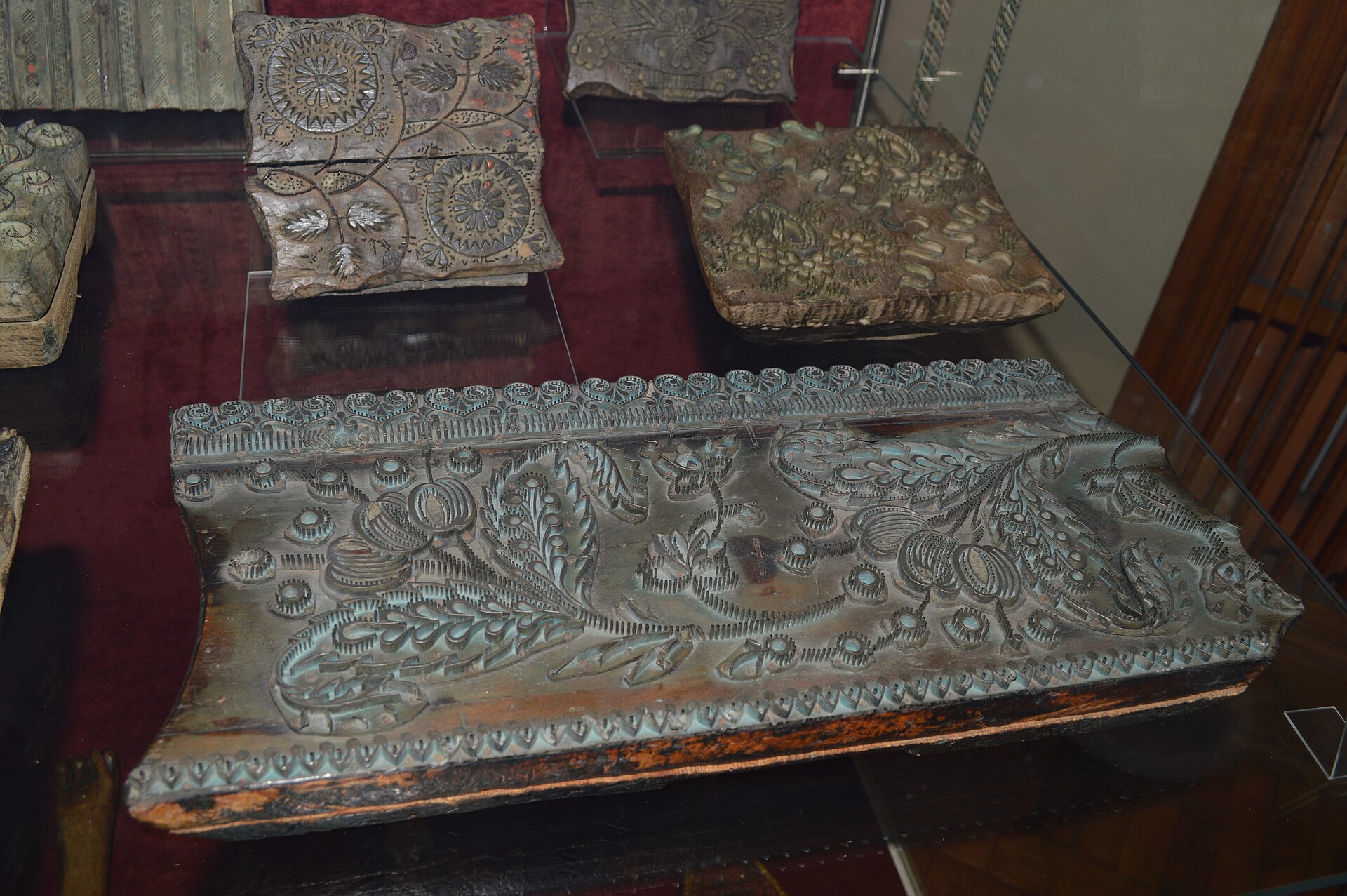
When you buy a block-printed dupatta, you pay for the carved wooden block, the printer's hand, and the dye. What you do not see on the listing is the water. Printing and dyeing cloth uses a great deal of it, and when the colour is fixed the water has to go somewhere. In Rajasthan, where most of India's hand block printing is done, two towns thirty kilometres apart send it to very different places, and the difference is not only an environmental footnote. It is the clearest sign of how a piece of cloth was actually made.
This essay follows the water rather than the pattern. It is about Sanganer and Bagru, near Jaipur, because they are the best documented, and because between them they show the whole range from dye water a field can drink to dye water that has taken two decades of litigation to contain.
Two kinds of dye water
The split is between natural dyes and synthetic ones. Natural dyes are plant and mineral colours fixed with mordants such as alum and iron: indigo for blue, madder for red, pomegranate and myrobalan for yellows and blacks. Synthetic dyes are chemical colours, usually fixed with chemical bleaches and salts, and some older ones are made from azo compounds that regulators restrict. The two look similar on the finished cloth. They are not similar at all in what they leave in the rinse water.
CarbonCopy, a climate-reporting site, visited Bagru in 2025 and put the natural-dye case plainly: the water discharged from vegetable dyeing "can be reused directly for farming and feeding livestock without the need for effluent treatment". Synthetic dye water cannot. It carries chemical load and heavy metals, and released untreated it poisons soil, groundwater and whatever waterbody it drains into. Same craft, same town in some cases, opposite consequences downstream.
The Sanganer story
Sanganer, about fifteen kilometres from Jaipur, is a centuries-old printing town. Its trouble began, as the India Water Portal recounted in a 2015 report by Amita Bhaduri, when hand block printing gave way to screen printing in the 1960s. Screen printing was faster and cheaper, and it leaned on synthetic dyes and chemical bleaching; some block-printing units followed suit. The effluent from these units was released untreated into the local drains, or nallahs.
The drain in question is the Amanishah nallah, which runs through Sanganer and feeds the Dravyavati river. The same report put the untreated discharge at 17 to 18 million litres a day by one industry estimate, and about 12.3 million litres a day by the official figure, flowing into the nallah and on into the river. Random samples from the Amanishah nallah, it noted, came back "highly polluted".
The scale of water the cluster draws is itself large. Citing a Central Ground Water Board figure, CarbonCopy reported block-printing water use of up to 1,000 litres per unit per day. With an estimated 850 dyeing and printing units in Sanganer running roughly 300 days a year, it worked the total to about 25.5 crore litres a year — in a state where, it noted, groundwater is scarce.
The courts, the closures and the treatment plant that was slow to come
The fix on paper is a Common Effluent Treatment Plant (CETP): a shared facility that collects wastewater from many small units and treats it before release. Getting one built and working in Sanganer has taken a very long time. The India Water Portal report traces a public interest litigation filed by a Jaipur lawyer in 1994, a 2003 High Court direction that the cost of the plant be shared between the central government, the state and the textile unit owners' association, and, in 2015, closure notices served on hundreds of units by the Rajasthan State Pollution Control Board.
The pressure did not end there. In 2023 the National Green Tribunal directed Rajasthan to pay ₹100 crore in interim compensation for the environmental damage from textile printing around Jaipur, and ordered that no new unit open until the infrastructure was in place. Even so, CarbonCopy found in 2025 that the main treatment plant could take the wastewater of only about 400 units against some 850 registered, so a share of the water still reaches the river. The gap is national: a Central Pollution Control Board review it cited found that of 191 CETPs across India, only 128 were complying with norms.
There is a human cost on both sides of the ledger. The Sanganer cluster employs around 10,000 people, the India Water Portal noted, many of them small job-workers for traders and exporters, for whom the cost of pollution control per piece is far higher than it is for a large mill. Cleaning the water and keeping people in work are not automatically the same project, which is why the matter has stayed in court for thirty years.
Why Bagru's water is different
Thirty kilometres south, Bagru kept to natural dyes, and its signature is dabu: a mud-resist paste of clay, lime and gum pressed onto the cloth before it is dyed, so the covered areas stay pale. Because the colour is vegetable and mineral, the spent dye bath is mild enough that, as CarbonCopy reported from the village, it can go back onto fields and to livestock without a treatment plant standing between the vat and the ground.
That does not make natural dyeing easy or well paid. The same report found Bagru's natural dyers working on thin margins and short of labour — one dyer put his profit at about ₹6 on every metre of cloth — and unable to work through the monsoon because the dyed cloth has to dry in the open. Natural dye is slower than synthetic, and far slower than screen printing, which the report measured at up to 500 metres of cloth a day against roughly 100 for hand block printing. The cloth that is gentlest on the water is also the most expensive to make, which is exactly why a cheap "natural-dye" claim deserves a second look.
What this means for a buyer
Most buyers treat natural dye as a matter of taste, or of whether the colour is kind to skin. The dye water is the part that reaches past the person who buys the cloth. Choosing natural dye, or at least an azo-free synthetic, is a choice about what a printing town's groundwater and fields carry after the cloth is sold.
You cannot read the dye water from a photograph, but you can ask about it. A few questions separate the claims:
- Ask whether the dye is natural, and name it. A seller who works with vegetable dyes can usually say indigo, madder, pomegranate or iron. "Eco-friendly colours" with no name is not an answer.
- Treat hand block printing and natural dye as two separate claims. A cloth can be hand block-printed with synthetic dye, or screen-printed to look like block work. A listing worth trusting makes both claims and does not blur them.
- Ask about azo-free dyes where the colour is synthetic. Many Bagru and Sanganer printers now use azo-free synthetic dyes; it is a fair thing to ask a seller to confirm.
- Favour sellers who name the place and the process. Bagru and dabu, Sanganer screen printing, a named unit or dyer — specifics are what a seller who knows the water can give. Our guide to [hand block-printed Ajrakh](post-ajrakh-block-printing.html) and to [Kalamkari](post-kalamkari.html), both natural-dye crafts, go through the same check on a single cloth.
None of this settles a purchase on its own, any more than a [GI tag](essay-gi-tags.html) does. But following the water is a good habit. It turns a vague preference for "handmade" into a specific question a seller can answer, and the answer tells you something real about how the cloth was made and what it left behind.