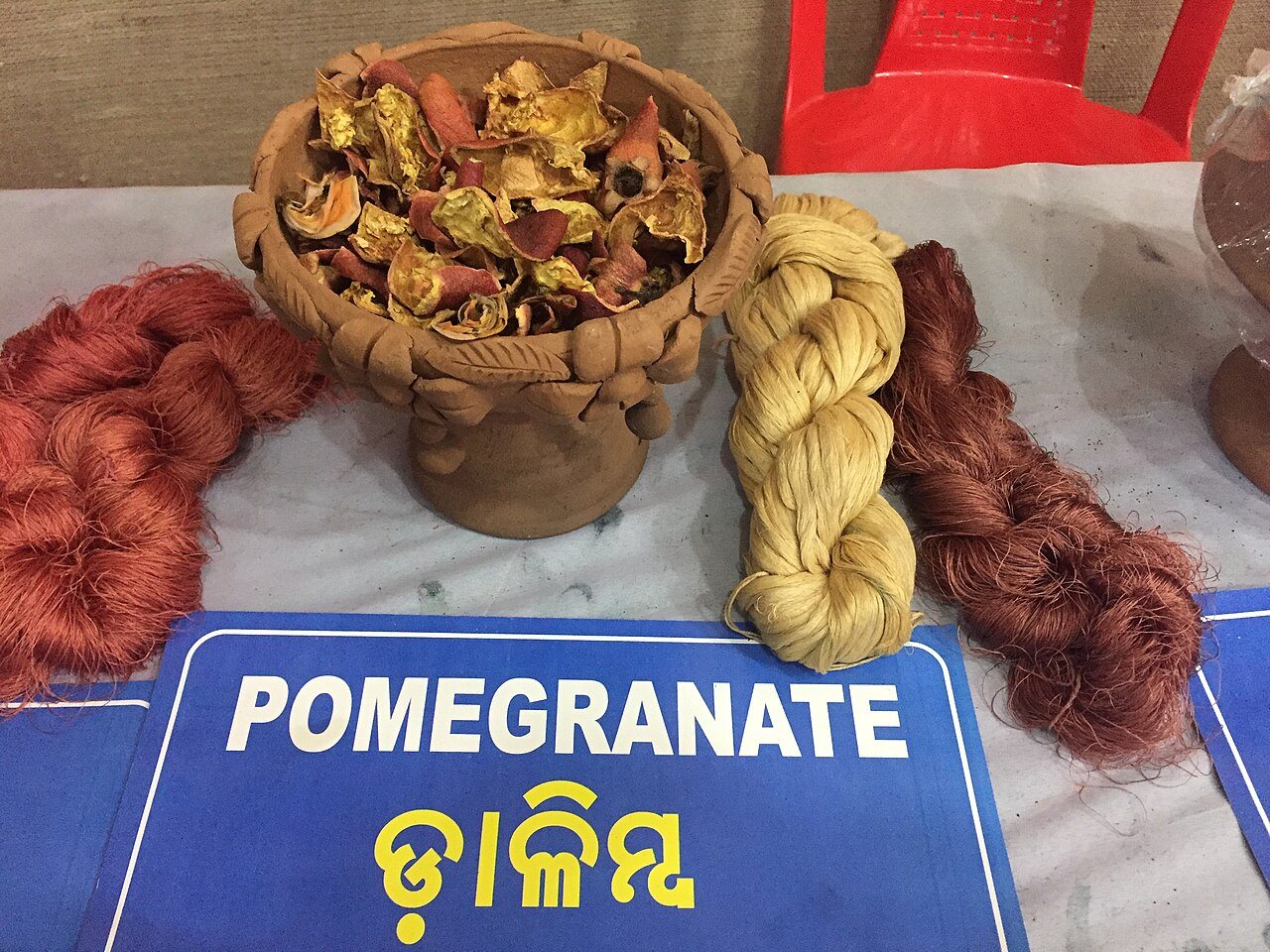
Sellers of handmade textiles use "natural dyes" to suggest a product that is safe for the skin, the river and the dyer, and "chemical dyes" to suggest the reverse. Every dye is a chemical compound. The questions that help a buyer are about particular dyes, the mordants used with them, and what happens to a dyehouse's waste water. If you pay more for natural dye, it helps to know which of these the extra money covers.
Indigo is the clearest case. The blue of Ajrakh from Kutch and the blue of denim come from the same compound, indigotin (C.I. Vat Blue 1), whether it was extracted from Indigofera leaves or made in a factory. Karl Heumann developed the first workable industrial synthesis in 1890, BASF and Hoechst went on to produce synthetic indigo by that route, and the same principal route is still used today.
The two kinds can still be told apart in a laboratory, by what travels with the indigotin. Plant indigo carries a red companion dye, indirubin. A 2019 study in the KKU Science Journal found indigo blue and indirubin in fabric dyed with natural indigo, and indigo blue alone in fabric dyed with synthetic indigo. Synthetic indigo carries residues of its manufacture. Michael Cordin, Thomas Bechtold and Tung Pham, writing in Scientific Reports in 2021, report that commercially produced indigo contains up to 0.6% aniline and 0.4% N-methylaniline by weight, and that the small mutagenic effect of indigo dye is most probably due to these contaminants.
Colourfastness depends on the dye
Fastness is how well a colour survives light, washing and rubbing. It decides how a piece looks after years of use.
Among natural dyes it varies widely from one plant to the next. A 2026 review of natural dyes on nylon in RSC Advances, by Muksit Ahamed Chowdhury and colleagues, concludes that indigoid dyes, anthraquinone dyes and dyes high in tannin are more suitable for cloth exposed to light than carotenoid and curcumin dyes, unless the latter are given a stabilising treatment. It reports light-fastness grades of 3, or 3 to 4, for curcumin, the colouring matter of turmeric. Madder's reds are anthraquinones, and myrobalan is a source of tannin. Wash fastness varies as well. A 2017 review in Natural Products and Bioprospecting by Mohd Yusuf, Mohd Shabbir and Faqeer Mohammad groups turmeric, annatto, harda (myrobalan), pomegranate and safflower as direct dyes, whose wash fastness is poor unless the cloth is given a special after-treatment.
Synthetic reactive dyes, the class used commercially on cotton, bond to the fibre itself. Arvind Negi's 2025 review in Polymers describes them forming covalent bonds with the hydroxyl groups of cellulose under alkaline conditions, with only the small share left unbonded on the fibre surface washing off easily.
Fastness has an environmental side. A shawl that keeps its colour for twenty years needs replacing less often than one that fades in three, and each replacement means more fibre, more dye and more water.
Mordants, the part the label leaves out
Many natural dyes need a mordant, a metal salt or other substance that binds dye to fibre. Hüseyin Benli's 2024 review of bio-mordants in Environmental Science and Pollution Research separates substantive dyes such as indigo and turmeric, which colour cloth without pretreatment, from dyes such as madder that colour only material that has been mordanted. The review also notes that the type of mordant has a considerable effect on the strength and shade of the colour. In Pedana Kalamkari, as Deccan Herald described it in 2013, alum fixes the colours, the black is made from iron and jaggery, and myrobalan is used to fix dye to the cloth.
The metals matter downstream. Benli lists copper, iron, chromium, cobalt, nickel and aluminium among mordant metals "whose residue in dyeing wastewater causes major problems with effluent disposal". Chowdhury and colleagues single out chromium(VI), copper sulfate, stannous chloride (a tin mordant) and zinc salts as "of high concern because of their carcinogenic, toxic, cytotoxic, aquatoxic, corrosive, or marine-pollution risks", and conclude that potassium dichromate, a chrome mordant, is unsuitable even where it performs well. Alum and iron salts are absent from that list. A workshop can use only plant dyes and still put chromium or tin into its waste water, and the words "natural dye" on a label do not say which mordant was in the pot.
The serious charge against synthetic dyes concerns one group of them. Some azo dyes, broken down by reductive cleavage, release aromatic amines. Yusuf, Shabbir and Mohammad describe the ban on benzidine and azo dyes that produce any of 22 amines "related with their carcinogenicity". In the European Union, entry 43 of Annex XVII to the REACH Regulation bars azo dyes that can release any listed amine above 30 mg/kg from textile and leather articles in direct and prolonged contact with the skin. In India, the Ministry of Environment and Forests acted under the Environment (Protection) Act, 1986. According to the Central Coir Research Institute, a government notification of January 1990 prohibited the handling of 42 benzidine-based dyes from 1993, and a notification published in the Gazette on 26 March 1997, S.O. 243(E), prohibited 70 more azo dyes, 112 in all. Under India's import policy, textiles may be imported only if they contain none of the dyes whose handling is prohibited under the Act. The health objection applies to these dyes, and a buyer can ask a seller of synthetic-dyed cloth whether it is certified free of them.
Water is the main environmental question
Dyeing uses a great deal of water whatever the dye. A 2023 review in Molecules by Barbara Pizzicato and colleagues cites an estimate of around 125 litres of water to dye and finish each kilogram of cotton. It lists heavy metals, chromium compounds, formaldehyde, benzidine and dyes among the pollutants in typical dye effluent.
For a buyer judging a dyehouse, the treatment of that water says more than the origin of the dye. Benli makes the point for natural dyeing, writing that conventional metal mordants, "when released into the environment as wastewater effluent at the end of the dyeing process, cause major damage to the ecosystem". The same holds for synthetic dyeing, and Tiruppur in Tamil Nadu shows what happens at scale.
Down To Earth reported in 2011 that dyes and salts from Tiruppur's units were dumped in the Noyyal river, and that farmers downstream had been fighting the dyeing and bleaching units in court since 2003. In 2006 the Madras High Court had ordered the units to reach zero liquid discharge, meaning no liquid effluent released into the open, by 31 July 2007. When they did not comply, the court in January 2011 ordered more than 700 bleaching and dyeing units and effluent treatment plants closed, and said they could reopen only once they achieved it. The court's remedy was to require the water to be treated.
What this means when you are buying
- Ask which plants, and which mordant. A seller who works with natural dye can name the plants, for example madder, indigo, myrobalan, pomegranate or catechu, and can say whether the mordant was alum, iron, or a chrome, copper or tin salt. A vague answer can mean the dyeing was bought in from elsewhere.
- Expect natural dye to look like natural dye. Chowdhury and colleagues point to the seasonal and regional variation of natural dyes and their lack of uniformity. Some unevenness along a length and some variation between pieces of the same design is normal, and a large, perfectly matched set sold as plant-dyed is worth a question.
- Expect washing instructions. Turmeric, pomegranate and safflower are among the natural dyes with poor wash fastness, so a careful seller gives washing instructions and warns about the first wash and about direct sun. A listing that promises plant dyes and unqualified machine-washability deserves a question.
- Know what a natural indigo premium pays for. The main blue is the same molecule as synthetic indigo. The extra money pays for the crop and the vat, for the indirubin that comes with plant indigo, and for a dye that does not carry the aniline residues Cordin and colleagues found in the synthetic product.
Natural dye from a workshop that can name its plants and mordants and treats its water is worth paying for. Natural dye as a label, with no answer to those questions, tells a buyer little. A synthetic dyehouse that keeps clear of the banned azo dyes and treats its effluent is a reasonable place to buy from.
Sources
- Michael Cordin, Thomas Bechtold and Tung Pham, "Quantification of aniline and N-methylaniline in indigo", Scientific Reports 11, 21135, 2021
- Orthai Saengvong and colleagues, "The simple natural indigo fabric test kit by column chromatography", KKU Science Journal, 2019
- All India Artisans and Craftworkers Welfare Association, Craft Katha, on Ajrak
- Muksit Ahamed Chowdhury and colleagues, "Coloration of nylon textiles with natural dyes: a critical review of recent progress, dye-fiber interactions, fastness, and functional performance", RSC Advances, 2026
- Mohd Yusuf, Mohd Shabbir and Faqeer Mohammad, "Natural colorants: historical, processing and sustainable prospects", Natural Products and Bioprospecting 7(1), 2017
- Arvind Negi, "Environmental impact of textile materials: challenges in fiber-dye chemistry and implication of microbial biodegradation", Polymers 17(7), 871, 2025
- Hüseyin Benli, "Bio-mordants: a review", Environmental Science and Pollution Research 31, 2024
- Deccan Herald, "Pedana Kalamkari made of natural colours gets GI tag", 9 November 2013
- Regulation (EC) No 1907/2006 (REACH), Annex XVII, entry 43, azocolourants and azodyes
- Central Coir Research Institute (Coir Board), note on banned dyes and amines
- Ministry of Environment and Forests, S.O. 243(E), 26 March 1997, Prohibition on the handling of Azodyes, as listed in the ministry's index of legislation reproduced by Karmayog
- SGS, "India updates azo dye requirements for imported apparel and textile products", 6 October 2023 and DGFT Public Notice No. 14/2023, Gazette of India, 14 June 2023
- Barbara Pizzicato and colleagues, "Advancements in sustainable natural dyes for textile applications: a review", Molecules 28(16), 5954, 2023
- Down To Earth, "Tirupur dyeing units told to close", February 2011 and "Towards zero discharge", May 2011