At 9:14 pm on 14 January 2027, by Drik Panchang's calculation for New Delhi, the Sun enters the zodiac sign of Makara. Britannica describes Makar Sankranti as the festival of that entry and of the start of the Sun's northward course, uttarayana. The day carries a different name and a different object in each region: the pot of Pongal in Tamil Nadu, the kite of Uttarayan in Gujarat, the fire of Lohri in Punjab, the gamosa and the jaapi of Bihu in Assam, and the sesame sweet of Sankranti in Maharashtra and Bihar. Every one of those objects has to be made by somebody before the week arrives.
This essay takes five festivals in alphabetical order, so that none sits ahead of another, and asks what each needs, who makes it and what the reporting says about the work. The 2027 dates come first, because the usual rule of thumb is a day out this year.
The dates in 2027
Britannica gives the rule as 14 January in an ordinary year and 15 January in a leap year. 2027 is not a leap year. Drik Panchang puts the Sun's entry into Makara at 9:14 pm on 14 January and AstroSage at 8:59 pm. Drik Panchang states that when the entry falls after sunset, the day's observances move to the next sunrise, and it lists Makar Sankranti on Friday 15 January 2027. AstroSage gives the same date.
The official lists do not match the panchang. The central government's holiday list for 2027, issued by the Department of Personnel and Training on 16 July 2026, has Makar Sankranti and Magha Bihu as a restricted holiday on Thursday 14 January and Pongal on Friday 15 January, as reproduced by GConnect. The Tamil Nadu government's list, reported by The Hindu on 22 October 2026, has Pongal on Friday 15 January. The published calendars disagree on whether Thiruvalluvar Day and Uzhavar Thirunal follow on 15 and 16 January or on 16 and 17 January, and we could not read the government order itself. For Pongal the two lists agree. For Sankranti and Magh Bihu the central list says 14 January and the panchang says 15 January.
January 2027, as published so far
Thursday 14 January: Bhogi, the first day of Pongal, and Lohri, in Drik Panchang's calendar for New Delhi. Britannica gives 13 January as the usual date of Lohri. Friday 15 January: Makar Sankranti, Thai Pongal, Magh Bihu and Uttarayan in the same calendar, and the Tamil Nadu government holiday for Pongal. Saturday 16 January: Mattu Pongal, with Thiruvalluvar Day on the Tamil Nadu list. Sunday 17 January: Kaanum Pongal, with Uzhavar Thirunal on the Tamil Nadu list. Gujarat has long kept Uttarayan on 14 January, with Vasi Uttarayan on the day after. The Gujarat and Assam governments' own 2027 holiday lists were not available to check when this was written.
Bihu, the gamosa and the jaapi
Magh Bihu, also called Bhogali Bihu, marks the end of the harvest in Assam. The night before is Uruka, a feast. Young people build a makeshift hut called a Bhelaghar from bamboo, leaves and thatch, eat the feast in it and burn it the next morning, according to the account of Magh Bihu on Wikipedia, which describes the Meji as the bonfire. The festival's food includes rice cakes such as sunga pitha and til pitha, and coconut sweets called laru.
Two Assamese objects recur in descriptions of Bihu. The gamosa is usually a white cotton rectangle with red borders and motifs, made in pat silk for special occasions. A Bihu dancer wraps one around the head, and elders are offered one during Bihu, when it is called a bihuwaan. The jaapi is a conical hat of tightly woven bamboo or cane and the leaf of tokou paat, Trachycarpus martianus. It is used in the Bihu dance and placed on house walls as a welcome sign.
Both now carry Geographical Indication registrations. The registry shows Gamosa of Assam as application 594, filed on 16 October 2017 by the Directorate of Handloom and Textiles, Assam, with a certificate dated 13 December 2022 and 1,080 authorised users listed. Assam Jaapi is application 979, filed on 2 September 2022 by the Navoday Handicrafts and Handloom Development Society of Nalbari and certified on 30 March 2024. The Bodo Gamsa has its own registration, application 962, filed by the Association of Bodo Traditional Weaver and certified on the same day as the jaapi.
A registration names a product. Reporting on what its makers earn is thinner. One record from the Assam government's MyGov portal, dated 4 January 2021 and headed assistance to lockdown-hit japi artisans, says 100 jaapi artisans of Mugkuchi in Nalbari district received ₹10,500 each under the Mukhya Mantri Thaluwa Udyog Bikash Achoni.
Lohri and the fire
Lohri is an evening fire. Britannica places it mainly in Punjab, with observance in Haryana, Himachal Pradesh and Delhi, traditionally on the last day of the month of Pausha. The community contributes firewood and dried cow-dung cakes as fuel. Children go round the neighbourhood singing Lohri songs, and in some places householders give them treats or money. After sunset people circle the fire and cast popcorn, rewri (a sweet of sesame and jaggery) and peanuts into the flames, to the beat of the dhol, with bhangra and giddha. Fresh roasted corn is a Punjab speciality. The first Lohri after a marriage and the first after a birth are considered sacred, and the couple and the baby receive gifts.
Folklore ties the festival to Dulla Bhatti, a figure Britannica places in the 16th century under the Mughal emperor Akbar. He is said to have rescued two poor girls, Sundri and Mundri, from servitude and arranged their marriages, and the song Sunder Mundriye ho tells it. Britannica adds that sugarcane and wheat are among the rabi crops harvested around this time.
Pongal and the pot
Pongal runs for four days. Britannica names them Bhogi, Surya, Mattu and Kaanum, and dedicates them to Indra, Surya, cattle and family. The word comes from the Tamil pongu, to boil over. Newly harvested rice is cooked in a pot decorated with leaves, flowers and pieces of sugarcane until it rises and spills, and people shout Pongalo pongal. In agrarian Tamil Nadu, according to Karthikeyan S of the DHAN Foundation in The New Indian Express, a family buys a fresh clay pot, cooks the ceremonial rice and dedicates the vessel to the sun god. In semi-urban and urban homes, bronze or stainless steel pots are kept and reused.
The clay pot comes from the potter community traditionally called Kuyavars. In January 2026 the same newspaper described Dinesh Kumar of Natarajan Manpaanai Koodam in Palavanthangal, whose father works in the business and whose grandparents ran it before him. His pots were priced from ₹80 to ₹690. He said a large vehicle once carried about 180 pots and now the loads are smaller, that firing is the most expensive stage, and that if the season goes well the year is manageable. Pongal and Navaratri are the two peak seasons for Kuyavars, the article says.
In Dindigul in January 2023, The Hindu spoke to a vendor who buys pots from Manamadurai, Tirunelveli, Shencottai and Kerala and sold a 1 kg pot for ₹150, a 1.5 kg pot for ₹200 and a 3 kg pot for ₹400. A potter of Gopalpatti said a pot takes at least 25 days to finish and that November rains had delayed the drying. S. Ganesan, 50, of the same village recalled more than 50 potters there five years earlier and fewer than 10 at the time of the report, and said the potters were disappointed that the state had not bought pots for the Pongal gift hamper.
Sankranti and the sesame sweet
In Maharashtra, Britannica writes, people exchange tilgul, a sweet of sesame and jaggery, and greet one another with Tilgul ghya, goad goad bola, which means take the tilgul and speak sweetly. In Bihar the sesame sweets are tilkut and til ke laddoo. Britannica adds that sesame is associated with the holiday especially in the Deccan, which gives it the name Til Sankranti in some regions.
Gaya in Bihar is the town best known for tilkut. Rediff reported in January 2026 that more than 250 tilkut shops operate in Gaya town, that local traders estimate about 50 quintals are sold there each day in winter, and that the best tilkut sells for ₹350 to ₹400 a kg and lesser grades for ₹200. Hundreds of families make it, and the work lasts three or four months a year. Lalji Prasad, who heads a body of tilkut makers in Gaya, told the reporter that makers had wanted a Geographical Indication for nearly a decade. A third-generation maker, Suresh Gupta, said shops elsewhere sell tilkut claiming it comes from Gaya.
The registry lists Gaya Tilkut (Sweet) as application 987, filed on 13 September 2022 by the Bihar Rajya Mishthan Bhojan Vikreta Sangh, with the status Examination and no certificate. The Times of India reported on 12 January 2026 that the application, vetted by NABARD, remains pending with the competent authority.
Uttarayan and the kite
Gujarat's kite industry runs on piece work. The People's Archive of Rural India reported in January 2022 that women account for 7 of every 10 of the 1.28 lakh people employed in a ₹625 crore industry in the state, a figure it takes from an Outlook report. In Khambhat and Ahmedabad many of them are women from Muslim and poor Hindu Chunara communities. A kite passes through seven pairs of hands, according to Sabin Malik, a third-generation contract manufacturer in Khambhat who works with about 70 craftspeople. Cutting the paper, pasting the paan, fixing the dori border, the spine and the cross spar are separate tasks, often done in different localities. Munawar Khan, a fourth-generation maker in Jamalpur, Ahmedabad, buys his paper from Bellarpur Industries in Ahmedabad or Tribeni Tissues in Kolkata, and the bamboo is ordered from Assam and cut in Kolkata (PARI).
PARI recorded pay of about ₹150 for a thousand kites, rising to ₹250 in October and November, for the pasting of cut-outs, and ₹65 for fixing a thousand spines. It cites a 2013 study by the Self Employed Women's Association in which 23 per cent of the women earned less than ₹400 a month and 4 per cent earned more than ₹1,200. India Development Review reported from Behrampura in Ahmedabad that contractors running wholesale shops at Jamalpur market supply the work to women's doorsteps at ₹100 for a thousand kites, ₹130 to ₹140 in the November and December peak, and that there is no work from January to March.
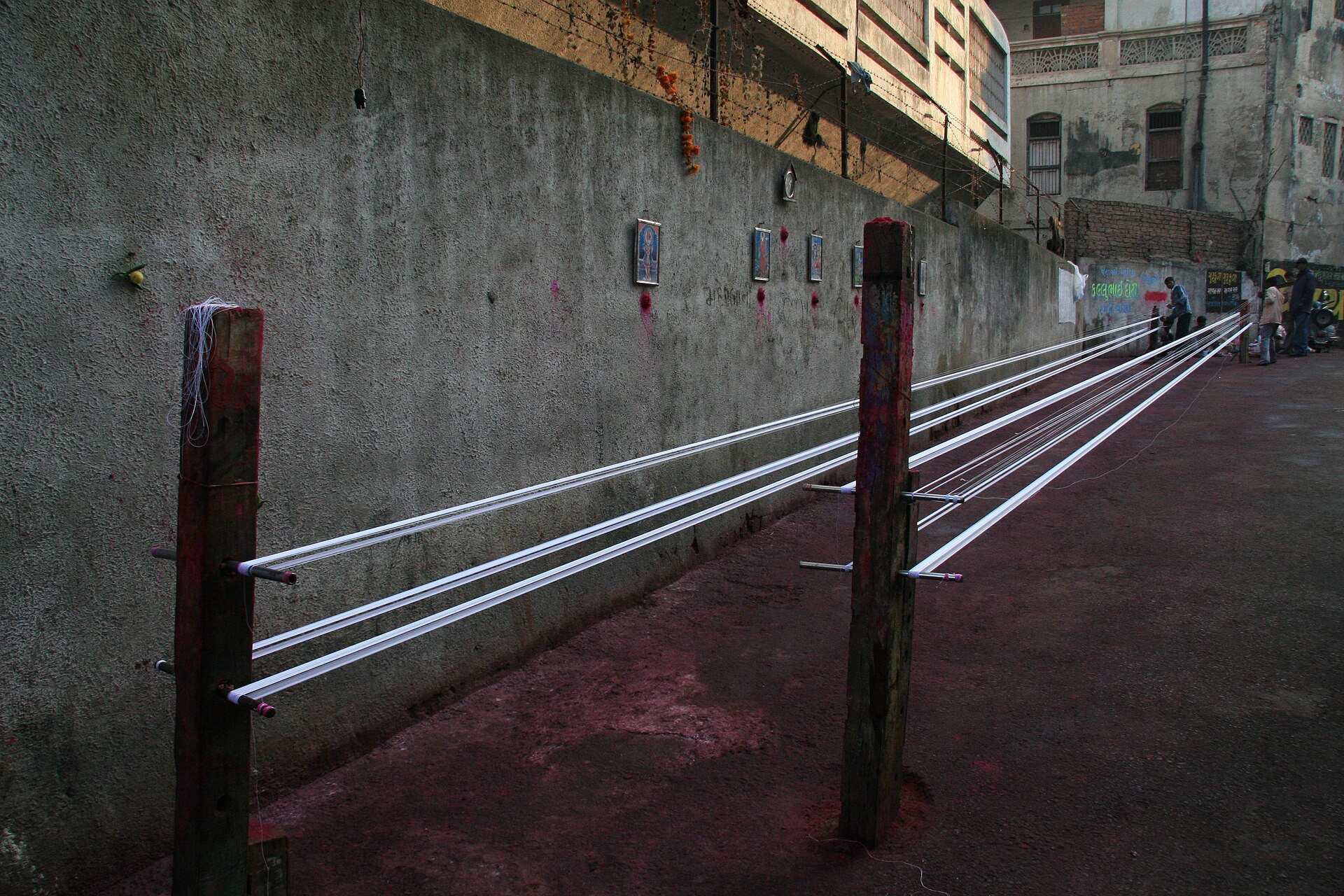
The string is a second trade. Manja is traditionally cotton thread coated with rice glue, tree gums or similar natural material and finely powdered glass, aluminium oxide or zirconia alumina as the abrasive. The synthetic variety called Chinese manja is based on non-biodegradable fibres. The string is sharpened to cut other kites out of the sky, and it also cuts birds and people.
The law has three layers. The National Green Tribunal, in a judgment of 11 July 2017, directed states to enforce a total ban on string made of nylon or any synthetic material, coated with synthetic substances, and non-biodegradable, as the Animal Welfare Board of India records. Mongabay India reported that the judgment made room for string treated as biodegradable, made with isabgol husk, wood powder or gumchi, and that plain cotton remains legal. In April 2024 the Board wrote to the Ministry of Environment and the states asking for amendments to the notifications under the Environment (Protection) Act, 1986, so that nylon thread and thread coated with powdered glass, cotton included, are prohibited and only plain cotton is permitted. In January 2025 the Gujarat High Court, in Siddharajsinh Mahavirsinh Chudasama v State of Gujarat, clarified that all kinds of glass-coated thread are banned in the state and that glass-coated cotton cannot be called harmless to humans and birds (Bar and Bench). In August 2022 the Delhi High Court dismissed a plea to ban kite flying and asked the Delhi government and police to enforce the manja ban strictly.
The harm is counted in Gujarat each January. Under the state's Karuna Abhiyan, run from 10 to 20 January 2026, 16,380 birds injured by kite strings were treated across the state, and 14,690 survived, according to figures from the Forest and Environment Department carried by DD News. Ahmedabad treated 7,040 and Surat 4,800. Pigeons made up 13,636 of the birds and black kites 905. The campaign began in 2017 and treated 7,301 birds in its first year. A larger network of collection centres can raise the count without more birds being hurt, so the two years do not show a trend. The Times of India reported on 16 January 2026 under the headline eight die during Uttarayan festivities, manja claims most victims, with fatal incidents in Surat, Vadodara, Bharuch, Aravalli and Anand, among them at least three deaths in Surat, two of them minors.
Sources
- Drik Panchang, Makar Sankranti 2027 for New Delhi; Drik Panchang, Sankranti calendar 2027. Sankranti moment, after-sunset rule, the four-day calendar. Read 26 October 2026.
- AstroSage, Makar Sankranti 2027. Sankranti moment 20:59 on 14 January, date 15 January.
- Department of Personnel and Training, O.M. No.12/2/2023-JCA, 16 July 2026, as reproduced by GConnect. Restricted holidays for 2027.
- The Hindu, "Tamil Nadu government releases list of public holidays for 2027", 22 October 2026
- Encyclopaedia Britannica: Makar Sankranti, Lohri and Pongal
- Intellectual Property India, Geographical Indications registry: Gamosa of Assam (594), Assam Jaapi (979), Bodo Gamsa (962) and Gaya Tilkut (987), read 26 October 2026
- Wikipedia: Magh Bihu, Gamosa, Jaapi and Manja (string)
- Assam MyGov, "Assistance to Lockdown-hit Japi Artisans, Mugkuchi, Nalbari", 4 January 2021
- The New Indian Express, "Pongal rooted in tradition: Future of earthen pots in a changing culture", 14 January 2026
- The Hindu, "Clay pot vendors, makers see good business on Pongal eve", 14 January 2023
- Rediff, "Gaya's Tilkut Awaits GI Tag", 14 January 2026; The Times of India, "GI tag continues to elude Gaya tilkut despite long-standing demand", 12 January 2026
- People's Archive of Rural India, "Kite makers craft Gujarat's Sankranti skies", 12 January 2022; India Development Review, "Festival of work: Women kitemakers have no respite", undated, first published around January 2023
- Animal Welfare Board of India, advisory on manjha with letters of 2013, 2014, 2016 and 25 April 2024; Mongabay India, "A sky full of kites becomes a death trap for birds", 16 January 2019
- Bar and Bench, "All types of glass-coated threads used for kite-flying banned: Gujarat High Court ahead of Uttarayan", 13 January 2025; The Hindu, "HC dismisses plea to ban kite-flying, says it's a cultural activity", 6 August 2022
- DD News (IANS), "Over 1.18 lakh injured birds rescued in Gujarat since launch of Karuna Abhiyan", 2 February 2026; The Times of India, "Eight die during Uttarayan festivities, manja claims most victims", 16 January 2026
Hero image is a representative photo via Wikimedia Commons.