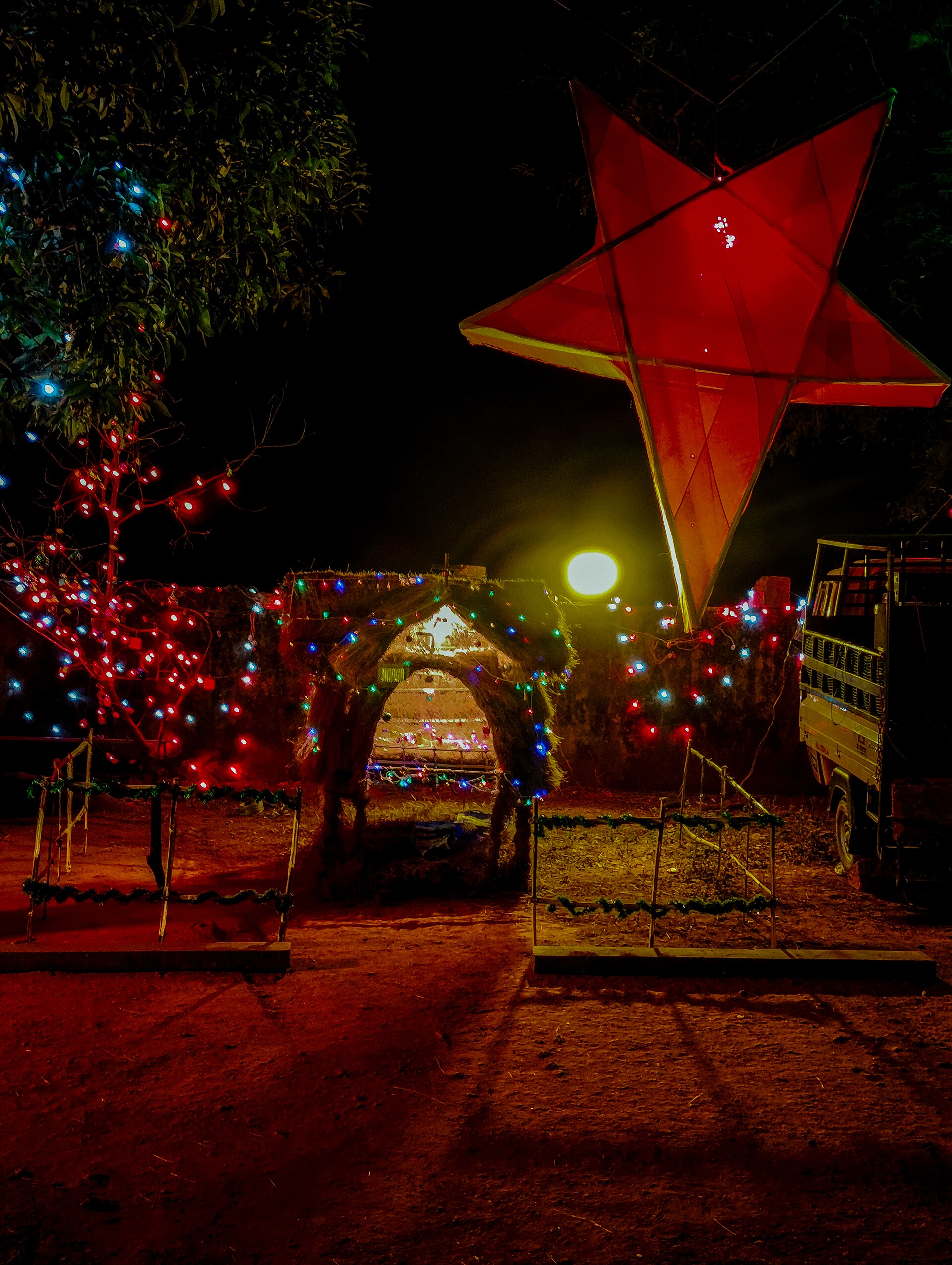
A family in Kerala and a family in Mizoram keep Christmas with different services, different food and different languages. The objects on this page are the ones that turn up again and again in reports from Indian Christmases: a star hung at the door, a crib built from earth and moss, a dark spiced cake, a long table in a church hall. Each belongs most clearly to one region, and each has makers whose work can be described. The communities who keep these customs have separate histories, and this essay follows five places in turn.
The star at the door
Goa's newspapers describe a star on every Catholic house at Christmas. The Gomantak Times, in a piece on Goan cribs, says every Goan Catholic home is decorated with a star that stands for Jesus. In Kolkata's Bow Barracks, an Anglo-Indian neighbourhood built as military housing during the First World War, a December 2025 report in The Federal describes residents decorating balconies with handmade stars and stringing up lights. The making of a star is easiest to follow in Kerala.
In Perumbalam, an island in Alappuzha district, artisans of the Responsible Tourism Mission make bamboo and paper stars. A Kerala Tourism article from January 2021 describes the work. The maker cuts raw, untreated bamboo into thin sticks sized to the star, and five sticks form one flat frame. Two frames are joined into a star with depth, and coloured paper goes over the frame. One star takes about thirty minutes of steady attention. The stars are sold through the social enterprise Culture Shoppe on a no-profit, no-loss basis, and the article says the project aims to reduce the flow of plastic Christmas lamps from China. An artisan named in the article, Haridasan M., says the families on the island have never bought a star, and the article adds that star-making also turns up at other festivals and at sports matches.
That is one project in one place, and it is the only account of star makers we could confirm in detail. We found no figures for how many stars Kerala sells or what share are plastic or LED. The Kerala Tourism article gives no price.
The crib and its materials
The Gomantak Times lists what Goan families have traditionally built a crib from. Millet seedlings (nachni) were sprouted about two weeks before Christmas so that they stood tall by 24 December. Mountains were made from clumps of clay dug from tilled fields, which Konkani calls dicvam, or from thick brown paper. Sand, stones, cotton for snow, grass from the hillsides, palm leaves, small artificial palms and recycled cardboard fill out the rest. The figures of the Infant Jesus, Mary and Joseph, the animals and the three kings were clay, and some were plastic or wood, often bought ready-made and kept as heirlooms. The article says boys in the village invented a new theme each year, and that a crib could take a day or several days to build.
The Directorate of Art and Culture of the Government of Goa holds a State Level Crib Competition every year. The notice for 2024 set it for 26 to 31 December, with one category for cribs made at home by individuals or families and another for cribs made by groups that work together. The first prize was ₹20,000 in the first category and ₹35,000 in the second, with five consolation prizes in each. Entries came from individuals and households in one category and from institutions, clubs, parishes and groups in the other, and forms had to be in by 18 December. The Directorate gave its purpose as promoting the tradition. The same notice reserved the right to cancel the competition if too few people entered.
Cribs are a custom among Mumbai's East Indians too. Wikipedia describes them as native to the Seven Islands of Bombay and the northern Konkan, speaking a dialect of Marathi-Konkani, and associates them with Salsette, Bandra, Thane and Vasai. A Free Press Journal report on Christmas in Vasai says cribs are built in homes, churches and public spaces there, and that organisations hold contests for the best presentation. we could not confirm who makes the figures sold in either city, or whether any plaster-cast workshops survive.
Plum cake, the bakery and the kuswar
The best-known story of the Indian plum cake begins in Thalassery, then called Tellicherry, in north Kerala. Mambally Bapu, who had learned to make biscuits, bread and buns in Burma, opened Mambally's Royal Biscuit Factory there in 1880. According to The News Minute's account, which draws on his descendant Premnath, a Briton named Murdoch Brown who owned an estate near Thalassery brought a cake from England and asked Bapu to make a Christmas cake. A planter of that name, who owned the Anjarakandy estate, died in 1828, so the name belongs to the family's account and the 1883 customer cannot have been him. The date given is 20 December 1883, although one other report gives 1884. The ingredients included French brandy, Bapu made the cake with a local brew, and Brown, who said "Excellent", ordered twelve more.
The story comes from the bakery's family and from local reporting. we found no independent record of it, and the "first Indian Christmas cake" label rests on those same accounts. The family's bakeries did spread. The same article says Cochin Bakers in Ernakulam and Best Hotel in Kottayam grew out of the family, the Malabar bakeries kept the Mambally name, and Santha Bakery in Thiruvananthapuram was founded in 1940 by Premnath's father. Premnath told the paper he was unsure how long the Thalassery bakery would continue, because the younger generation was not interested.
Kolkata's Christmas cake has a different address. Nahoum & Sons dates from 1902, when it was a small outlet across the street from Hogg's Market, and moved into its New Market shop in 1916. In December 2023 a news agency reported queues of around a thousand people outside it. Bow Barracks makes cake in kitchens. The Federal reports that families there bake plum cake, make ginger and grape wine, cook vindaloo, and share the cakes among neighbours. Since 2011 the West Bengal tourism department has run the Kolkata Christmas Festival on Park Street, working with the Christian community, with a carnival at Allen Park and lighting along the road.
In Goa and along the Konkan coast, the sweets travel as a platter called the kuswar, from the Indo-Portuguese consoada, a Christmas Eve feast. The platter holds kulkuls, which are fried curls of dough, neureos, which are half-moon pastries filled with coconut and jaggery, and bebinca, a layered dessert of egg and coconut milk that legend credits to a nun at the convent of Santa Monica near Old Goa. Some families make the sweets at home and others order them.
Where the feast is the object
In the 2011 census, Christians were 87.93 per cent of the population of Nagaland, 87.16 per cent of Mizoram and 74.59 per cent of Meghalaya, the three states where they form a majority. A report in the Assam Tribune on 27 December 2024 describes how Mizoram marks the end of Christmas with community feasts held in church halls, where people of every background eat together. Male volunteers, called fatu, prepare the meat dishes, women cook vegetables and salads, and children help. Elders fill the halls with Mizo Christmas songs while the food is made. In some remote villages the festivities run for days.
Reports from Mizoram add that congregational singing, called Zaikhawm, follows the church services, and that feasting is an older part of Mizo culture than Christianity. The things made for the season here are a meal and the labour of cooking it for a congregation. we did not find a reliable account of lanterns or stars in the Mizoram or Nagaland towns, and leave them out.
What the sources do and do not show
The Perumbalam stars are made by hand, the Goan crib is built in the home from clay, seedlings and paper, and the Bow Barracks cakes and wines come from family kitchens. The Thalassery cake began as a baker's response to an order from a customer. Each of these has a named place and a source.
The sources say little about what these objects cost, or about who loses work when a factory product arrives. The only direct statement is the Perumbalam project's own aim of reducing the flow of plastic lamps from China.
The Bow Barracks report adds two figures. It says about 132 families live there, nearly 80 per cent of them Anglo-Indian, and that migration has brought the number of Anglo-Indian families below 100. The two figures describe different things.
Hero image is a representative photo via Wikimedia Commons.