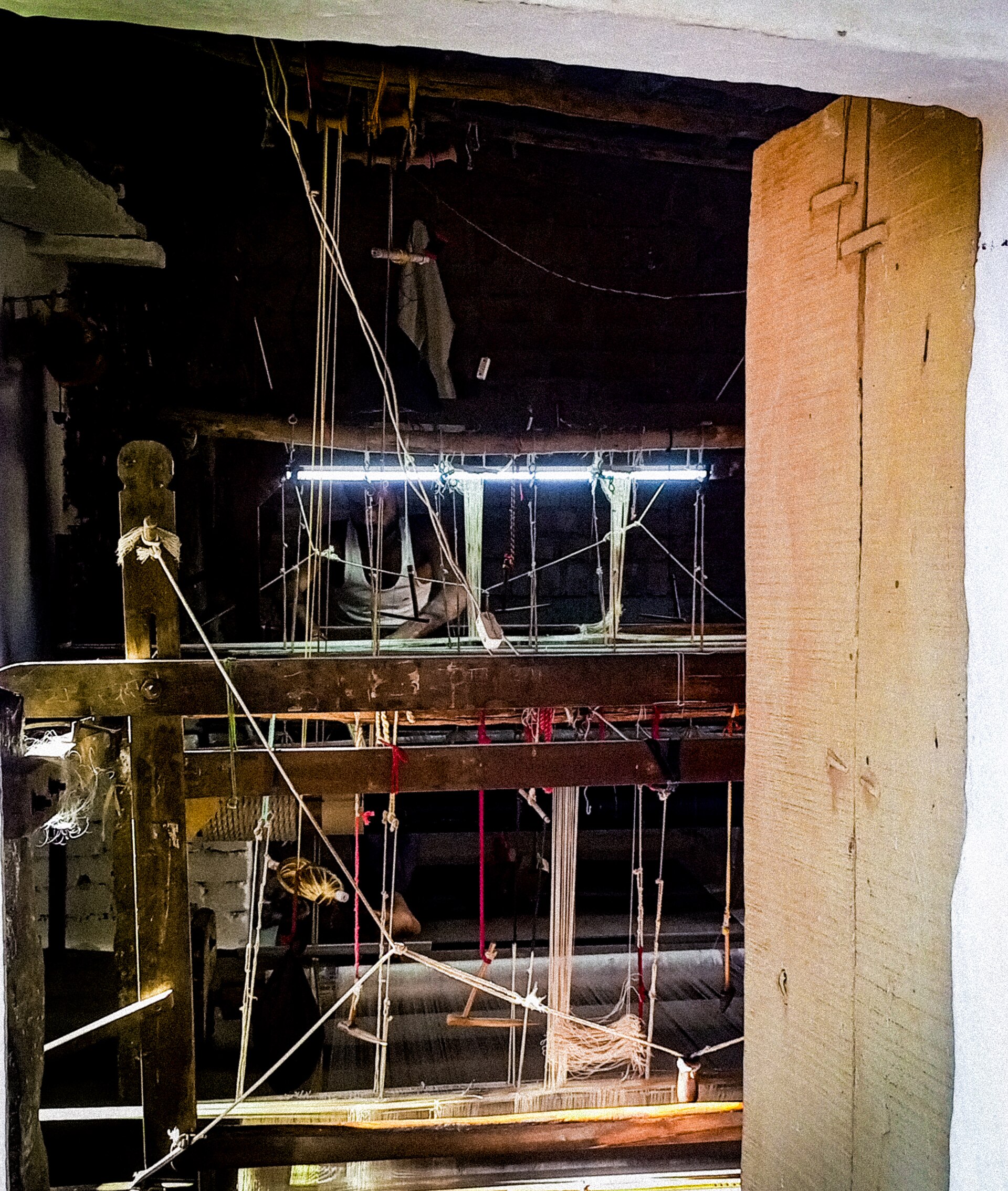
A seller's page says the saris come from a weavers' cooperative. The sentence is written to answer a question the buyer has not yet asked, which is whether the person at the loom is paid fairly. Read as law, the word cooperative answers a smaller question. It says how an organisation was registered and how its members vote.
This essay follows the word through the statutes and the labels that sit around it, and then looks at what is known about money. The sources are the text of the Multi-State Co-operative Societies Act, 2002, one state Act, the producer company chapter of the Companies Act, 2013, government descriptions of the Handloom Mark and related schemes, the Fourth All India Handloom Census, and the few studies that compare what weavers earn under different arrangements. No published figure turned up for the share of an emporium's price that reaches the maker, and the essay says so where that matters.
What the law makes a cooperative
In Indian law a co-operative society is a society that has been registered as one. The Karnataka Co-operative Societies Act, 1959 defines a "co-operative society" in section 2(c) as "a society registered or deemed to be registered under this Act". The Multi-State Co-operative Societies Act, 2002 uses nearly the same words for a "multi-State co-operative society" in section 3(p). Karnataka has its own Act. The 2002 Act is the central one, and section 5(1) allows registration only if the society's main objects serve the interests of members in more than one State.
Registration under the 2002 Act has conditions. Sections 5(1) and 7(1) allow registration only if the bye-laws provide for "social and economic betterment of its members through self-help and mutual aid in accordance with the co-operative principles". Section 31 gives every member one vote, including a member who is an employee of the society. Section 33 caps any one member's holding at a prescribed portion of share capital that may not exceed one-fifth, with exceptions for the government bodies and societies listed in section 25. An individual-member society needs at least fifty signatories from each State it covers (section 6(2)(a)). These rules describe who governs the society, and a society that meets them has a governance structure that a firm owned by one family lacks.
Parliament amended the 2002 Act in 2023. The Lok Sabha passed the bill on 25 July and the Rajya Sabha on 1 August, according to PRS Legislative Research. In the text as the Lok Sabha passed it, the amendment creates a Co-operative Election Authority for board elections and lets a state society merge into a multi-State society by a two-thirds resolution. It also adds a Co-operative Ombudsman in a new section 85A, who inquires into complaints made by "any member" about "deposits, equitable benefits of society's functioning or any other issue affecting the individual rights of the concerned member". The same text provides that a registration application not decided within the statutory period is deemed accepted. A buyer reading this machinery should notice who it protects. The complaint belongs to a member, and a weaver who supplies a society without being a member does not appear in the provision.
What registration leaves out
None of the sections quoted above sets a price or a wage for the work a member supplies, and the conditions for registration do not mention one. A society can meet every condition and pay little. It can also pay well. The answer sits in the society's bye-laws and accounts.
The census shows how small a part cooperatives play in the weaver's actual sale. The Fourth All India Handloom Census, 2019-20, enumerated 5,457 non-household units, meaning establishments that produce using looms, and 70.3 per cent of them were cooperative societies, according to the People's Archive of Rural India's summary of the report. The same summary reports how the people it counts sell: 64.1 per cent in the open market, 17.6 per cent to master weaver households and 8.8 per cent through cooperative societies. Of the weavers the census counts, fewer than one in ten reach the market through a cooperative society.
The studies that compare pay point in different directions. A 2023 paper in the Parikalpana KIIT Journal of Management surveyed 435 weaving households in Bargarh district, Odisha, in September to November 2021. Independent weavers earned the most, at a mean of ₹16,913 a month. Weavers working under a cooperative society averaged ₹13,630, and weavers working under a master weaver or middleman averaged ₹10,766. The paper describes the difference between cooperative and master-weaver pay as not significant, so the means alone do not show that the cooperative paid more. They also report that few workers were employed under it. The census figures they cite for Odisha are 69 per cent independent, 21 per cent under master weavers and 10 per cent in cooperatives.
Manas Ranjan Bhowmik, who teaches economics at the Ramakrishna Mission Vivekananda Educational and Research Institute, reached a harsher view for two other places. Writing in Economic and Political Weekly in December 2019, he reports from his fieldwork in the Chirala handloom hub in Andhra Pradesh (2011-12) and in West Bengal (2015-17) that master weavers reaped more profit and that those working under cooperatives were not paid enough. In the same article he points to Goa, where 95 per cent of weavers are organised in cooperatives or other non-household units according to the census, and where, he writes, the largest number of weavers earn more than ₹5,000 a month. He reads that as a correlation between organisation and earnings. These are small studies in a handful of places. Together they show a cooperative can be better or worse than the alternatives depending on the society, and the word does not say which.
Producer companies are a different legal form
Some newer groups of weavers and artisans register as producer companies. A producer company is a company, and the rules for it sit in Chapter XXIA of the Companies Act, 2013, which a notification brought into force on 11 February 2021. Section 378A(j)(ii) counts the "produce of persons engaged in handloom, handicraft and other cottage industries" as primary produce, so artisans qualify. Section 378C(1) lets ten or more individuals, each a producer, form one. Where the members are all individuals, section 378D(1)(a) gives each a single vote "irrespective of his shareholding or patronage".
The chapter has its own vocabulary for money. Section 378A defines a "limited return" as the maximum dividend the articles specify and a "patronage bonus" as a payment out of surplus to members in proportion to their use of the company. It also defines a "withheld price" as the part of the price due for goods a member supplies that the company holds back for payment at a later date. Section 378B(2) requires the company to deal primarily with the produce of its active members. The structure is built so that the people who make the goods own the company. It does not fix what any member is paid at the time of sale. A page that says "producer company" gives the buyer the same information as a page that says "cooperative", which is a registration, a membership and a voting rule. The Press Information Bureau's explainer reports that 200 Handloom Producer Companies were formed under the National Handloom Development Programme between 2020-21 and 2026-27.
What the labels certify
The Handloom Mark was launched in 2006. The Press Information Bureau's 2026 explainer says it assures buyers that a product is handwoven, and that 29,402 registrations had been issued by 30 June 2026, with 815 retail outlets selling labelled goods. A 2016 Ministry of Textiles reply in the Lok Sabha acknowledged that "some powerloom and textile mills products are being sold in the name of handlooms" and said the government carries out surveillance to check misuse of the label. The Handlooms (Reservation of Articles for Production) Act, 1985 reserves 11 articles for handlooms, and agencies inspect powerloom units that make them.
The India Handloom Brand, launched on 7 August 2015, adds quality criteria. The explainer says its certification covers natural-fibre products with assured fast colours, skin-friendly dyes and social compliance, and that 2,305 registrations had been issued across 184 categories by June 2026. Craftmark, run by the All India Artisans and Craftworkers Welfare Association, certifies handmade craft products "produced in a socially responsible manner". AIACA's Craftmark page still says more than 80 craft enterprises used the mark, reaching more than 110,000 artisans in 23 states, while AIACA's home page and its 2022-23 annual report put the figure at more than 280 certified enterprises and about 178,000 artisans, so the number a buyer sees depends on which page of the same organisation's site they land on. Geographical Indications protect a place name, and [another essay on this site](essay-gi-tags.html) covers what they tell a buyer.
Each of these labels tests a different thing: the loom, the dye, the process, the place. "Social compliance" and "socially responsible" are the nearest either description comes to labour, and the pages we read do not define them or say what a weaver is paid. On a sari from a cooperative, the Handloom Mark speaks to the loom and the registration speaks to how the society is governed.
Emporia and apex societies
State emporia sit one step further from the loom. Co-optex, the Tamil Nadu Handloom Weavers' Co-operative Society, was established in 1935 and describes itself as the apex marketing body for the state's weaver societies. It procures cloth from them and sells through its own shops. By its own account Tamil Nadu had 1,134 handloom weaver cooperative societies on 31 March 2021, which produced cloth valued at ₹847.65 crore in 2020-21 and sold handloom products worth ₹1,027.01 crore. Cauvery Handicrafts belongs to a different category. The Government of Karnataka established the Karnataka State Handicrafts Development Corporation in 1964 to preserve and promote the state's crafts, and the emporia are its retail arm. One is a cooperative and the other a state corporation. Neither source we found says what share of the shelf price reaches the maker.
How a buyer can check
The questions below take a few minutes and a seller who runs a real cooperative can usually answer them in a message.
- Ask under which Act the society or company is registered and what its registration number is. A real society has one, and the Karnataka and multi-State definitions both turn on registration.
- Ask whether the people who wove the piece are members, or whether the society buys from non-member weavers or from master weavers. Membership is what carries the vote and the right to complain.
- Ask how the weaver is paid, per piece or by wage, and how soon after delivery. A producer company may legally withhold part of the price for later, so the timing is part of the answer.
- Ask whether the piece carries a Handloom Mark, and which registration it was issued under. The label proves the loom. Ask separately about the maker.
- Look for a named weaver, a village or a society's own page. A seller who can say which society wove the piece has usually dealt with the society.
The essay on buying artisan work online suggests that a small gift from a makers' cooperative needs little research. That advice holds for a small gift, and the evidence here argues for more care as the price rises. At that point the seller should be able to say who the maker is and how the money moves.
Sources
- Multi-State Co-operative Societies Act, 2002, full text as originally enacted (Indian Kanoon). Sections 3(p), 5, 6, 7, 31 and 33, read on 26 October 2026. The text is the 2002 version.
- Multi-State Co-operative Societies (Amendment) Bill, 2023, as passed by the Lok Sabha on 25 July 2023 (PRS Legislative Research). The amendments to sections 7 and 17 and the new section 85A.
- PRS Legislative Research, bill track for the 2022 amendment bill. Passage dates and summary of features.
- Karnataka Co-operative Societies Act, 1959, section 2(c) (Indian Kanoon)
- Companies Act, 2013, sections 378A, 378B, 378C and 378D, as compiled by the Companies Act Integrated Ready Reckoner. A private compilation; the commencement notification of 11 February 2021 is linked from each page.
- Press Information Bureau, "National Handloom Day 2026", 6 August 2026. Handloom Mark, India Handloom Brand, Handlooms Act, Handloom Producer Companies, census headline figures.
- Press Information Bureau, "Original Handloom Products", 8 December 2016. Lok Sabha reply on powerloom products sold as handloom.
- All India Artisans and Craftworkers Welfare Association, Craftmark
- People's Archive of Rural India, summary of the Fourth All India Handloom Census 2019-2020, via the Internet Archive. Non-household units and the channels through which weavers sell.
- Manas Ranjan Bhowmik, "Fourth Handloom Census: Government's Claims Belie Ground Reality", Economic and Political Weekly Engage, 13 December 2019
- Meher, Venkatachalapathy and Panda, "Does the Weavers' Cooperative Society Yield Higher Income to the Handloom Weavers? Evidence from Odisha", Parikalpana KIIT Journal of Management 19(2), December 2023
- Co-optex, About us
- Cauvery Handicrafts (KSHDCL), emporium page
Hero image is a representative photo via Wikimedia Commons.