Many shoppers flinch at the price of handwoven cloth. Picture a handwoven stole at ₹4,000 beside one at ₹400 that looks much the same at a glance. The obvious conclusion is that the dearer one carries a markup for the word "handmade". In craft, the low price is usually the one that needs explaining.
A useful way to read either price is to work out the hours, materials and people behind it. A factory price tells you little about how a thing was made. A handmade price is mostly labour and materials, so once you know roughly what those cost, the number becomes a fair report of the work that went into the piece.
What the weaver is paid
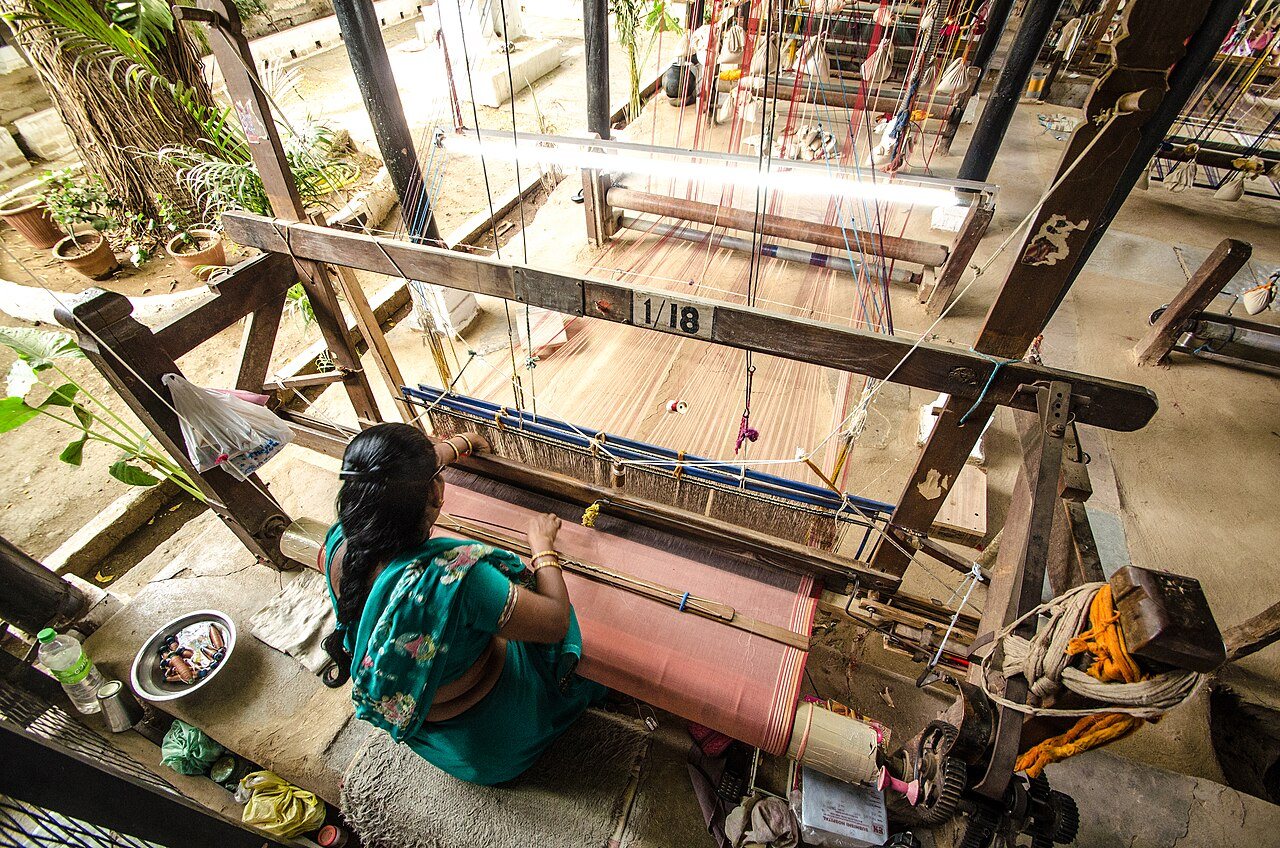
Start with time, which a photograph cannot show. Mohit M. Rao, reporting from Chanderi in Madhya Pradesh for the People's Archive of Rural India (PARI) in 2020, quoted the weaver Suresh Koli, who said a simple sari takes about four days to weave and one with zari butti, brocade motifs worked by hand, takes 8 to 30 days. UNESCO describes jamdani as "a time-consuming and labour-intensive form of weaving" because its motifs are made directly on the loom with a discontinuous weft. The same UNESCO text names the people who work around the weaver, the "spinners, dyers, loom-dressers and practitioners of a number of other supporting crafts". Their work is finished before the cloth is, and none of it shows in the finished piece, so a buyer who sees a length of fabric tends to price it as one.
Pay is the next part of the arithmetic. In the same PARI report, a simple Chanderi sari that the trader sold to retailers at ₹2,000 earned the weaver about ₹600 for four days of work, which is about ₹150 a day. The Ministry of Rural Development puts the national average daily wage under the rural employment guarantee at ₹327.40 from 1 July 2026. The Fourth All India Handloom Census, carried out by the Ministry of Textiles in 2019-20, found that 66.3% of weaver households earned less than ₹5,000 a month. If a weaver's share of a ₹400 stole were the 20 to 30 per cent of the wholesale price that PARI reported for Chanderi, the weaver would get less than ₹120 for it, which is under half of one day's rural employment wage. A stole at that price was either made by machine or made by someone paid far less than a day's labouring wage for it.
A quick check before you buy
Estimate how many days the piece could have taken to make, then divide the price by that number. If the result is below a rural labourer's daily wage, which the 2026 national average puts at ₹327.40, before any yarn or seller's margin has been paid for, the piece was probably made by machine or the maker was underpaid. The calculation is rough, and it takes a minute.
What handspun yarn and natural dye cost
Raw material widens the gap. Handspun yarn is paid for by the hank. The Khadi and Village Industries Commission (KVIC) raised the spinning wage from ₹12.50 to ₹15 a hank from 1 April 2025, and in 2023 the government told the Lok Sabha that a spinner on the New Model Charkha produces about 22 hanks a day. At the 2025 rate that comes to about ₹330 for a day's spinning before incentives, and every hank of khadi yarn carries that labour before a weaver touches it.
Natural dyes add costs of their own. A 2023 review in the journal Molecules by Barbara Pizzicato and colleagues found that natural dyes "show low dye uptake, poor fastness, and uneven dyeing" and need mordants, usually metallic salts, to fix them to the cloth. The review describes natural dyeing as "long and expensive", needing more water and more dye material to reach the depth of colour a synthetic dye gives, and it lists the reproducibility of shades as a problem, because the colour depends on the plant's variety, maturity, soil and weather. The plant dyes it names include indigo and madder.
Synthetic dyes were adopted for the opposite qualities. The same review says they came to be preferred because "they are easier to use, they do not require the use of mordants, and they allow to obtain fast, bright, and reproducible shades". A ₹400 scarf may well be power-loom cloth dyed with synthetics, which is a fair purchase when the listing says so. The problem is a listing that calls it handwoven silk.
Small batches carry every fixed cost alone
Factory production spreads the cost of machines and design over a very large number of identical pieces, so each piece carries little of it. A handloom weaver spreads the same kinds of cost over far fewer pieces. Setting up a loom with a new warp, working out a new design and accepting the pieces that come out uneven are all costs that a short run has to absorb.
Handwoven cloth cannot be sold as cheaply as power-loom cloth. A seller who prices it as if it could is paying someone less. A high price on a handwoven piece usually means the fixed work of making it has been divided among a small number of buyers.
Where the money goes
A high price does not guarantee that the weaver was paid fairly. PARI found that most weavers in Chanderi work for traders or master weavers, who supply the yarn and the design and pay per piece. Weavers there "typically earn about 20-30 per cent of the wholesale price", and weavers told the reporter that traders keep a profit of around 40 per cent of the wholesale price after costs and the weaver's pay. The trader then sells to retailers, who add their own margin. Paying less does not fix this, because the weaver has the least power in the chain to refuse a lower rate.
The useful question for a buyer is where the money goes. A seller who can name the cluster, the technique, the yarn and how the weaver is paid knows the supply chain. If a seller cannot say where a piece was made, treat the handmade claim with caution.
Why 'cheap handmade' is the phrase to distrust
Taken together, these costs mean a high price on handwoven cloth usually reflects the labour, the materials and the short runs behind it. A very low price on something sold as handmade means one of two things. The piece was made by machine, or the cost was pushed onto the weaver, dyer or spinner, who was paid less for it.
A buyer does not have to choose the dearest piece, and a mill sari sold as a mill sari is a fair purchase. A price is information about how a thing was made, and when a handmade price looks too low it is worth asking where the money went.
Sources
- Mohit M. Rao, "MP weavers hanging by a Chanderi thread", People's Archive of Rural India, 6 May 2020
- Ministry of Textiles, Fourth All India Handloom Census 2019-20, in the PARI Library
- PIB, Ministry of Rural Development, revised wage rates under the VB-G RAM G Act, 30 June 2026
- PIB, KVIC wage increase for khadi artisans from 1 April 2025, 12 March 2025 and PIB, Wages of khadi artisans, Lok Sabha reply, 7 December 2023
- UNESCO, Traditional art of Jamdani weaving, Representative List of the Intangible Cultural Heritage of Humanity, 2013
- Barbara Pizzicato and others, "Advancements in Sustainable Natural Dyes for Textile Applications: A Review", Molecules 28(16), 2023