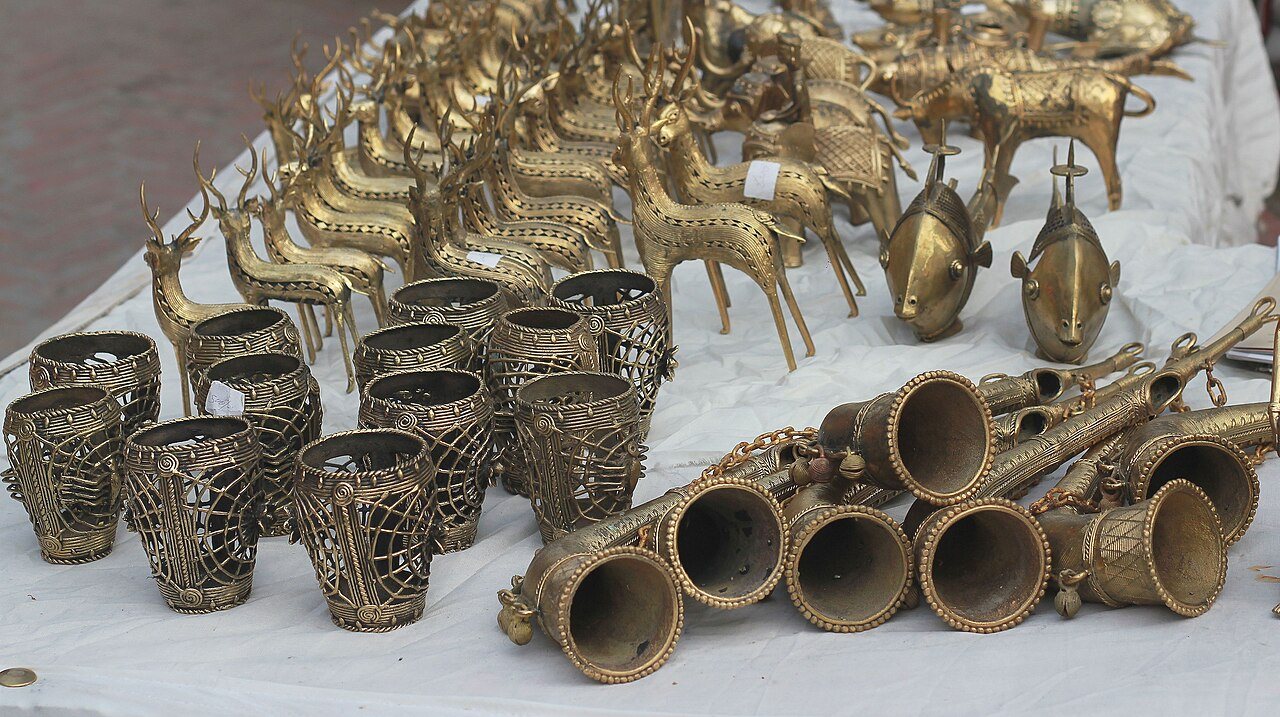
A Dhokra figure is cast by the lost-wax method. The maker models the figure in wax over a clay core, covers it in clay, heats the mould so the wax runs out, pours molten metal into the space it leaves, and breaks the mould to get the casting out. Because the mould is destroyed, no two pieces are the same. The bronze "Dancing Girl" of Mohenjo-daro, made roughly 4,000 to 4,500 years ago, was cast this way, which is the basis for the claim, repeated on almost every Dhokra listing, that the craft is 4,000 years old. The method is that old. The craft's GI applications also assert an unbroken tradition from Mohenjo-daro to Bastar, and we found no archaeological work documenting one.
Corrected 6 October 2026. An earlier version of this guide gave a GI date and registry number that were wrong, cited a book that does not appear to exist, named the wrong community and metal for Bastar, and linked every product card to a shop's homepage. This version is checked against the GI registry and the GI Journals.
What Dhokra is, and who makes it
Dhokra, also spelled Dokra, is made in Chhattisgarh, Odisha, West Bengal, Jharkhand and Telangana. In Bastar, the GI Journal names the casters as the Ghadwa community and the metal as bell metal, "brass and bronze", melted together. In West Bengal, the Bengal Dokra GI Journal records that the name once referred to groups of wandering metal casters, and the metal there is recycled brass scrap. Both journals describe the same sequence: a clay core, a layer of beeswax (in Bastar, sometimes paraffin mixed with resin) carrying the detail, an outer coat of clay and cow dung, firing, pouring, and a mould broken open with a wooden mallet.
The Bastar journal notes two changes the "unchanged for 4,000 years" line ignores: paraffin has partly replaced beeswax, and finished pieces are now polished, which "was never done earlier". Hand-modelled pieces show uneven surfaces and, often, the maker's fingerprints in the wax detail. The usual subjects are animals, human figures and local deities.
GI status
Bastar Dhokra is GI application No. 83, filed on 12 March 2007 by the Chhattisgarh Hastshilp Vikas Board, with certificate No. 62 dated 22 April 2008. Its registration runs to 11 March 2027. Bengal Dokra (No. 563) was registered in 2018, as was Adilabad Dokra from Telangana (No. 521). Jharkhand Dokra Craft (No. 1243) is shown as registered. Odisha has no registered Dhokra GI; three applications are under examination. A GI registers a name and a place, and individual pieces carry no GI paperwork. You can ask whether the maker is a registered authorised user, because the registry lists them by name.
What it costs
Prices from named makers on 6 October 2026: small Bastar pieces from the Chhattisgarh store of Tribes India cost about ₹1,350 to ₹3,000 after its current discount, a piece by a named artist on MeMeraki ₹1,650, and single Odisha Dokra figures on iTokri about ₹1,600 to ₹1,800. We have no reliable figure for how long a piece takes or what a caster earns, and an earlier version of this guide gave numbers it could not support. A listing at ₹200 rarely names a maker or a place, so ask before you buy.
Real or not
- Look for the hand. Uneven surfaces, wax-thread detail that varies along its length, and fingerprints pressed into the wax all survive into the metal.
- Ask where it was cast and by whom. The Tribes India Bastar listings below name the artisan and the region. If a seller cannot tell you either, you have no way to know what you are buying.
- Know which GI applies. No Odisha Dhokra can be GI-tagged yet. A Bastar, Bengal or Adilabad piece can be, if the maker is a registered user.
Where to buy it
- Tribes India, run by TRIFED under the Ministry of Tribal Affairs, sells Bastar Dhokra through its Chhattisgarh store, with the artisan's name on the listing. Its product pages carry some obvious template errors in the specifications, so rely on the description and ignore the table.
- MeMeraki sells work by named artists.
- iTokri currently lists Odisha Dokra from a named seller group, and no Bastar pieces.
- Dilli Haat and state craft fairs: stalls rotate, so check which states are present before you go.
Specific picks
Four pieces, each checked on 6 October 2026. The three Bastar pieces are on a 40 per cent discount at the time of writing.
Top pick · Bastar, named artisan
Nandi, by Sumitra
via Tribes India (Chhattisgarh store) · Bastar Dhokra · About 900 g · Five in stock when checked
Gift pick · Bastar
Raja and Rani, by Upendra
via Tribes India (Chhattisgarh store) · Bastar Dhokra · Two in stock when checked
Larger piece · Bastar
Nandi sitting, 5 × 9 in, by Balsingh
via Tribes India (Chhattisgarh store) · Bastar Dhokra · About 1.9 kg · Two in stock when checked
Named artist · Under ₹2,000
Turtle in Dhokra, by Anil Baghmare
via MeMeraki · Lost-wax cast · Made to order, so check the delivery date · MeMeraki lists the artist under Madhya Pradesh
Care
Dust with a soft dry cloth. The metal darkens with time and many owners like it that way. If you want it brighter, people commonly use lemon and salt on brass; try it on a hidden spot first, rinse and dry it thoroughly, and do not use it on a piece whose dark finish is part of the design.
Sources and further reading
- GI registry, Bastar Dhokra, No. 83, and its GI Journal No. 24, on the Ghadwa casters, the bell metal and the process
- GI registry, Bengal Dokra, No. 563, and its GI Journal No. 101
- Ruth Reeves, Cire Perdue Casting in India (Crafts Museum, New Delhi), an early survey of Indian lost-wax casting