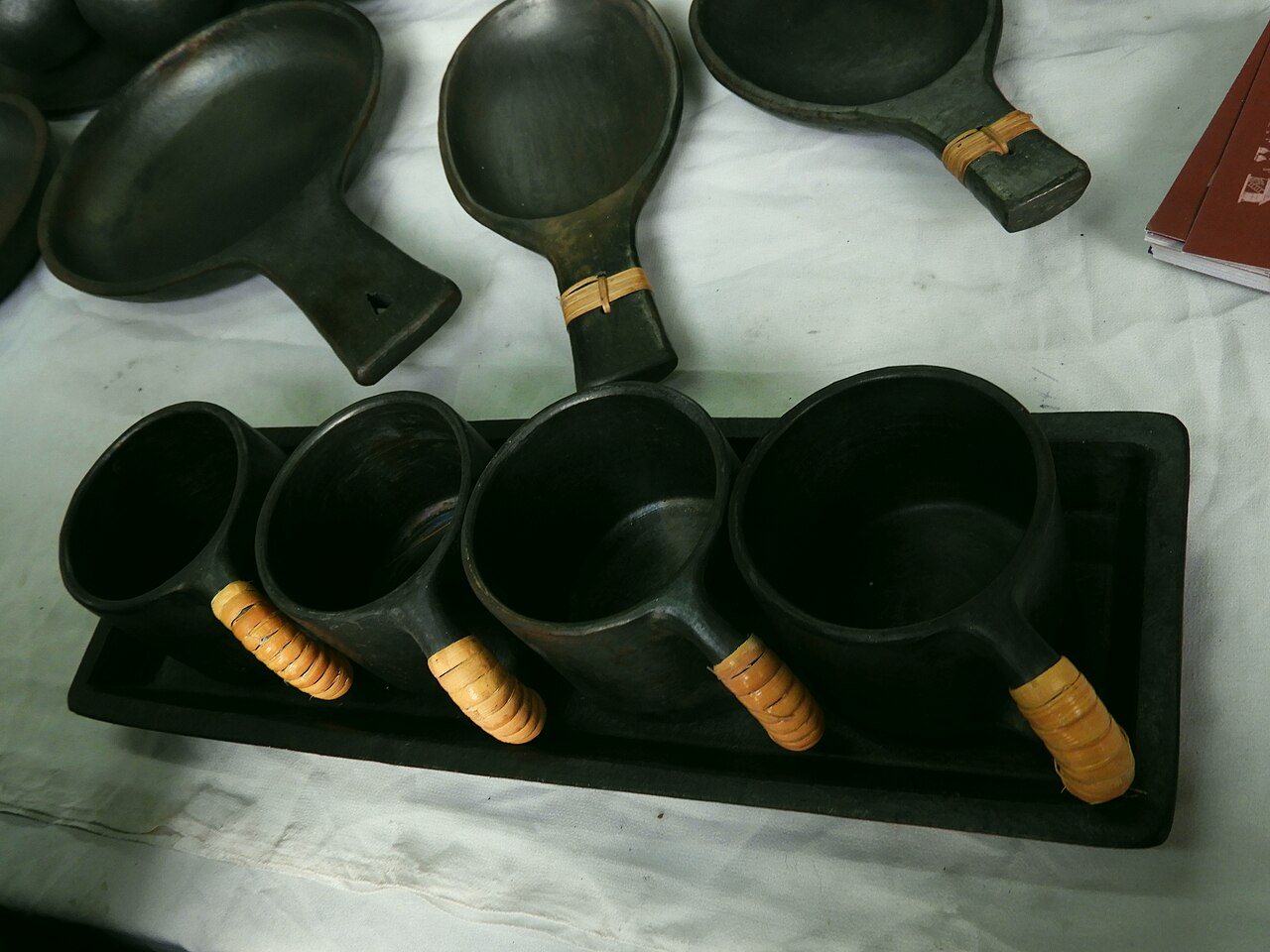
Longpi pottery is black, unglazed and heavy for its size, and it looks like nothing else in an Indian kitchen. It is made in a few villages of Ukhrul district in Manipur, by Tangkhul Naga potters; it takes its common name from Longpi and is also called Nungbi pottery, after Nungbi Khullen, which one 2023 account calls the only surviving potter village. It is made from ground serpentinite stone mixed with clay and shaped without a wheel. The stone in that mix is also the subject of the one question about Longpi that nobody has yet answered, which this guide sets out below.
Corrected 6 October 2026. An earlier version of this guide said Longpi had a GI tag, that it was "food-safe by default", that every piece was one woman's work, that it worked on induction, and that iTokri was the best place to buy it. All five claims were wrong. This version follows the sources.
What Longpi is
Two materials go in. The clay and the serpentinite are each ground to powder with a mortar and pestle and sieved through bamboo, then mixed with water in a fixed proportion, with more stone than clay; any deviation, the makers say, gives fragile pots. The dough is rolled out, cut into strips and built up by hand without a potter's wheel, sometimes around a metal vessel used as a form. Once dried, the pots are fired in an open bonfire, and while still hot they are rubbed with the fresh leaves of a local tree, which gives Longpi its dark sheen. There is no glaze.
Both men and women make it. The Ukhrul district administration describes it as "basically a male-oriented handicraft", the best-known master potter, Machihan Sasa, received the Padma Shri in 2024, and women's collectives also produce it.
GI status
Longpi pottery is not a registered Geographical Indication. An application for "Manipur Longpi Pottery" (No. 1495) was filed on 3 April 2025 by The Sasa Hampai Pottery Training Cum Production Cooperative Society, Longpi Kajui, and is still under examination. Until it is registered, no Longpi piece can be GI-certified, whatever a listing says.
Is it safe to cook in?
Probably, though nobody has checked. Longpi has no glaze, so the usual worry with pottery, lead in the glaze, does not apply. The question is the stone. Serpentinite can carry nickel and chromium, and the asbestos-type mineral chrysotile forms in serpentine rocks. The Indian Bureau of Mines records chromite in Ukhrul district and small quantities of chrysotile asbestos in the east of it. Studies of other cookware show nickel and chromium can leach into acidic food. We found no published laboratory test of Longpi cookware for metal or fibre release.
This is a gap in the evidence, and no study has found harm. If the uncertainty bothers you, use Longpi for serving, for rice and for dal, and avoid long simmering of sour food in it until someone tests it. Treat any seller's claim of extra iron or magnesium "in your food" as unsupported.
How it cooks
What follows is what sellers and makers say, and we have no independent test to set against it. The thick walls hold heat, so food stays warm on the table. The burnished surface becomes less sticky as it is seasoned with oil. Sellers describe a mild earthy taste. It suits low and medium heat on gas or in an oven. It does not work on induction, which needs a magnetic metal base; Zishta, one of the main sellers, says so in its own FAQ, even though an Amazon listing of a Zishta kadai claims otherwise.
Real or not
- Ask where it was made. A seller of the real thing names Longpi, Ukhrul or the maker. Brown Living's listings name the village and, on one piece, the potter.
- Look for a burnished, unglazed surface. A glossy glaze means a different kind of pottery. Longpi has a soft, dark lustre, and small irregularities in shape that come from building without a wheel.
- Weight is a weak test. Longpi is dense, and Zishta lists a 20 cm kadai at 1.2 to 1.4 kg, which is lighter than many buyers expect.
- Price. On 6 October 2026, cups from established sellers cost ₹750 to ₹1,050, a serving bowl ₹2,300, and cooking pots ₹4,000 to ₹6,000. A cooking pot sold as Longpi for ₹500 is very unlikely to be one.
Where to buy it
Brown Living (through its vendor October Pumpkin Co.) and Zishta are the two online sellers we found with Longpi in stock and listings that say how it was made. iTokri, Tribes India and Jaypore, which this guide used to recommend, had no Longpi when we checked. Craft fairs such as Dilli Haat sometimes host Manipur artisans; check the schedule before you go.
Specific picks
Three pieces, each checked on 6 October 2026. All three are serving pieces, for the reason given above. A bowl, a cup and a kettle are where the untested question about the stone matters least.
Top pick · Serving
Longpi oval serving bowl
via Brown Living · Serpentinite stone and clay, hand-shaped without a wheel or mould · Ukhrul
Named maker · Tea
Longpi pumpkin kettle with cane handle, 650 ml
via Brown Living · Made by the master potter Hommi in Ukhrul, according to the listing
Under ₹1,000
Longpi chai cup with cane handle
via Brown Living · Natural stone and river clay, no wheel or mould · Ukhrul
Caring for Longpi
This is the makers' and sellers' advice. Season the inside with cooking oil before first use. Wash by hand with warm water and a soft sponge, no steel wool and no dishwasher. Avoid sudden changes of temperature, and never put a hot pot under cold water or take one from the fridge straight to the flame, because the stone-and-clay body can crack. The surface darkens with use.
Sources
- GI registry, application No. 1495, Manipur Longpi Pottery
- Ukhrul district administration, on Longpi pottery
- 30 Stades, on how Longpi is made (2023)
- Indian Bureau of Mines, Indian Minerals Yearbook 2022, Manipur
- A study of metal leaching from cookware into food
- Zishta, Longpi kadai and its FAQ on induction