Kondapalli is a small town 20 to 25 kilometres from Vijayawada, in what is now NTR district of Andhra Pradesh. It has a hill fort at its edge and, in Bommala Colony, the workshops where families carve, assemble and paint the wooden toys the town is named for. Artisans and the state trace the craft to the 16th century, when Nakarshalu (Aryakshatriya) families are said to have come from Rajasthan at the invitation of a local ruler; the district administration puts it at "nearly four centuries".
Corrected 6 October 2026. An earlier version of this guide said the toys were recognised by UNESCO, that the GI was granted in 2008, and that the craft employed over 3,000 families. All three were wrong. The figures below are sourced.
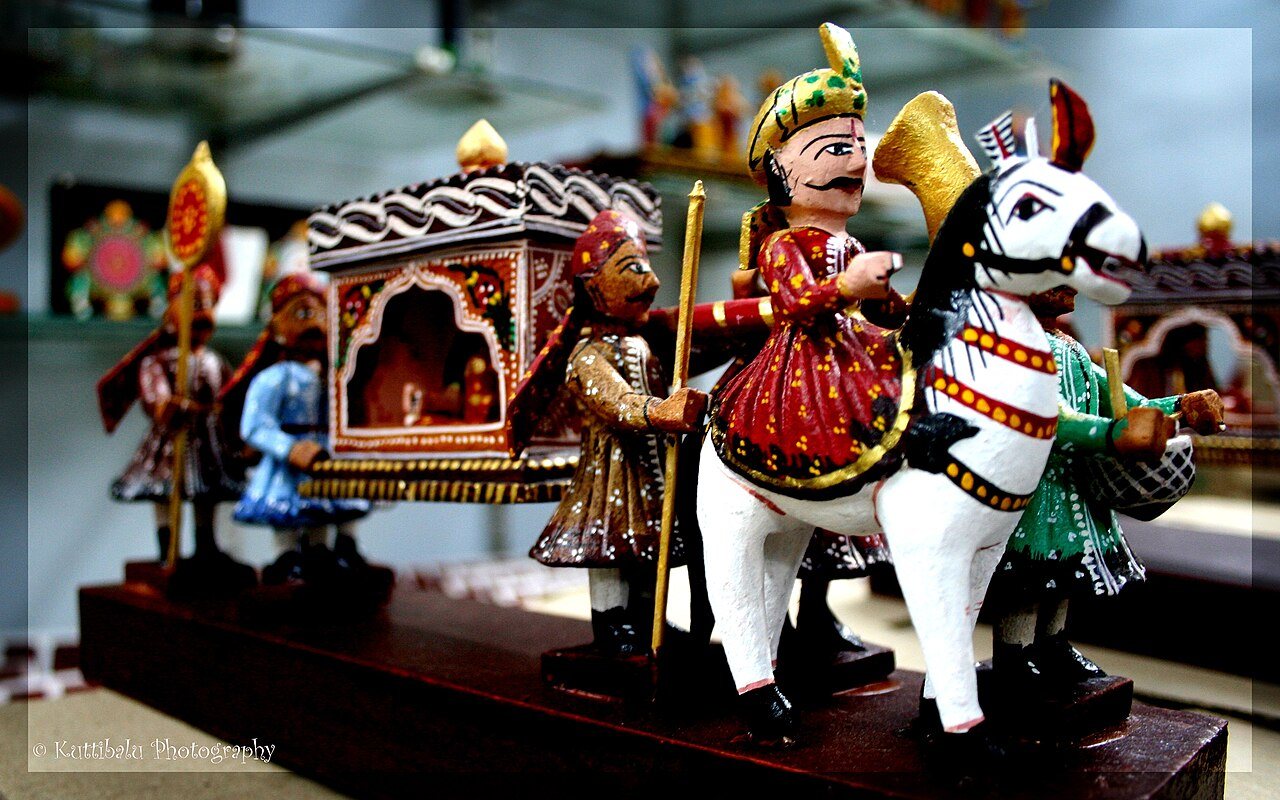
The toys are called Kondapalli Bommallu. They are carved mainly from tella poniki (Givotia rottleriformis), a light softwood, with ankudu also used, and they depict bullock carts, elephants, Dasavatharam sets, village scenes and wedding processions. They are a registered Geographical Indication. They are also a craft of a few hundred people. The Deccan Herald counted about 500 artisans in about 110 families in 2010, and the artisans' cooperative's records, as reported by PARI in 2017, listed 229 toy-makers, 107 men and 122 women.
What makes Kondapalli toys distinctive
The wood. Tella poniki is light and soft enough to carve fine detail with hand tools, and the finished toys are, in Al Jazeera's phrase, "paper light". The wood was traditionally cut in the nearby hills. Artisans now say the local forests are exhausted and buy it from further away, and the FAO lists Givotia rottleriformis among the craft woods becoming scarce.
The construction. A Kondapalli piece is carved in parts. The wheels, yoke, bullocks and driver of a cart are made separately and joined with makku, a paste of tamarind-seed powder and sawdust.
The painting. Colours are bold and flat. The old colours came from plants such as modugu flowers, marigold and pomegranate. Many artisans now use enamel or acrylic paint and Fevicol; Al Jazeera found in 2016 that only a handful still worked the old way. The section on children below explains why that matters.
GI status
Kondapalli Bommallu is GI application No. 44, filed on 10 November 2005 and held by the LANCO Institute of General Humanitarian Trust and the Kondapalli wooden toy makers' cooperative. The registry dates the certificate (No. 30) 12 January 2006, which is earlier than its own journal date of 18 September 2006, and the press reported the grant in 2007. It is valid to 9 November 2035.
The economics
The few earnings figures on record are low. A painter in a Kondapalli workshop told PARI in 2017 that she earned ₹100 a day for painting from 10 in the morning to 6 in the evening, and The News Minute reported a four-foot log of tella poniki at ₹1,000. The toys compete with cheaper factory-made and imported ones, and many younger people in the town are choosing other work in the cities. The GI protects the name and has no effect on the price of wood or a painter's wage.
Buying a Kondapalli toy at a fair price is a market signal that the work is worth doing. At Lepakshi, the Andhra Pradesh Handicrafts Development Corporation's shop, an 8-inch bullock cart cost ₹1,155 and an 8-inch Ambari elephant ₹735 in October 2026. A cart sold as Kondapalli for ₹150 is unlikely to be one.
What to buy
- Bullock cart, the best-known piece: a pair of bullocks, a cart and a driver. Lepakshi sells 8, 10 and 12-inch carts at ₹1,155, ₹1,470 and ₹1,785.
- Ambari elephant, an elephant carrying a howdah. ₹735 for 8 inches and ₹1,470 for 12 at Lepakshi.
- Dasavatharam set, the ten avatars of Vishnu, set out on the Bommala Koluvu, the festival steps of dolls kept at Navratri and Sankranti. Our Golu dolls guide covers the display.
- Dancing doll, another staple of the Bommala Koluvu. ₹998 for 10 inches at Lepakshi.
- Village figures: market men, washerwomen, sages. Artisans told The News Minute that Krishna and Arjuna, dancing dolls, the Buddha and village figures now sell better than carts.
Real or not
- Weight. Real Kondapalli is very light for its size. A heavy piece is probably another wood or MDF.
- Joins. Turn it over. A carved-in-parts toy shows its joins and small asymmetries. This and the next point are rules of thumb; we found no published test.
- Paint. Hand painting leaves visible brushwork. Spray or print is uniformly smooth.
- Seller. Lepakshi is the state corporation and names Kondapalli and tella poniki on every listing. On marketplaces, buy from a seller who names both.
Where to buy
- Lepakshi, run by the Andhra Pradesh Handicrafts Development Corporation since 1981, sells online and in its own shops. Its Kondapalli range ran from ₹659 to ₹1,785 when we checked.
- iTokri carries single Kondapalli figures from a social enterprise vendor that names the town.
- Kondapalli itself, if you are near Vijayawada: you can buy from the workshops in Bommala Colony.
Specific picks
Three pieces, each checked on 6 October 2026.
Top pick · From the state corporation
Kondapalli bullock cart, 8 inch
via Lepakshi · Tella poniki, hand-carved and hand-painted · 8 × 3.5 × 6.5 in · In stock
Gift pick · Under ₹1,000
Kondapalli Maharaja Ambari elephant, 8.5 inch
via Lepakshi · Tella poniki, hand-painted · In stock
For the festival steps
Kondapalli Sankranthi set
via Lepakshi · Hand-carved figures for the Sankranti and Bommala Koluvu displays · In stock
Care, and children
These are display pieces. The wood is soft, the parts are glued, and most of the paint is now enamel, which nobody has tested for toy safety, and GI and artisan-made toys are exempt from India's Toys (Quality Control) Order and the BIS mark. Keep them on a shelf, out of a small child's mouth. Dust with a soft dry brush, keep them away from water and direct sun, and hold them by the base.