A hand-stitched leather sandal can be mended by a cobbler. A brass handi whose silvery tin lining has worn away can be re-tinned by a kalaiwala. A Kashmiri shawl with a hole can be darned by a rafugar until the hole is hard to find. Each of those jobs belongs to a trade with its own skill and its own families.
The Kolhapuri guide on this site says a stitched sandal can be re-stitched or re-soled in a way a moulded one cannot, and the kansa guide tells owners of brass to have the lining redone. Both send the reader to a repairer. This essay looks at who those people are, what the few available studies say about how they are doing, and what India's right to repair programme covers.
Three repair trades
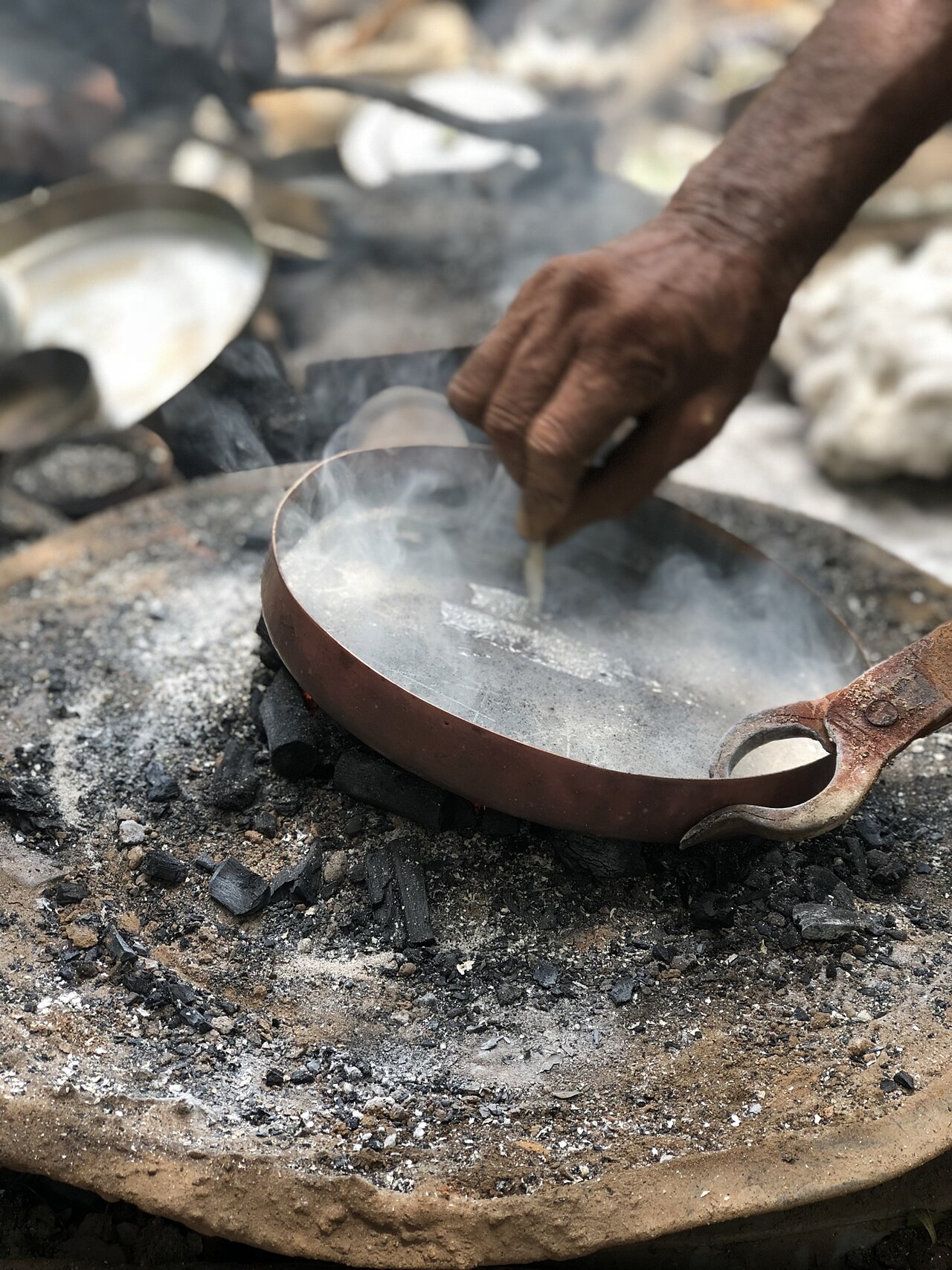
Brass and copper react with sour food, so cooking vessels made from them are lined with tin, and the lining wears away. Sheetal Bhatt, who writes the food blog theroute2roots, described in 2018 how her family had its brassware re-tinned and put the interval at six to eight months of use. Her kalaiwala, Jagdishbhai, was a fifth-generation tinner with more than 45 years at the work. His children had not taken it up. She wrote that steel and aluminium came into kitchens because they were easier to clean, that her family's brassware went into lofts and trunks, and that the kalaiwala's visits fell to one every couple of years and then stopped.
Darning a Kashmiri shawl is a separate trade. Its best-known centre is the town of Najibabad in Uttar Pradesh. Dolly Kumar of the National Institute of Fashion Technology interviewed four of them for a paper in the International Journal of Novel Research and Development. They told her they had learned by sitting six to eight hours a day for more than 25 years, having started at six or seven under a father or grandfather. They sit on the floor in daylight, because the fine needle and the broken threads are hard to see in any other light. The yarn for a repair comes from the shawl being mended, and a repair can take six to eight months or as long as a year. Kumar gives the price of a Kashmiri shawl as at least ₹10,000 and up to ₹3 lakh, and writes that the number of rafugars has fallen over the last 30 to 40 years.
The cobbler's trade has the most numbers behind it. Muffaddal Hamid and Radhika Jain interviewed 75 cobblers across Pune between July and September 2019 and published the results in South Asia Research in 2023. Five of the 75 earned under ₹5,000 a month, 25 earned ₹5,000 to 9,999, 27 earned ₹10,000 to 14,999, 14 earned ₹15,000 to 19,999 and four earned more than ₹20,000. Forty-three said they earned just enough to cover food, shelter, clothing and education. The authors write that the profession is almost hereditary, that most of the men were taught by a family member, and that cobblers in India mostly belong to the Chamar community and meet social disregard. Twenty-two of the 75 had come to the work after the age of 30, the authors say mainly after late migration or unemployment.
What a cheap replacement does to a repairer
Asked about the previous five years, 52 per cent of the Pune cobblers said their income had fallen, 13 per cent saw no change and 35 per cent said it had risen. The authors report that the price of their services had stayed almost constant for a decade, so the fall in income came from fewer customers. They attribute that to e-commerce reaching almost every income class in Pune, cheaper footwear, better footwear, and more purchases of footwear that cannot be repaired once it tears. In most areas fewer customers were choosing to repair shoes they could have replaced.
The same study shows that the trade has a way up. The four highest earners made ₹25,000, ₹31,000, ₹36,000 and ₹1,50,000 a month. None was over 35 and none had more than ten years in the work. The authors say younger cobblers used the internet, listing their business on Google or selling locally made footwear, which narrowed the income gap with older men. Experience and education showed no clear link to income in the sample.
Kalai left the household economy by another route. The object left the kitchen first, and the tinner's visits stopped after it.
Where repair is busy
Phone repair has the opposite story. Himadri Das interviewed 30 mobile repairers in Ahmedabad for coursework at CEPT University, and the Maintainers blog published a summary in 2023. Most respondents told him that phone selling had declined since 2014 while repair, refurbishing and resale of used phones had grown. A shop could be opened with ₹5,000 and a 120 square foot stall in the walled city, where rent had risen from ₹2,000 to ₹25,000. Repairers reported more customers and also more shops, so supply had overtaken demand in places, and one said that 10 to 15 per cent annual growth was realistic without dishonest practice. The shortage they named was of technicians who can repair at a complex level, and one respondent and a partner had started a training institute with a 45-day basic course to fill it.
The Department of Consumer Affairs counts complaints about repair in the same product category. Complaints in the mobiles and tablets category at the National Consumer Helpline rose from 19,057 in 2022-23 to 21,020 in 2023-24 and 22,864 in 2024-25, which the Department says shows a need to improve access to repair.
Set beside the three crafts, the phone trade has things they lack. It has training institutes, a start-up cost of a few thousand rupees and, according to the repairers, households that own more phones than they used to. The kalaiwala's trade, the darner's and the cobbler's are taught inside families, and the Pune authors link the cobblers' hereditary work to the lack of formal education and of skills development for other jobs. Five reports cannot establish a rule. The craft reports raise the question of who will learn the trade, and the phone report raises the question of who will train enough technicians, which a private institute is already trying to answer.
The scrap dealer, the kabadiwala, sits next to both. Mongabay India reported in May 2026 that India has 7,226 e-waste producers, 295 authorised recyclers and 53 refurbishers, the people who repair and renovate used equipment for reuse, and that together the formal recyclers and refurbishers process 5 to 10 per cent of the e-waste the country produces. Informal collectors handle much of the rest. One collector in Pune told the reporter he earns ₹100 to 500 a day. Collectors in Bengaluru said copper stripped from wires sells for ₹1,000 to 1,200 a kilogram. A waste picker working with the NGO Chintan said he used to sell mixed e-waste at ₹40 a kilogram and now gets ₹65 through its formal chain. The report says informal collectors have little legal recognition under the e-waste rules.
What the right to repair programme covers
The Department of Consumer Affairs set up a committee on the right to repair in July 2022. At its first meeting, on 13 July, it chose four sectors: farming equipment, mobile phones and tablets, consumer durables, and automobiles with their equipment. The Department's release listed the problems it had in mind. Companies avoid publishing repair manuals, manufacturers control spare parts, and a customer who buys from an unrecognised seller can lose the warranty. The release also notes that India already has a large third-party repair sector, including people who strip products for spare parts.
The Right to Repair Portal India was launched on National Consumer Rights Day, 24 December 2022. In March 2024 the Department asked companies in the four sectors to join it and to publish manuals and repair videos, the price and warranty of spare parts, the differences between guarantee, warranty and extended warranty, and the addresses of their service centres and of any third-party repairers they recognise. By May 2025 more than 65 companies had joined.
In May 2025 a committee under Additional Secretary Bharat Khera submitted a report on a repairability index, to begin with smartphones and tablets. It scores a product on six parameters: depth of disassembly, repair information, spare parts available within a reasonable time, software updates, tools, and fasteners. Manufacturers would declare their own scores and show them at the point of sale, on e-commerce sites and by QR code on the packaging. A release of 4 November 2025 still described the scheme as proposed.
All four sectors are factory goods with a manufacturer who can be asked for a manual, a part number and a service centre. The sandal, the vessel and the shawl have no manufacturer to ask. The knowledge a buyer would need is held by the repairer, and the Pune study found it passed mostly inside families.
What a buyer can do
Ask at the point of sale who would repair the piece. The answer for a stitched sandal is a cobbler, for a brass or copper vessel a kalaiwala, and for a woven shawl a darner who may live in another state.
Find the repairer before the object needs one. The comments under Bhatt's 2018 post, running as late as May 2026, are from readers in Delhi, Mumbai, Vadodara and Malaysia asking where to find a kalaiwala. Her replies say that kalaiwala shops still exist in Ahmedabad and point to one opposite Mandvi ni Pol in Manekchowk.
Pay the fee that is asked. The Pune cobblers' prices had stayed almost constant for a decade while their incomes fell, so there is little room in them to bargain down.
For a phone, tablet, appliance or tractor, the portal at righttorepairindia.gov.in is the place the Department points buyers to for manuals, spare-part information and service centres from the companies that have joined. The repairability index, once it is in force, would add a score to the shelf label.
The Pune authors recommend three measures for cobblers: a secured place to work, a permit that lets them use their skills freely, and cheap credit.
Sources
- Sheetal Bhatt, "Kalai: the vanishing shine of re-tinning", theroute2roots, 8 July 2018. Re-tinning interval, Jagdishbhai, steel and aluminium, reader comments.
- Dolly Kumar, "Role of Rafugars in Textile Repair and Recycling in India", International Journal of Novel Research and Development. Interviews with four rafugars in Najibabad.
- Muffaddal Hamid and Radhika Jain, "Socio-Economic conditions of Cobblers in Pune City", South Asia Research, 2023. Survey of 75 cobblers, July to September 2019.
- Himadri Das, "Evolving Mobile Repair Business in Ahmedabad City, India", The Maintainers, 29 November 2023. Interviews with 30 repairers.
- Shoma Abhyankar, "How NGOs are bringing India's informal waste collectors into the system", Mongabay India, 22 May 2026
- Press Information Bureau, "Department of Consumer Affairs sets up committee to develop comprehensive framework on the Right to Repair", 14 July 2022
- Press Information Bureau, "Department of Consumer Affairs conducts Stakeholders Meeting on Right to Repair Portal India", 8 March 2024
- Press Information Bureau, "Report for Framework on Repairability Index (RI) in Mobile and Electronic Sector submitted", 3 May 2025. Complaint counts, portal onboarding, index parameters.
- Press Information Bureau, release on the logo competition for the Repairability Index, 4 November 2025. Portal launch date and status of the index.
Hero image is a representative photo via Wikimedia Commons.