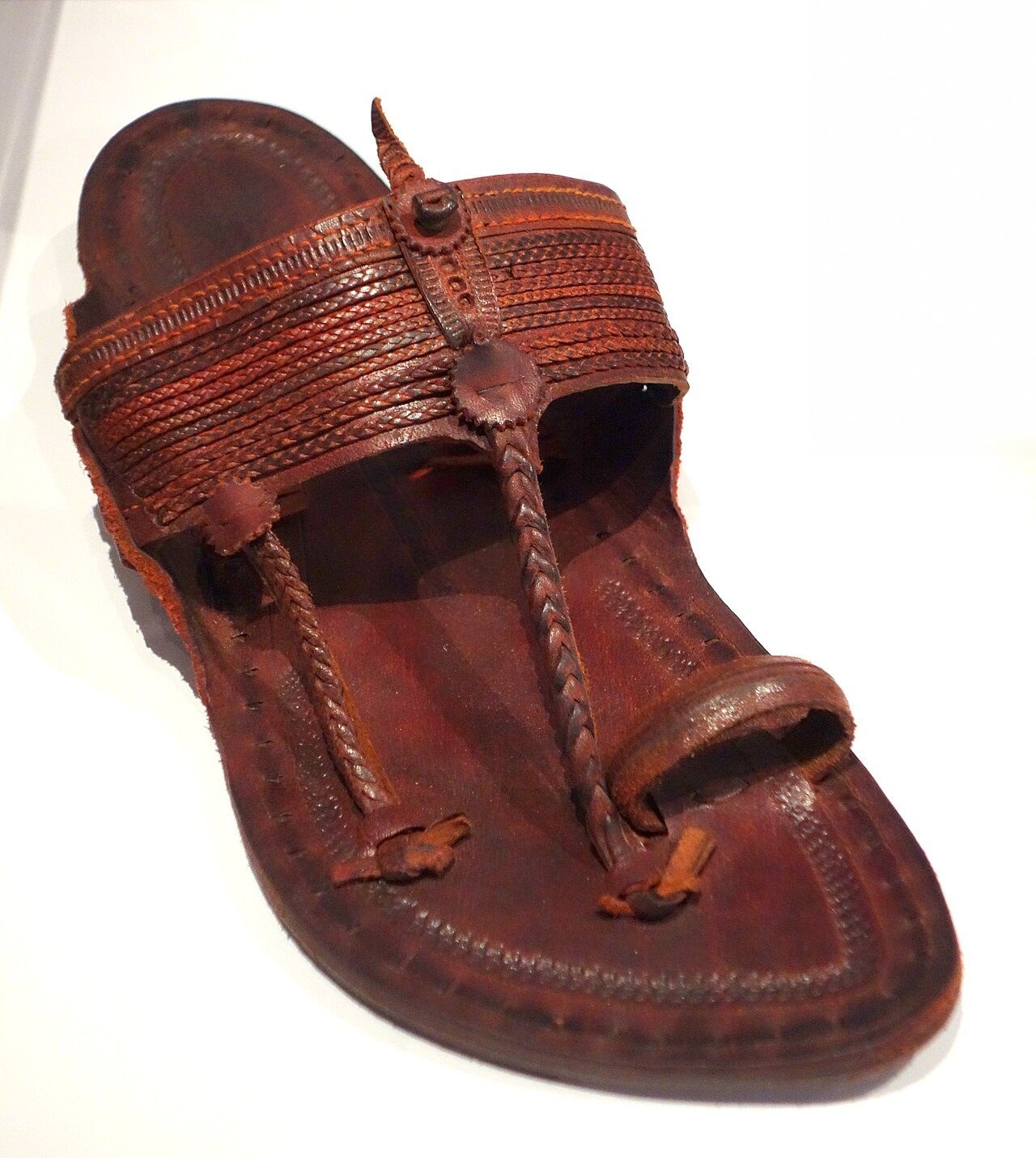
A Kolhapuri is a flat, open-toed leather sandal with a loop for the big toe, a braided strap running back from it, and a broad band across the instep. The shape is so easy to copy that most pairs sold under the name, from Delhi footpaths to European catwalks, were never near Kolhapur. A pair made the traditional way is cut from bag-tanned leather, stitched with thread cut from the same hide, and carries no nails at all.
The craft is old, and the GI application dates it to the 12th and 13th centuries. The pair you buy today differs from the medieval one. The heavy farmer's chappal of the past could weigh close to three kilograms, and the lighter, slimmer shape now sold everywhere is usually traced to a redesign in the 1920s. This guide is about the method of making, which has outlasted the change in shape.
What a Kolhapuri is made of
The GI specification defines the chappal by its leather. Sole, insole, upper and heel are all bag-tanned, a slow vegetable tanning in which hide is soaked in tannin from bark, babul among them, where factory leather is soaked in chromium salts. The layers are joined by stitching with leather thread. There are no nails. Some workshops do use a little local adhesive to hold parts in place while they stitch, so a trace of glue proves nothing about a pair. The stitching holds it together.
Chrome-tanned leather, which is most factory footwear, is faster and cheaper to make. The difference also matters to some wearers. Chromium in leather is a known cause of contact dermatitis in people sensitised to it, and footwear is one of the usual routes. For anyone with that allergy a vegetable-tanned sandal is the safer choice.
Styles carry local names, often from villages and communities. Kapshi and Pukari are the two buyers meet most often, and listings from the GI corporations also use names such as Kurundwadi. The makers are mostly from Charmakar leather-working communities, who also repair what they make.
Time depends on the strap work. A plain everyday pair is quick, and an experienced hand can finish several in a day. A pair with fine braiding takes a week or more, and the most elaborate can take over a month.
GI status
Kolhapuri Chappal is GI application No. 169, filed in 2009. The registry records the certificate as dated 11 December 2018, valid to 3 May 2029; the news reached the press in mid-2019, which is why many sources give 2019. The proprietors are two state leather corporations: LIDCOM in Maharashtra and LIDKAR in Karnataka. The GI covers eight districts: Kolhapur, Sangli, Satara and Solapur in Maharashtra, and Belagavi, Bagalkot, Dharwad and Vijayapura (Bijapur) in Karnataka. Much of the Karnataka work is in Athani, a taluk of Belagavi district. Only registered authorised users in those districts may lawfully sell their sandals as Kolhapuri chappals.
The Prada episode, and what came of it
On 22 June 2025 Prada sent toe-ring leather sandals down its men's Spring/Summer 2026 show in Milan without naming where the design came from. After protests from Kolhapur, Lorenzo Bertelli wrote to the Maharashtra Chamber of Commerce at the end of June acknowledging that the sandals were "inspired by traditional Indian handcrafted footwear". On 10 December 2025 Prada signed a memorandum of understanding with LIDCOM and LIDKAR in Mumbai, and on 27 April 2026 it launched a limited "Made in India x Inspired by Kolhapuri Chappals" sandal, alongside a three-year training programme for 180 artisans run with NIFT and a Kolhapur leather institute.
For a buyer the more useful consequence came from LIDCOM. In July 2025 it announced QR-coded certification. Scanning the code on a certified pair shows the maker or unit, the district, the materials and techniques, and whether the GI certification is valid. It is the first authenticity check a buyer can run on a phone.
Hand-stitched pair or moulded copy
- Turn it over. On a hand-stitched pair the sole layers are joined by a visible line of stitches running round the edge, and the straps are stitched or knotted through the sole. A single moulded sole with straps glued into slots is a factory sandal.
- Look at the cut edge of the sole. Stacked leather shows its layers. Rubber, EVA foam and PU show one even material all the way through.
- Do not reject a rubber heel on sight. Makers selling through LIDKAR and Kolhapur workshops such as Korakari add anti-slip rubber or TPR pieces under the heel for modern roads. The leather and the stitching above it are what matter.
- Ask for the QR code or the seller's GI status. LIDCOM-certified pairs carry one. A seller who names the maker, the district and the style gives you something to check. A listing that uses "Kolhapuri" only as a style word gives you nothing to check.
- Price. On 6 October 2026, hand-stitched pairs from LIDCOM's listings cost ₹873 to ₹1,293, LIDKAR's ₹1,038 to ₹2,832 before GST, and Korakari's traditional lines ₹990 to ₹2,790. Nothing made this way was on sale below about ₹870. A pair at ₹300 is a factory sandal made in the Kolhapuri shape.
Where to buy
The two GI corporations are the most accountable sellers, and both sell online, though neither makes it easy. LIDCOM has no shop of its own, and the "Shop Now" link on lidcom.in sends buyers to Umed Mart, a store run by a farmers' producer company, where most LIDCOM listings were sold out on the day we checked. LIDKAR runs its own shop, which names the supplier of each pair, though its listings do not state the tanning method or GI status. Among private makers, Korakari, which says it has made chappals in Kolhapur district since 1973, is the clearest about method; it also sells artificial-leather sandals, so check that the pair you choose is from its leather line.
Kolhapuris run narrow and stiff and need a week or two of short wear before they are comfortable. Measure your foot and check it against the seller's size chart, since your usual shoe size can mislead, and if you are buying for Diwali, check the delivery date before you pay, because none of these sellers ships at marketplace speed.
Specific picks
Three pairs, each checked on 6 October 2026 for price, stock and what the listing claims. Stock at the GI corporations moves quickly, so if one is gone, the same seller's other styles are the next place to look.
Top pick · GI-certified
LIDCOM Punching Kolhapuri, women's, tan
via Umed Mart · LIDCOM-branded · Listing states vegetable-tanned leather, handcrafted in Kolhapur, GI certified · Sizes 6–11
From the Karnataka co-proprietor
LIDKAR Kolhapuri, men's
via LIDKAR · Supplier named on the listing · Leather lining and leather sole with an anti-slip TPR heel · Tanning method not stated · GST extra
Fine braiding · Kolhapur maker
Korakari Vintage Tan, men's
via Korakari · Kapshi shape, ten leather braids, hand-stitched with leather cord · Listing states naturally tanned leather and a leather sole · Sizes 6–11
Looking after a pair
- Keep them out of the rain. Water stiffens and warps vegetable-tanned leather, and a leather sole soaks it up. Makers and sellers agree on this more than on anything else. Wear something else in the monsoon.
- Condition dry leather sparingly. Sellers recommend oil or a leather conditioner when the straps feel dry, and they disagree on how often. Use a small amount, and only when the leather feels dry.
- Dry them away from the sun if they do get wet, stuffed with paper, and store them flat somewhere that is not damp.
- Repair them. A stitched sandal can be re-stitched or re-soled by a cobbler in a way a moulded one cannot, and Charmakar workshops repair as well as make. Repair is the main reason a hand-stitched pair is worth about four times the price of a copy.
The hero photograph is a museum piece, chosen because it shows the construction clearly. Product cards link to current listings, checked on 6 October 2026.