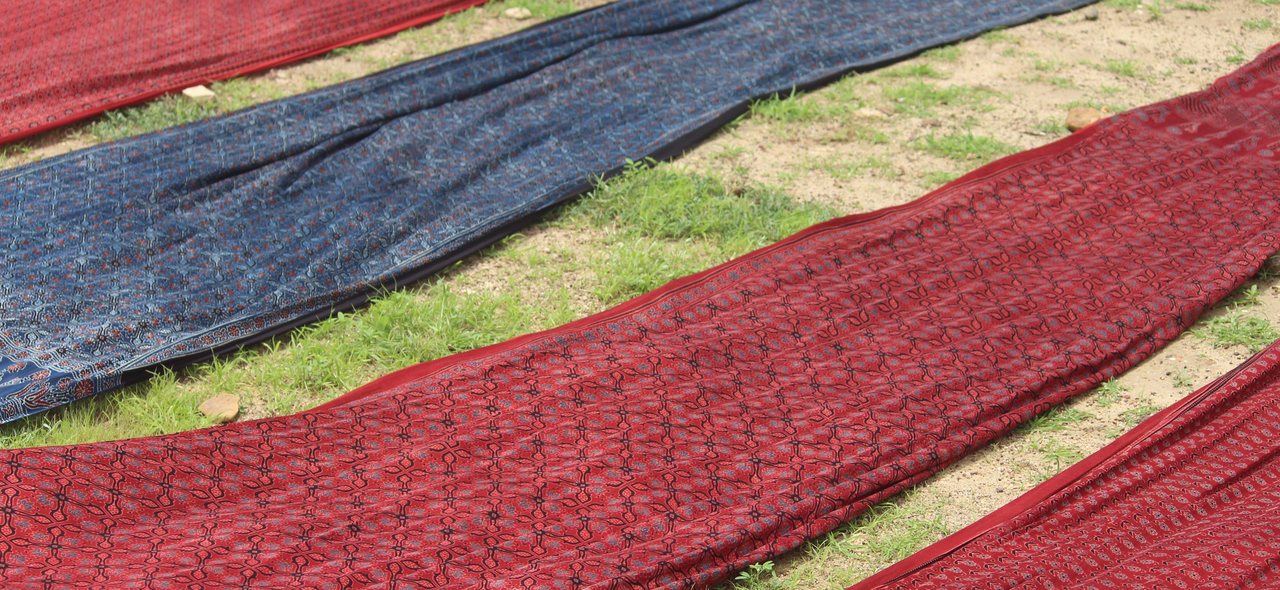
Ajrakh is cotton cloth printed with carved wooden blocks in repeated stages of resist and dye. The result is a dense geometric grid in indigo, madder red, black and white. Ajrakhpur, a village near Bhuj in Kutch, is its best-known workshop centre. This guide covers how the cloth is made, what the "natural dye" label does and does not tell you, how to separate block print from screen print, and what listings cost.
Where ajrakh is made
The printers of Kutch are Khatri families who trace the craft to Sindh. Mongabay reports the belief that one family's ancestors brought it in the 16th century, and a profile by Shefalee Vasudev says it came about four centuries ago. Ajrak is also printed in Sindh in Pakistan, where the name is Sindhi, so the Kutch label describes one branch of a wider tradition.
Ajrakhpur is recent. After the 2001 earthquake, and after the groundwater at the old printing village of Dhamadka had worsened, about 100 families moved to the present site, 40 km away. The traditional colours are blue, red and white, and the motifs include the makodo, mor, champakali and chakli.
How a metre of ajrakh is made
Gaatha's description of the process runs as follows. The cloth is washed and beaten, then soaked in harda (myrobalan) and pounded. Blocks dipped in a paste of gum arabic and lime print the outlines that will stay white. A black paste of rust from scrap iron, tamarind seed powder and jaggery is printed next, and it turns permanently black after the indigo bath. Further resists of alum, gum arabic, millet flour and red clay, and of lime and gum arabic, cover the areas that must stay undyed. The cloth then goes into an indigo vat for 10 to 15 minutes. For red, it is boiled for two to three hours with tamarisk galls and madder. Some stages are repeated, and when a cloth is printed on both faces it is turned over and printed again.
No two sources count the stages the same way. Mongabay says 16, Gaatha says up to 16, The Wire says 12 to 14, and Vasudev says nine to 21. An iTokri listing says each piece takes 15 to 20 days. Printing stops in the monsoon because humidity affects the dyes.
What natural dye settles, and what it leaves open
Natural dyes have been used since the craft began, and the ingredients named above (indigo, madder, myrobalan, iron rust, tamarind seed, jaggery) are plant and mineral materials. The Wire reports that chemical colours came into use in the 1970s to meet demand for cheaper ajrakh. Gaatha itself describes a synthetic indigo method, mixed with sodium hydrosulfide and caustic soda, beside the natural vat that ferments for months. A piece is therefore natural-dyed only if the maker says so, and a seller who cannot say which indigo was used has not told you.
Natural dye does not make the craft light on resources. Mongabay puts the water used in Ajrakhpur at about 1 lakh litres a day, and describes an effluent plant built in 2007 that covered only part of it, with a larger common treatment plant planned to recycle 1.5 lakh litres a day. Iron in water spoils the work: Sufian Khatri is quoted there saying that even one per cent iron gives the pale yellow cloth black spots. We found no study comparing ajrakh with other textiles over its whole life, so a claim that it is the most sustainable textile you can own has no source behind it here.
Telling block print from screen print
The Wire names screen printing as the cheaper alternative that has cut into demand for block-printed ajrakh. The checks below come from seller guides, including iTokri's, and none of them has independent testing behind it.
- Turn the cloth over. Gaatha's process includes printing the reverse with the same blocks, and seller guides say a hand-printed piece shows the pattern on both faces at close to equal strength. A pale or blank back suggests a one-sided print.
- Look for small irregularities. Hand-carved blocks leave slight shifts where repeats meet. Machine-perfect registration across a long length is a reason to ask questions.
- Judge the colour. Seller guides describe natural-dyed ajrakh as deep and slightly muted. Bright, flat, uniform colour is described as a warning sign.
- Ask which indigo and which dyes. The answer separates natural from synthetic, which a label does not.
- Ask who made it. Gaatha's cotton dupatta names its maker, Sufiyan Khatri of Ajrakhpur. The iTokri fabric listings checked for this guide name none.
GI status
Kutch Ajrakh is a registered Geographical Indication under the name Kutch Ajrakh Print of Gujarat (application No. 1050), for textiles in classes 24 and 25. The registry names the Ajarakhpur Hastkala Vikas Sangathan of Ajrakhpur, in Bhuj taluka, as the applicant. It was filed on 31 January 2023 and advertised in Journal 188 on 19 December 2023. A certificate of registration dated 22 April 2024 is listed among the documents, although the certificate number, date and validity fields on the record are blank. The registry lists 95 authorised users. The registry records the geographical area as Gujarat, and the authorised users we read are printers in Ajrakhpur, Dhamadka, Anjar and Bhachau, all in Kutch district. Ajrak from Sindh is outside it.
Where to buy and what it costs
Buy from a maker, or from a seller who names one. Gaatha sells a cotton dupatta of 220 by 88 cm made by Sufiyan Khatri of Ajrakhpur for ₹1,900. On iTokri, prices as of 26 October 2026 started at ₹325 to ₹395 for natural-dyed cotton fabric (each listing sets the length sold) and ran from ₹1,990 to ₹3,390 for cotton and mul cotton dupattas. All of those list hand block printing and natural dye in the product title, and some name Kutch. Ask any seller for the dye details, the maker and photographs of the reverse side.
Specific picks
Two iTokri listings, with prices as shown on 26 October 2026. Each is described as hand block printed and natural dyed in its title, and neither names a maker in its title, although some other iTokri listings credit a printer such as Tosif Khatri, so ask for the details above before ordering.
Top Pick · Cotton dupatta
Pure mul cotton Kutch hand block print natural dyed ajrakh dupatta
via iTokri · Mul cotton · Listing title states Kutch, hand block print and natural dyed · No maker named
Gift Pick · With tassels
Ajrakh hand block print natural dyed cotton dupatta with tassels
via iTokri · Cotton · Tassel finish · Listing title states hand block print and natural dyed
Looking after ajrakh
- Wash gently. iTokri advises cold water, mild liquid detergent and no long soaks. Gaatha advises mild detergent too.
- Expect some bleeding at first. Both sellers say natural colours may run in the first washes. iTokri suggests soaking fabric in salt water before stitching, and Gaatha suggests washing a new piece separately.
- Dry in the shade and store in a cool, dry place.
Hero image is a photograph taken in Ajrakhpur, Gujarat, used under the Pexels licence. Product cards link to listings with prices as of 26 October 2026.