Sharad Navratri begins on Sunday 11 October this year and ends with Dussehra on Tuesday 20 October. In Gujarat its nights belong to garba, the circle dance around a lit earthenware pot or an image of the goddess Amba, which UNESCO added to its Representative List of intangible heritage in 2023. Elsewhere Navratri is kept with steps of dolls in Tamil Nadu, Andhra and Karnataka, and as Durga Puja in Bengal, both of which have their own guides on this site. This one is about what people wear to garba.
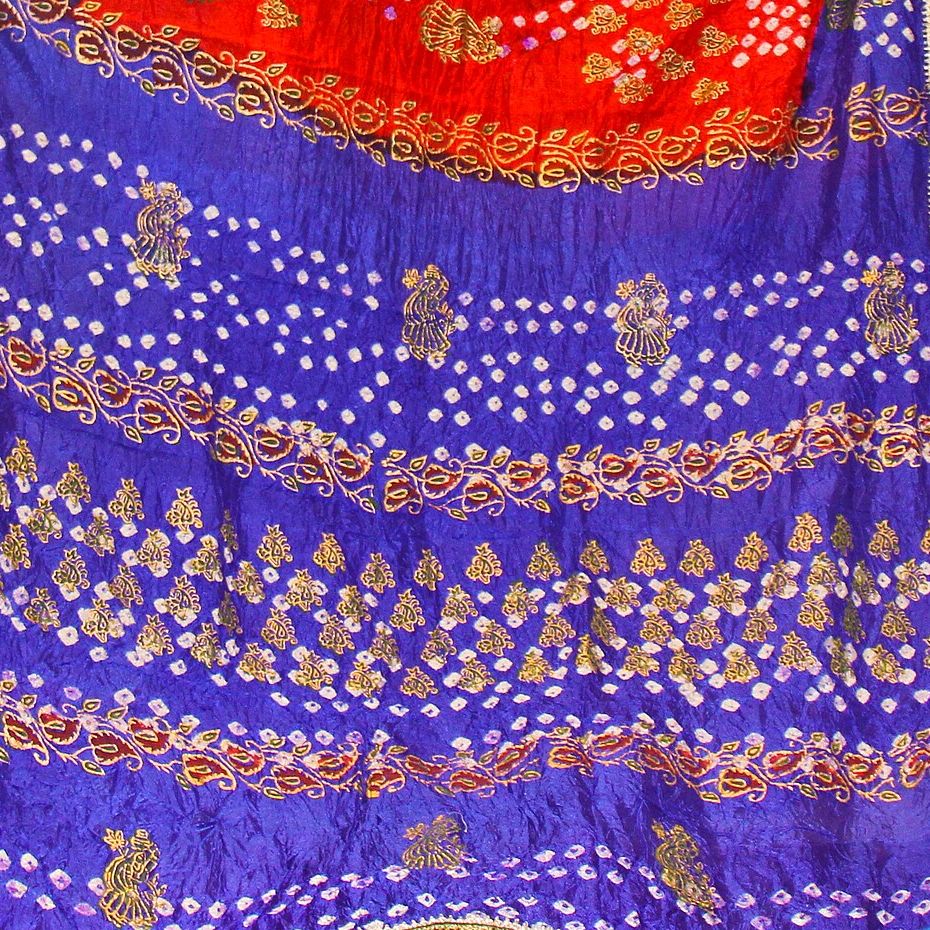
That usually means two crafts from the same part of India. Bandhani is tie-resist dyeing, in which thousands of tiny knots are tied into cloth before it goes into the dye, so that each knot leaves a dot. Kutch embroidery is the needlework of the communities of Kutch, much of it set with small mirrors. Both are copied heavily, and both have a GI registry entry that describes the craft in its applicants' own words.
How bandhani is made
The GI Journal for Kutch Bandhani sets out the sequence. The cloth is bleached. The design is marked on it with geru and soot, through a pin-pricked plastic sheet or with wooden blocks. Women then tie the knots, which the trade calls bheendi, pinching a point of cloth and binding it with thread; a metre of fine work carries thousands. The cloth is dyed, usually starting with the lightest colour, and areas meant for a second or third colour are wrapped in plastic so the dye reaches only the rest. When it has dried completely the cloth is pulled crosswise and the knots spring open, leaving a white or pale dot wherever thread kept the dye out.
Tying alone takes from 4 to 90 days depending on the design, by the Journal's account. The Kutch speciality is the rai dana, a dot the size of a mustard seed. The Jodhpur Bandhej Journal names the Rajasthani knots and patterns: ekdali (one knot), trikunti (three), chaubandi (four), boond, kodi, leheriya and mothra among them. Kutch has its own named designs, such as the black Chandrokhani worn by Khatri brides and the gharchola of Jamnagar.
The Journal says the work has been carried out by the Khatri community of Kutch and Saurashtra, and names centres in Mandvi, Bhuj, Anjar, Jamnagar, Morbi, Rajkot and Deesa. In Rajasthan the Jodhpur Journal names Jodhpur, Nagaur, Churu and Barmer. Fabrics run from cotton and mulmul to georgette, chiffon and gajji silk, the lustrous silk used for the best dupattas.
On dye, the Kutch Bandhani Journal names vat and naphthol dyes for cotton and acid dyes for silk. Both are synthetic. The same document elsewhere lists natural colours among the product's qualities, so the registration contradicts itself. Unless a seller states that a piece is naturally dyed, assume synthetic dyes, which are standard in the craft.
GI status
Kutch Embroidery: application No. 103, certificate dated 10 July 2008, proprietor the Development Commissioner (Handicrafts). Some sources give 2013, which is wrong. Jamnagari Bandhani: No. 221, certificate dated 10 November 2016, held by the Jamnagar Chamber of Commerce and Industry; its area covers Jamnagar city and all of Kachchh district. Kutch Bandhani of Gujarat: No. 756, certificate dated 30 March 2024, held by the Kachchhi Khatri Bandhani Hastkala Association, Bhuj. Jodhpur Bandhej Craft: No. 751, certificate dated 1 August 2023. Several Kutch embroidery styles have their own applications pending, among them Rabari (No. 1231), Mutva (No. 1675) and mirror work (No. 2077), and a Rajasthan trust has filed for Soof and Pakka embroidery as well.
Kutch embroidery
The Kutch Embroidery GI Journal names the Ahir, Rabari, Mochi and Marwada Meghwal communities, lists 27 stitches, and covers nine talukas of the district: Bhuj, Anjar, Nakhatrana, Lakhpat, Mandvi, Mundra, Bhachau, Rapar and Abdasa. The major techniques it names include Mochi bharat, abhla or mirror work, Heer bharat, Suf, Kharek and Paako. Each community's work is recognisable to people who know it, which is why the NGOs that sell it name the style on every piece. A large piece takes weeks or months.
Three organisations do most of the work of keeping this embroidery in the market. Shrujan has worked with embroiderers in Kutch since 1969 and sells through shrujan.com. Kala Raksha, founded in 1993, runs a museum and artisan design and pricing committees. Khamir, set up after the 2001 earthquake, is a platform for Kutch crafts generally; its shop sells bandhani.
Tied or printed, hand or machine
- Buy it with the knots still tied. This is the GI Journal's own test. It says Kutch bandhani is "often sold with knots still tied, in order to indicate that they are not printed", and "as long as the ties are there, the customer can be sure he is not buying an imitation". You open the knots yourself by pulling the cloth crosswise.
- Look at the outline of each dot. The Journal judges quality by the contours, kaff, of the dots. A tied dot has a soft, slightly irregular edge and the dots vary a little in size and spacing. A printed dot is flat and identical to its neighbours.
- Feel for texture. Untied bandhani keeps a puckered, crinkled surface where the knots were. A print is smooth. Sellers of the real thing describe this consistently, though no laboratory has tested it.
- Do not rely on the back of the cloth. Retailers contradict each other on whether a print shows through to the back, so it proves nothing either way.
- Mirror work: turn it over. On hand embroidery each mirror is held by a frame of thread worked around it, which you can see from the reverse. Cheaper pieces often have acrylic discs glued on instead, perfectly round and liftable at the edge; sellers of hand work describe this check, and it is easy to do in a shop. Hand-cut glass mirrors are slightly irregular.
- Read the fabric line. A "modal silk" dupatta on one craft site turns out, a few lines down the same page, to be a "semi-synthetic, plant-based fiber". Modal is a rayon. The dupatta may be good value at its price, and the word silk in its title is misleading.
What it costs
Prices on 6 October 2026: hand-tied gajji silk bandhani dupattas at Khamir cost ₹5,600 to ₹11,200, and at Gaatha ₹3,520 to ₹8,350. Cotton and mulmul bandhani dupattas from Kutch run ₹1,090 to ₹1,690 at iTokri. Hand-embroidered stoles at Shrujan start around ₹3,500, a Pakko dupatta was ₹11,000, and full shawls run ₹15,000 to ₹45,000. On these prices a silk bandhani dupatta under ₹2,000 is probably printed or made of another fibre, and the ₹1,500 to ₹5,000 range this site usually works in buys good cotton bandhani or a smaller embroidered piece.
Nothing ordered now is likely to arrive for the first night of garba. Navratri runs nine nights, though, and Dussehra and Diwali (8 November) follow. Check each seller's dispatch time before paying.
Specific picks
Four pieces, each checked on 6 October for price, stock and what the listing says about how it was made. The Gaatha stole is a single piece and may go quickly. Khamir's hand-tied gajji silk dupatta at ₹7,200 is the benchmark if you want to see what the top of the range looks like.
Top pick · Hand-tied silk
Twinkle Drops silk bandhani stole, by Jabbar Khatri
via Gaatha · Made by Jabbar Khatri, Bhuj · Hand-tied, 100% silk · 224 × 52 cm, which is the size of a stole and narrower than a full dupatta · One in stock
Garba dupatta · Cotton
Kutch tie-dye cotton bandhani dupatta, green
via iTokri · 100% cotton, full size 240 × 116 cm · Tied before dyeing · No maker named and no natural-dye claim
Kutch embroidery · NGO-sourced
Neran hand-embroidered stole
via Shrujan · Handloom cotton, 24 × 70 in · Neran style, hand-embroidered by women in Kutch
Mirror work · Under ₹1,500
Hand-embroidered mirror work dupatta, white
via iTokri · Hand embroidery and mirror work on a screen-printed cotton base, which the listing states · No community named
Sources
- GI registry: Kutch Embroidery, No. 103, Jamnagari Bandhani, No. 221, Kutch Bandhani of Gujarat, No. 756, Jodhpur Bandhej Craft, No. 751. The quotations and the method come from the GI Journals filed with each.
- UNESCO, Garba of Gujarat, inscribed 2023
- Dates: Drik Panchang, Sharad Navratri 2026 and the central government's 2026 holiday list
- Kala Raksha, Khamir and Shrujan's shop
The hero photograph is a representative piece from Rajasthan, chosen because the dots are easy to see. Product cards link to current listings, checked on 6 October 2026.