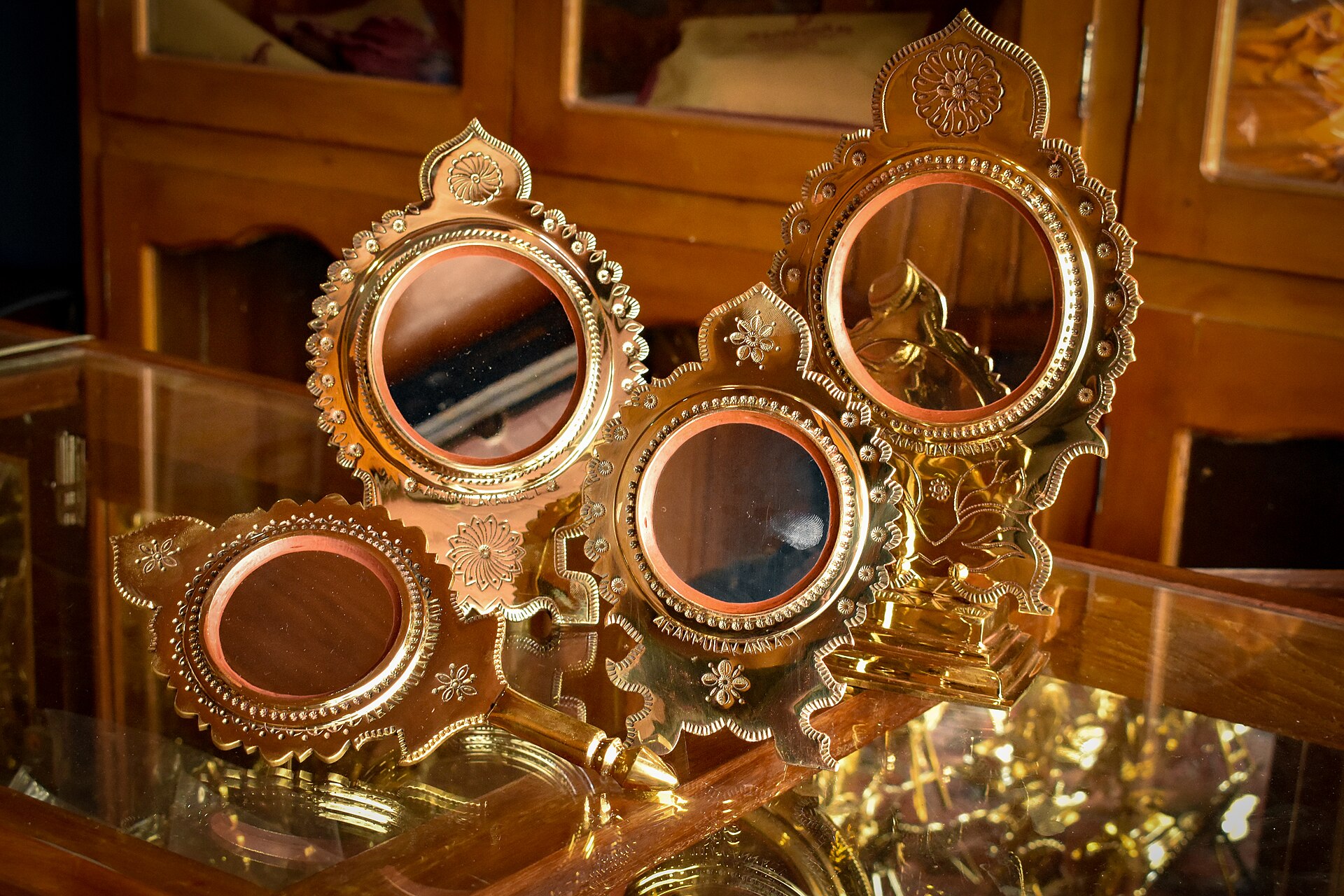
The Aranmula kannadi is a mirror with no glass in it. A thin disc of copper-tin bronze is cast, ground and polished until it reflects, and then set in a brass frame with a handle. It comes from Aranmula, a town in Pathanamthitta district, Kerala, and it is one of the eight auspicious articles, the ashtamangalyam, that accompany a bride at a traditional Kerala wedding. It is also expensive, widely imitated, and made by a small number of workshops. This guide sets out what is known about the metal and the making, where the accounts disagree, and what to ask before you buy.
What it is
Wikipedia describes it as a metal-alloy first surface mirror. The reflection comes from the front of the metal, so there is no second image from a glass layer in front of a silvered back. The alloy is copper and tin. The metallurgist Sharada Srinivasan, writing in Sahapedia, puts the tin at about 32 to 33 per cent, close to the delta phase of bronze at 32.6 per cent tin. That phase is silvery white and reflects across the spectrum. The same article says as-cast delta bronze is brittle, and that makers cast a blank about two millimetres thick.
The craft is old. Local tradition links it to the Aranmula Parthasarathy Temple. One legend says eight families of temple artisans came from Tirunelveli district in Tamil Nadu, another names Sankarankoil, and a third credits a widow, Parvati Ammal, with dreaming up the alloy. A mirror carrying a Travancore royal seal has been dated by compositional analysis to the 17th or 18th century. The craft has long been held by hereditary families of the Vishwakarma community, and the formula has been described as a closely guarded secret.
How it is made
Accounts of the casting differ. Sahapedia describes two finely ground clay discs, separated by thin spacers of the same alloy, packed into a clay crucible-and-mould. The mould is heated cup down, and when the metal melts it is tipped so that it flows into the gap. The clay comes from the Pampa riverbanks. A report in Open magazine describes a clay mould of two slabs with a 3 mm gap, a melt whose temperature and timing are judged by eye, and a day of cooling. Others describe a lost-wax method. Workshops may differ, and the secrecy makes the question hard to settle.
Polishing is the long step. Open magazine says it takes hours with water paper, oil, velvet and finally cotton cloth, and Kerala Tourism speaks of polishing sessions that go on for several days. Sahapedia gives several days as well. Homegrown reports that a mirror takes anywhere between two days and four months to make, and that mirrors are usually made to order. The News Minute reported in 2015 that small pieces took two to three days and large ones almost three to four months.
GI status
The Aranmula kannadi holds a Geographical Indication. The registry record (application No. 3, class 20, Kerala) is titled Aranmula Kannadi (Aranmula Metal Mirror). The applicant is the Viswabrahmana Aranmula Kannadi Nirman Society, as the registry spells it. The registry lists three authorised users, all individuals: Maniammal TK, P. Gopakumar and Aravind S of Thikkinampallil (read on 26 October 2026). The certificate, No. 10, is dated 19 September 2005, with validity shown to 7 December 2033. Open magazine reports that only mirrors made by the society's members are considered authentic; it counted 19 member units in the villages of Aranmula and Mallapuzhacherry, up from seven in 2005. Other sources give the year of the GI as 2003 or 2004-05, and the registry's certificate date is 2005. The name of the society is easy to confuse. Craftsmen told The News Minute that a rival society with a nearly identical name was set up in 2005, so ask a seller which body a piece comes from. A separate application for Thikkinampallil Aranmula Kannadi (No. 535), filed on 28 December 2015 by a family charitable trust, was refused, and the registry lists an order dated 6 June 2019.
Real and imitation
Imitations are on sale. Homegrown says fake products have made their way into the market, and craftsmen quoted by The News Minute say that migrant labourers make duplicates without the traditional methods or rituals. The makers describe a purification oath, the vratham, that a mirror-maker takes. A buyer cannot check that. These checks can be made.
- Ask for a certificate of authenticity. The certificate should say where the mirror was made.
- Ask which society or workshop made it. The GI is held by one society, and a similarly named rival exists. A seller who cannot name the maker gives you little to go on.
- Look at the reflection. Sahapedia says a pen point held against an authentic mirror gives a perfect point image, because there is no glass to refract, while a glass mirror does not give a point image. Try it in the shop.
- Look at the size and price. Open magazine found sizes from two to six inches common, with some up to 12 or 18 inches. A large mirror advertised for a few hundred rupees deserves questions.
- Look at the frame. INTACH's heritage archive says the frame is of pure brass. The brass frame is a normal part of the object, and it is the disc that you are checking.
Where to buy and what it costs
The most direct route is Aranmula. Open magazine's writer visited the Parthasarathy Handicrafts Centre at Aranmula junction, in the same building as a workshop, and found a board outside warning against fakes. Kerala Tourism lists traditional craftsmen, authorised outlets in Aranmula and Kerala's official emporiums. Online sellers exist, and the same checks apply to them.
Prices reported by Open magazine at the workshop were ₹2,000 for a two-inch mirror, over ₹10,000 for a six-inch one and over ₹1 lakh for a 12-inch one. The News Minute gave a range of ₹3,500 to ₹2 lakh in 2015. One online seller, Zishta, lists a 3.8 cm frill-edge piece at ₹3,190, made to order and shipped within 7 to 10 days, and does not name a society on that page. Treat all of these as indicative, since the reports date from different years.
Two listings from CultureShoppe, a Kerala craft retailer whose 7 inch wall mirror at ₹36,000 also appears on the Kerala Tourism Responsible Tourism Network (read on 26 October 2026). Neither listing names the society, the maker or the certificate, so ask for all three before you order. Both showed as available when we looked. The small conch-shaped mirror sits just above the ₹3,190 piece quoted above, and the 2.5 inch mirror sits between the ₹2,000 and ₹10,000 workshop figures that Open magazine reported.
Top Pick · Conch shape
Aranmula Kannadi - Conch-Shaped Handmade Metal Mirror, 1.5 inch
via CultureShoppe · 14 x 7 cm, about 150 g · Brass, tin and copper · Maker, society and certificate not named on the listing
Larger · Vaal kannadi
Aranmula Vaal Kannadi Handmade Metal Mirror 2.5 inch
via CultureShoppe · 18 x 8 cm, about 300 g · Brass, tin and copper · Maker, society and certificate not named on the listing
Looking after it
- Keep it at room temperature, away from heat and dust. Kerala Tourism gives this as the basic requirement.
- Wipe it with a soft cloth. Kerala Tourism says there is a prescribed way to wipe off finger marks. Ask the seller to show you.
- Avoid chemicals and water. Zishta's care note tells buyers to use no cleaning agents and warns that water can oxidise the surface.
- Handle the disc gently. Sahapedia describes as-cast high-tin bronze as brittle, while INTACH's heritage archive says the mirrors do not crack if they fall. No source tests a drop, so handle the disc gently and hold the mirror by its frame.
Hero image is a representative photo via Wikimedia Commons.