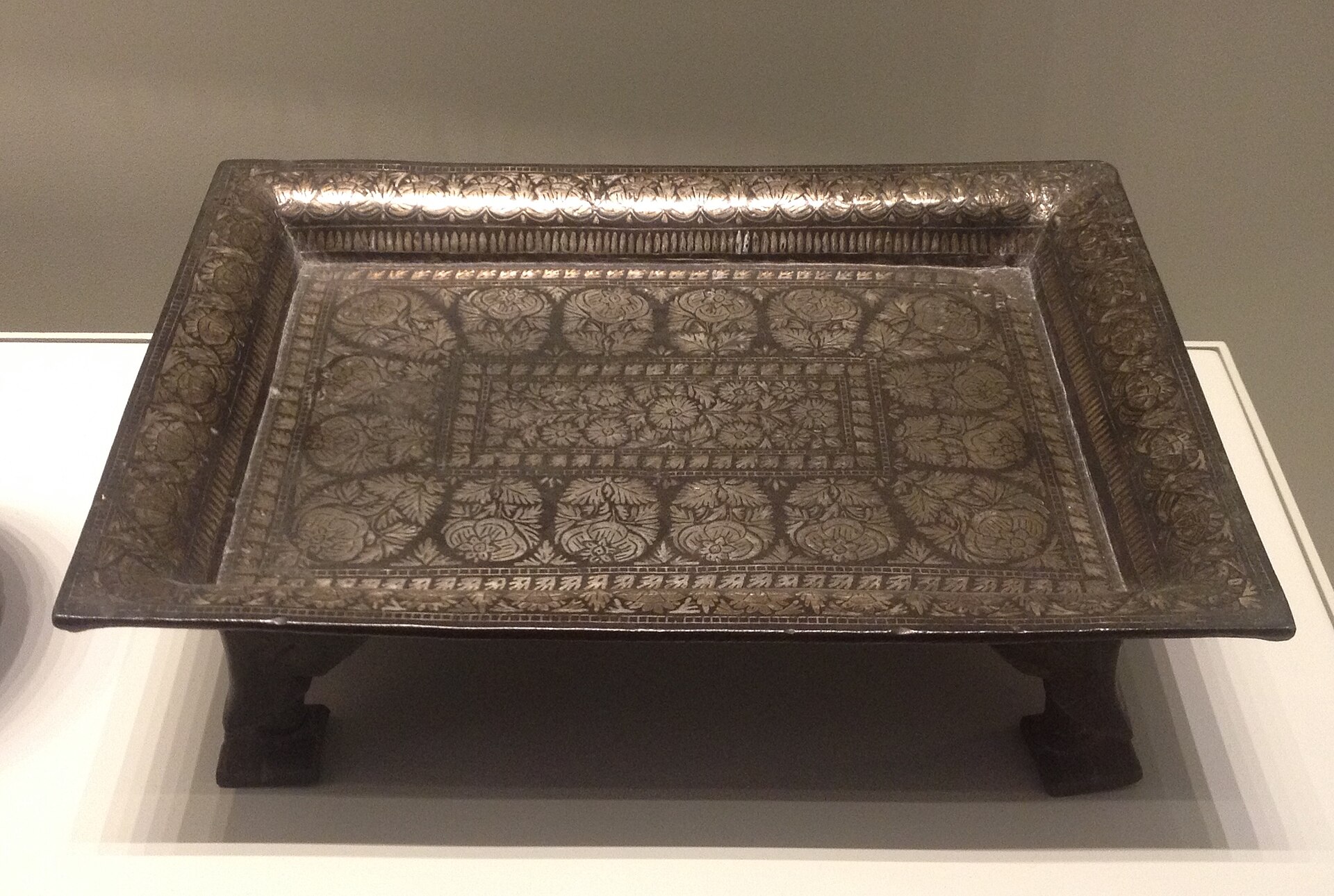
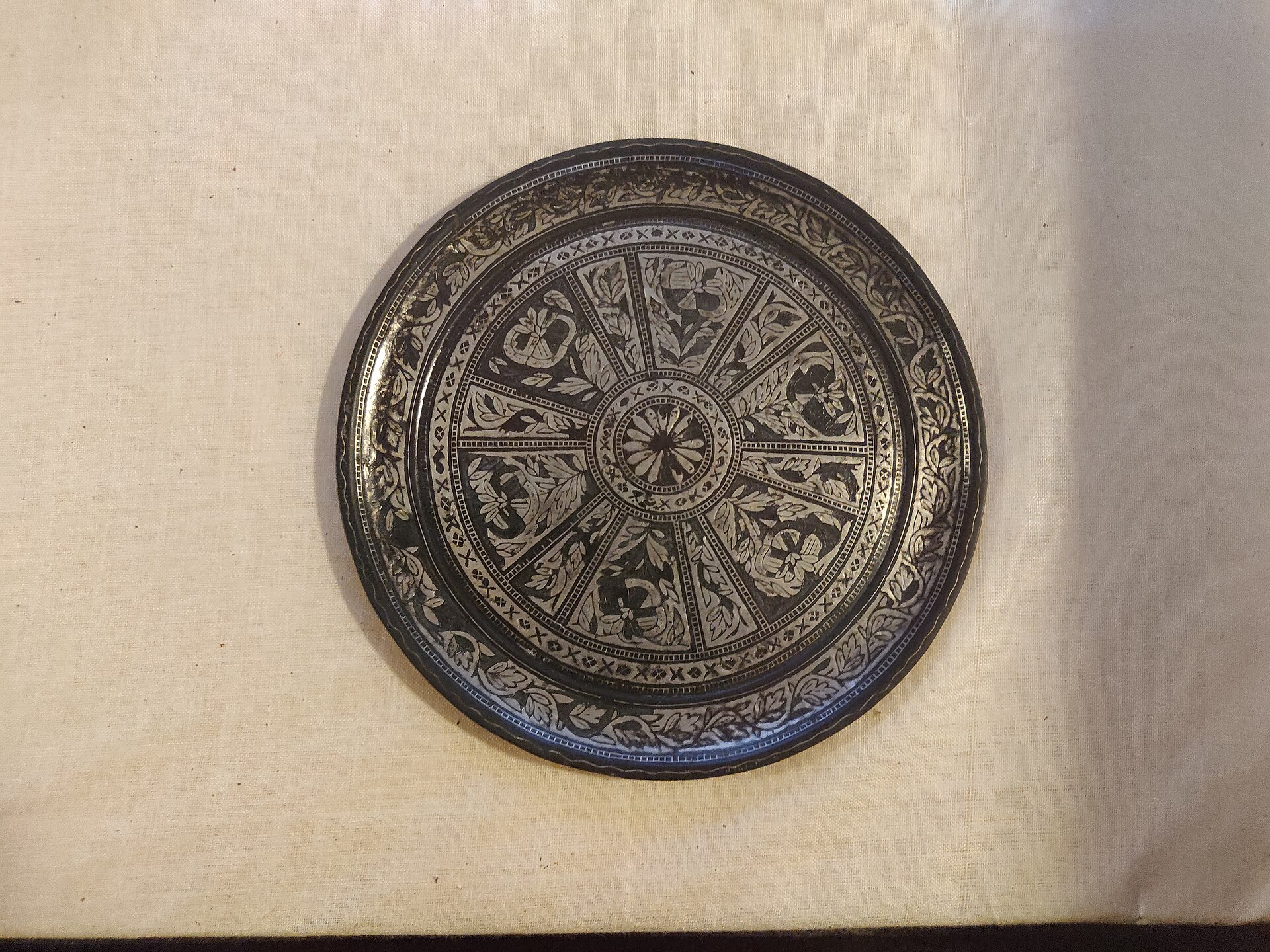
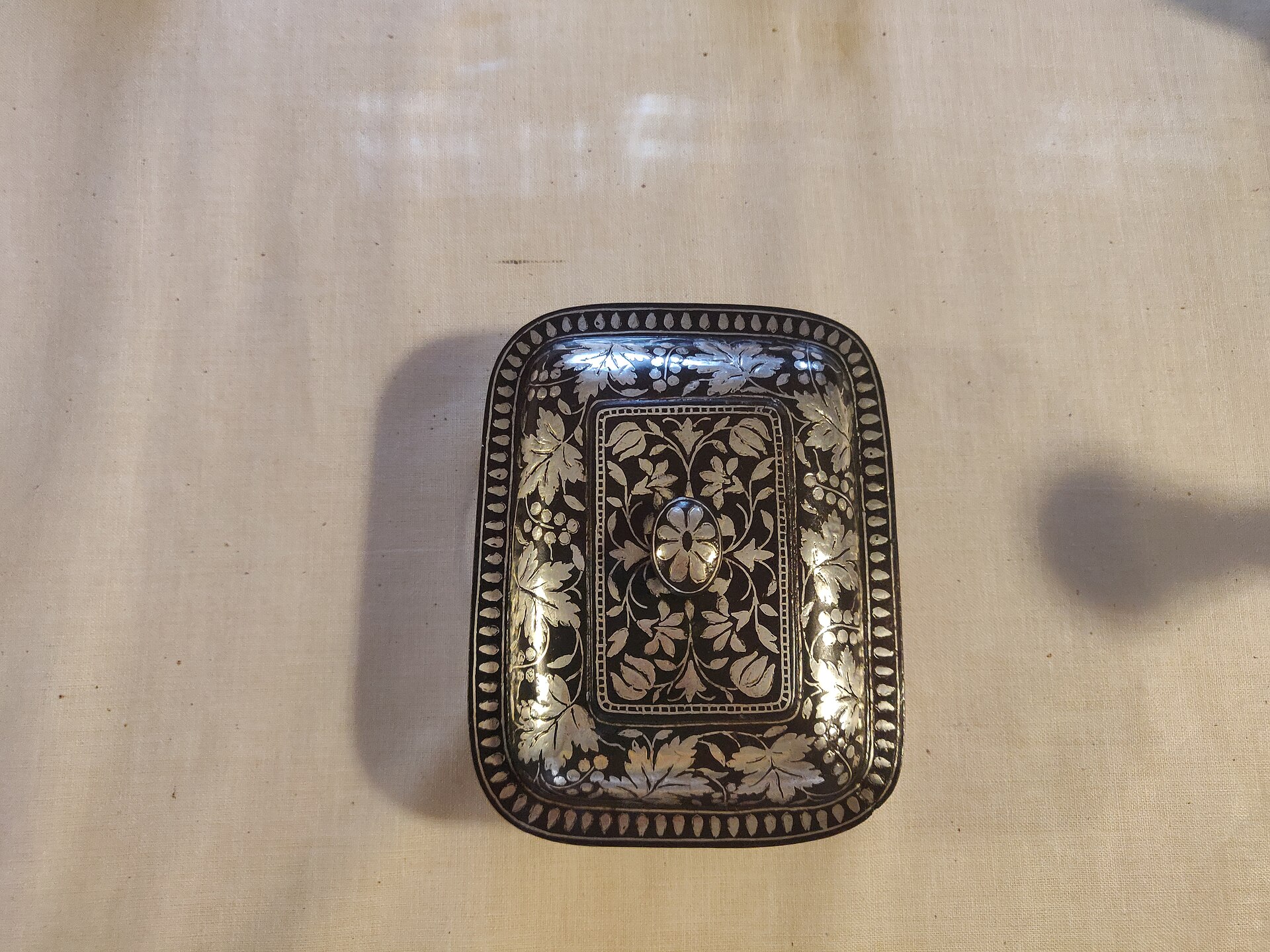
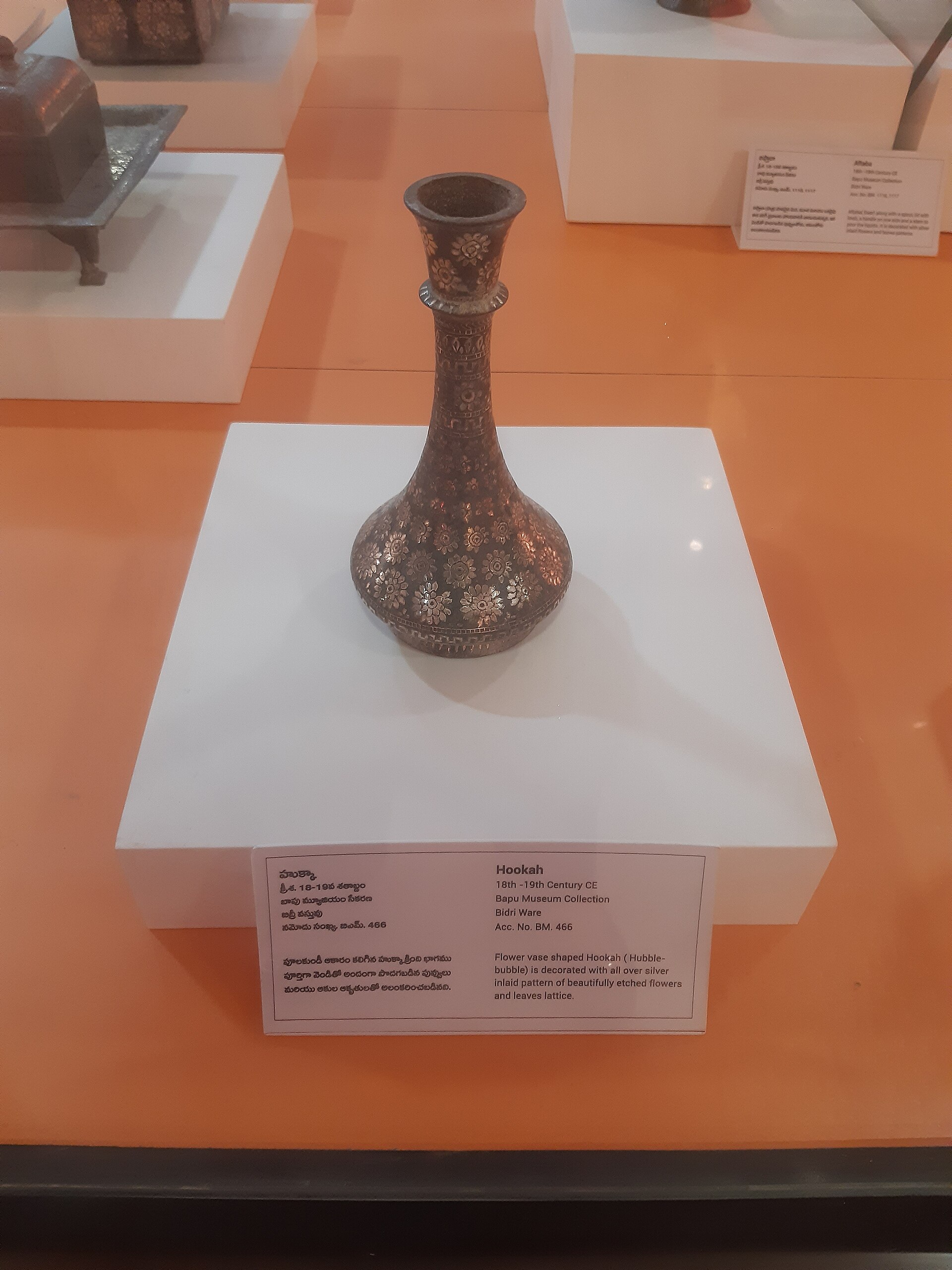
Bidriware is cast metalwork from Bidar in northern Karnataka. The body is an alloy that is mostly zinc, the decoration is silver wire or thin sheet hammered into cut grooves, and the finished piece is blackened with soil taken from Bidar fort. The black forms on the alloy and leaves the silver bright, which gives Bidri its silver patterns on a matt black ground.
Few people still make it. In 2021 a Bidar artisan named Khwaja told The News Minute that only 150 to 160 artisans were left in the community, and the GI register lists 182 authorised users of the Bidriware name. This guide covers how a piece is made, what the GI registration covers, how to check a piece before you buy it, and where to buy one.
What Bidriware is made of
Where the craft began is uncertain. Tradition links it to the Bahmani sultans, who ruled the Deccan from 1347 to 1527, and the Salar Jung Museum in Hyderabad traces its designs to Persian inlay work. Susan La Niece, a scientist at the British Museum, notes that no record of Bidri has been found from before the middle of the 17th century. Bidar has remained the centre of the craft, and the Salar Jung Museum says there are also workshops in Hyderabad today.
The base metal is mostly zinc with a little copper. A Bidar artisan told The News Minute that he uses 60 grams of copper for every kilogram of zinc, which is about 6 per cent. When 27 pieces at the Victoria and Albert Museum were analysed, all held between 2 and 10 per cent copper, most of them between 2 and 5 per cent. The alloy is cast in a mould, filed and polished, and given a temporary dark coat of copper sulphate so the maker can see the design as it is drawn. The design is cut with chisels, silver wire or cut sheet is hammered into the grooves, and the surface is smoothed and polished. Some pieces carry brass inlay as well as silver.
Blackening is the last step. The soil is traditionally dug from beneath the walls of Bidar fort and mixed with ammonium chloride, and the piece is dipped in the solution or coated with it as a paste. The zinc alloy turns black almost at once, while the silver and brass inlay stay bright. The Salar Jung Museum identifies the active agent in the soil as an alkali nitrate, and La Niece found that a solution of potassium nitrate, ammonium chloride and salt works in its place. The black layer is very thin. La Niece measured it at three to ten micrometres, which matters when you come to clean a piece.
The Salar Jung Museum holds nearly 600 pieces of Bidri, among them huqqa bases, surahis, paandans, ewers, basins, trays and boxes. Newer work includes vases, ashtrays, cufflinks and jewellery. The museum names five inlay techniques: tarkashi (silver wire), taihnishan (silver sheet), zarnishan (low relief), zarbulund (high relief) and aftabi (designs cut from an overlaid sheet). Most pieces combine two or more of them.
GI status
Bidriware is GI application No. 20, filed on 24 January 2005 by the Karnataka State Handicrafts Development Corporation (KSHDCL). The certificate of registration is dated 30 January 2006, and after renewal the registration is valid to 23 January 2035. The register gives the geographical area as Karnataka and lists 182 authorised users. The first entries give addresses in Bidri Colony on Mailoor Road in Bidar. Ask a seller whether the maker is one of them.
Checking a piece before you buy
A photograph shows little of how a piece was made, so read the listing as closely as you look at the picture. These checks help separate cast and inlaid Bidri from other black and silver metalwork.
- Read the materials line. A Bidri listing should name a zinc alloy, or zinc and copper, and pure silver inlay. Cauvery and Tribes India name zinc and silver on their listings. If a listing says only "metal" or "oxidised metal", ask the seller what the body is made of.
- Look at where the silver sits. The inlay is hammered into grooves cut in the metal and then polished level with the surface, so under a magnifying glass you should see a clean edge where the silver meets the black. Silver printed or painted on top of the surface has not been inlaid.
- Expect a matt black. The British Museum study describes the patina as matt and puts the colour down to fine particles that absorb light. If the black is glossy, ask the seller how it was finished.
- Check the colour of any worn spot. Under the black, Bidri alloy is a pale grey-white metal. Yellow metal showing at an edge or a chip points to a brass or copper body.
- Do not scratch-test it. The black layer is only a few micrometres thick, so a scratch on a real piece goes through to pale metal and leaves a permanent mark.
- Do not judge by weight. The Salar Jung Museum notes that pieces vary in weight with the alloy, and that the heavier ones contain more lead.
- Compare prices. On 6 October 2026 the smallest pieces from the named sellers in this guide were listed at ₹710 to ₹969, a small box at Cauvery and a pair of cufflinks at Bidri.in. Boxes and small vases ran from about ₹1,200 to ₹3,000, and large vases at Cauvery were listed at over ₹10,000. If a "silver inlay" piece costs far less, ask what the silver is.
Sheet inlay covers more of the surface than wire inlay and uses more silver, and both are traditional techniques. A piece with sparse wire work is still Bidri if the body is the blackened zinc alloy and the silver is set into it.
Where to buy
The most accountable sources lead back to Bidar or to the corporation that holds the GI. Each of them has a drawback, listed here with the seller.
- The workshops in Bidar. Several of the authorised users listed first on the GI register give addresses in Bidri Colony on Mailoor Road, which is the obvious place to start a visit.
- Cauvery Handicrafts, the brand under which KSHDCL, the GI proprietor, sells Karnataka crafts through its showrooms and on cauveryhandicrafts.net. Its listings describe a zinc and copper alloy, pure silver wire and Bidar fort soil. All 34 Bidriware listings on the site showed "Stock: Not Available" on 6 October 2026, so for now the showrooms are the way to buy from it.
- Tribes India, the shop of TRIFED, a national cooperative set up by the Government of India in 1987. Its Bidri listings name Bidar, Karnataka, zinc and silver, and say orders ship within days. The same listings tag every piece "Tribe: Meda" and do not explain it, so the maker cannot be traced from the page.
- Workshops selling direct, such as Sultan Brothers Bidri Works, which runs Bidri.in, names itself as the legal owner in its terms and says its pieces are handcrafted in Bidar. Ask any private seller whether the maker is a registered authorised user.
- iTokri and general marketplaces such as Amazon. Descriptions vary from seller to seller, so look for a named maker or seller, Bidar as the origin, and the alloy and pure silver inlay in the description.
Specific picks
Three pieces, each checked on 6 October 2026 for price, stock and what the listing says. The two Tribes India pieces had one or two in stock, so if one has sold, the same seller's other Bidri listings are the next place to look.
For a first purchase, a small box or a pair of cufflinks lets you look closely at a maker's inlay before you spend more on a vase.
Top pick · Silver inlay box
Tribes India Bidri jewellery box
via Tribes India · Listing states made in Bidar, zinc and silver, pure silver inlay, blackened with Bidar fort soil · About 200 g · Two in stock
Vase · Tarkashi inlay
Tribes India Bidri jug vase
via Tribes India · Listing states made in Bidar, zinc-copper alloy, tarkashi pure silver inlay, blackened with Bidar fort soil · Listed as 300 g in one place and 400 g in another · One in stock
Wearable · Cufflinks
Bidri.in silver inlay cufflinks, men's pair
via Bidri.in (Sultan Brothers Bidri Works) · Listing states pure silver inlay on an oxidised black alloy, handcrafted in Bidar, with an authenticity card · Alloy not named · About 2.5 by 2 cm
Looking after Bidriware
Bidri needs little care. Most damage comes from cleaning it too hard or keeping it somewhere damp.
- Do not use metal polish or silver cleaner. The black is a layer a few micrometres thick, and La Niece notes that working the surface after blackening risks damaging it. Polish wears through it to the pale metal underneath.
- Dust with a soft, dry cloth. Tribes India's listings give the same advice.
- Keep it dry. La Niece reports that storage in damp conditions causes grey-white blistering corrosion that is hard to put right and can lift the inlay. Wipe off any water straight away.
- Oil it now and then. Makers rub finished pieces with vegetable oil to deepen the black, and a Bidar artisan told The News Minute that a rub with coconut oil brings back a piece that has lost its sheen. Use very little.
- Keep it for display. Bidri is sold as decorative ware, and none of the three listings in this guide says it is suitable for food or drink. Do not cook in it or serve food from it.
Kept dry and cleaned gently, the patina protects the alloy from ordinary corrosion. The pieces La Niece and her colleagues analysed at the Victoria and Albert Museum date from the 18th to the 20th century.
The photographs are museum examples of the craft and do not show the listed pieces. Photos via Wikimedia Commons: balajijagadesh (CC BY-SA 3.0); $nowPearl (CC BY 3.0). Product cards link to current listings, checked on 6 October 2026.