Jaipur blue pottery looks like glazed ceramic, and most people assume it is clay thrown on a wheel. Very little of it is clay. The dough is mostly ground quartz with powdered glass, a small amount of fuller's earth (Multani mitti), a plant gum and a soda salt, pressed into plaster moulds and fired once at a low temperature. The recipe recorded by D'Source, a design education resource that documents Indian crafts, is 40 kg of quartz powder, 7 kg of scrap glass and 1 kg each of Multani mitti, katira gond and saaji. Fuller's earth is a clay, so the dough is about 2 per cent clay by weight.
Many sellers, iTokri among them, describe the craft as using no clay at all. The recipes show a little clay used as a binder, in a body that is almost entirely quartz and glass. The difference from ordinary pottery is still large. The dough has so little plasticity that pieces are moulded, and the single low firing leaves them fragile.
The market also carries clay pottery painted or printed in the same cobalt and white and sold as blue pottery for much less. Some of it is pleasant decoration. It is a different object, made a different way. Because the craft is defined by its material, a buyer can check a piece by its weight, by how it takes light, by its painting and by its price. This guide covers what the craft is, how to check a piece, where to buy one and how to look after it.
What blue pottery is
Blue-glazed tile and pottery reached India from Central Asia and Persia. The account in Ceramics Monthly traces the technique to Mongol artisans who combined Chinese glazing with Persian decoration, its arrival in India in the 14th century, and its move from Delhi to Jaipur in the 17th century. Other accounts, summarised in Wikipedia's entry on the craft, place its arrival in Jaipur in the reign of Sawai Ram Singh II (1835 to 1880), who is said to have sent local artisans to Delhi to learn it. The same entry describes the body as a frit material similar to Egyptian faience.
By the 1950s the craft had almost vanished from Jaipur. The painter and muralist Kripal Singh Shekhawat revived it, with the support of Kamaladevi Chattopadhyay and Rajmata Gayatri Devi, and Kripal Kumbh, the studio he founded, still operates.
A piece is built in a mould. The dough is rolled into a flat round, which makers call a chapati, pressed into a plaster of Paris mould and backed with ash so that it takes the shape, then left to dry for a day or two. Feet and bases are added on a wheel. The surface is filled and sanded, coated with a slip of quartz, glass and maida, and painted by hand with metal oxides mixed with gum. Ceramics Monthly lists cobalt for dark blue, copper for turquoise, chromium for green, iron for brown, cadmium for yellow and manganese for purple. The piece is dipped in glaze and fired once, with no separate biscuit firing. D'Source gives the kiln temperature as 800 to 850°C over four to five hours, and the workshop Ceramics Monthly visited fires for eight hours to 1,000°C. In both accounts the kiln then cools for two to three days before it is opened.
The motifs come from Persian and Mughal design. Arabesques, flowers and geometric borders are common, along with birds and animals such as elephants and peacocks. Each piece is painted freehand, so no two match exactly.
Why it is fragile, and what to use it for
Wikipedia's entry notes that firing at a very low temperature makes the pieces fragile and that the range of items is mainly decorative. Every iTokri listing checked for this guide repeats the warning. Buy with these points in mind:
- It suits the forms Jaipur workshops mostly make, which are plates, vases, tiles, coasters, trays, boxes, door knobs and wall hooks.
- No published test of lead or cadmium release from finished Jaipur pieces turned up in the research for this guide. The glaze recipes recorded by D'Source and Ceramics Monthly are powdered glass, borax, zinc oxide, potassium nitrate and boric acid, with no lead compound listed. Wikipedia's entry says older glazes contained lead and that production has moved to lead-free glazes, but it gives no source for this, and Ceramics Monthly lists cadmium and chromium among the colouring oxides. This guide makes no claim that any piece is safe for food. Use blue pottery for display, and ask the seller in writing before serving food in it.
- iTokri's care notes for its plates say to wipe them with a clean dry cloth and keep them away from water, perfumes and sprays. None of the listings mentions a dishwasher or a microwave, and this guide would use neither.
- A knock that a stoneware mug would survive can chip a piece. Handle it the way you would handle glass.
How to tell a real piece from a copy
No single check settles it, and the strongest evidence is the material. Avyaan, a seller of blue pottery, publishes the checks below, and they agree with how the craft is made:
- Weight. A quartz-body piece is lighter than a clay piece of the same size, and clay copies feel denser and heavier. iTokri's listings give weights to compare against, about 360 grams for a 20 cm plate and 150 grams for a 10.5 cm bowl.
- Light. Held up to strong light, a real plate lets a little light through the body, according to Avyaan. A clay copy is completely opaque.
- Painting. Every element is painted by hand, so lines vary in thickness and no two pieces in a set are identical. Printed decoration repeats exactly from piece to piece.
- Surface. A moulded, hand-finished piece is slightly uneven in thickness and shape. A perfectly uniform, machine-smooth form points to factory ceramic.
- Price. Avyaan puts the minimum for a medium plate of 10 to 12 inches at ₹600 to ₹1,000, and says a piece offered at ₹150 to ₹200 is machine-made on a clay body. On iTokri on 6 October 2026, a set of six coasters cost ₹590, a 4-inch bowl ₹690 and an 8-inch wall plate ₹1,450.
GI status
Blue Pottery of Jaipur is a registered geographical indication, application No. 66, entered in the registration year April 2008 to March 2009, according to the GI registry's list of registered indications. A logo for it was registered separately in 2016 to 2017 under application No. 540. The registration protects the name, and it is fair to ask a seller whether their work is covered by it.
Where to buy it
Buy from sellers who source from Jaipur workshops and can tell you what a piece is made of.
- iTokri, a craft store based in Gwalior, lists a large range of blue pottery from a supplier it names as Rajasthan Blue Pottery, including plates, bowls, coasters, vases and wall hooks, each with its size and weight.
- Jaipur studios sell direct. Kripal Kumbh, Kripal Singh Shekhawat's studio, still operates, and Neerja International sells its Jaipur blue pottery through its own website, priced in US dollars. The craft is also practised in Sanganer, Mahalan and Neota.
- Rajasthali, the Rajasthan government's handicraft emporium in Jaipur, sells blue pottery in person.
- Amazon India carries many listings under the name. Quality varies widely, and the words blue pottery in a title tell you nothing about the body, so apply the weight and light checks when a piece arrives.
Specific picks
Three pieces, each checked on 6 October 2026 for price, stock and what the listing says. All three come from the same supplier on iTokri and only one to three of each were in stock, so if one has gone, the same supplier's other pieces are the next place to look.
Top pick · Wall plate
Blue pottery plate and wall frame, 8 inch
via iTokri · Supplier named as Rajasthan Blue Pottery · 20 × 20 cm, about 360 g, with a hole at the back for hanging · Listing describes the quartz and glass dough and the low firing · Wipe with a dry cloth
Everyday · Set
Blue pottery coasters, set of six
via iTokri · Supplier named as Rajasthan Blue Pottery · 9 × 9 cm tiles on a velvet-paper backing, about 350 g for the set · Multicolour · Wipe with a clean wet cloth
Affordable · Wall hook
Blue pottery tile wall hook, one peg
via iTokri · Supplier named as Rajasthan Blue Pottery · 14 × 7 cm tile with an iron peg, about 80 g, wall-mount hook on the back · Blue
Looking after blue pottery
Handle it the way you would handle glass. The low-fired body chips when it is knocked, so give a piece a stable place and lift it with both hands.
For cleaning, iTokri's listings say to wipe plates with a clean dry cloth and coasters with a clean wet one, and to keep pieces away from perfumes, sprays and standing water. Empty and dry a vase after the flowers come out.
Keep pieces out of the dishwasher, the microwave and the oven. None of the sellers checked for this guide gives instructions for using blue pottery in any of them.
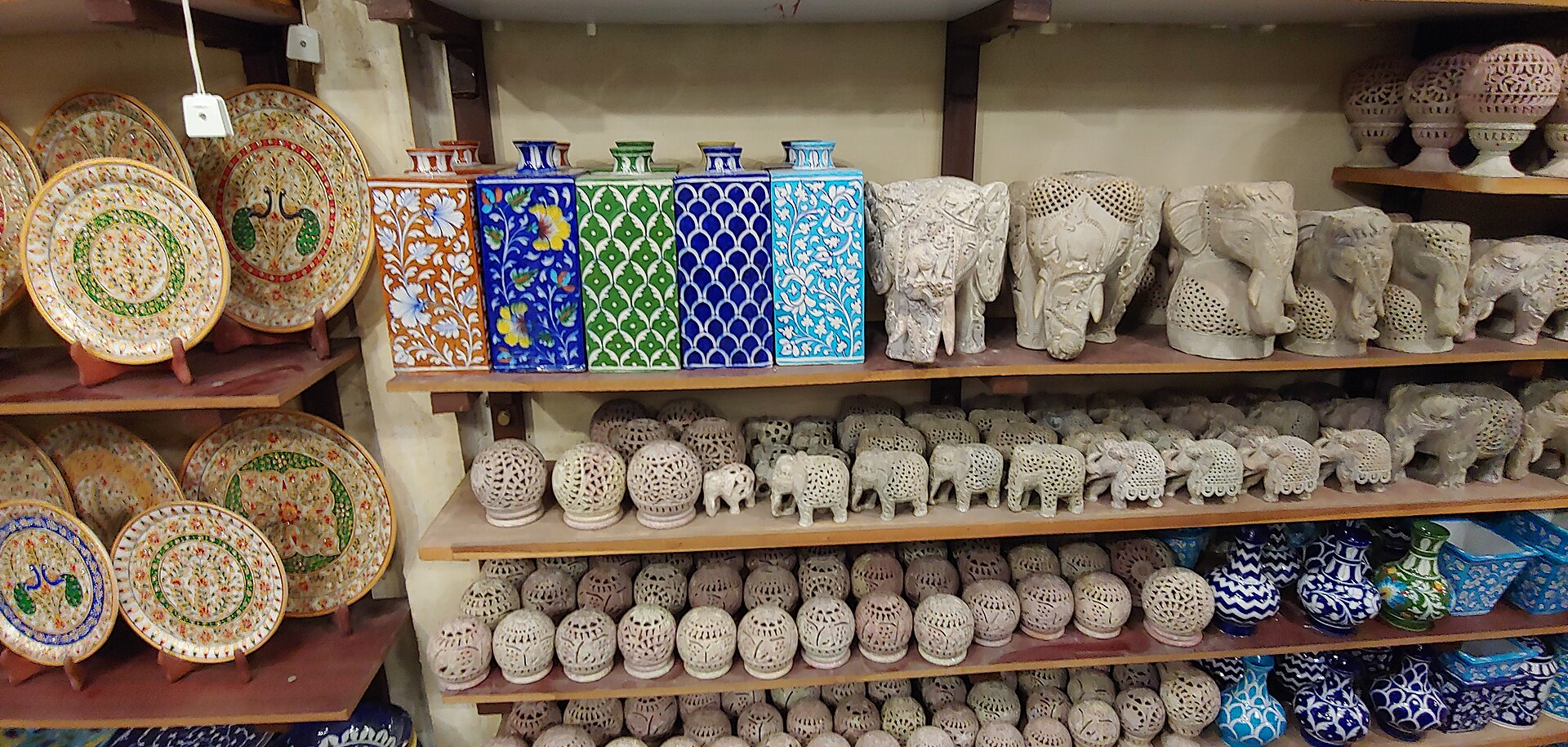
The hero photograph shows pieces of the craft and is not one of the listings. Product cards link to current listings, checked on 6 October 2026. Photo via Wikimedia Commons: Atcelsius / Wikimedia Commons (CC BY-SA 4.0).