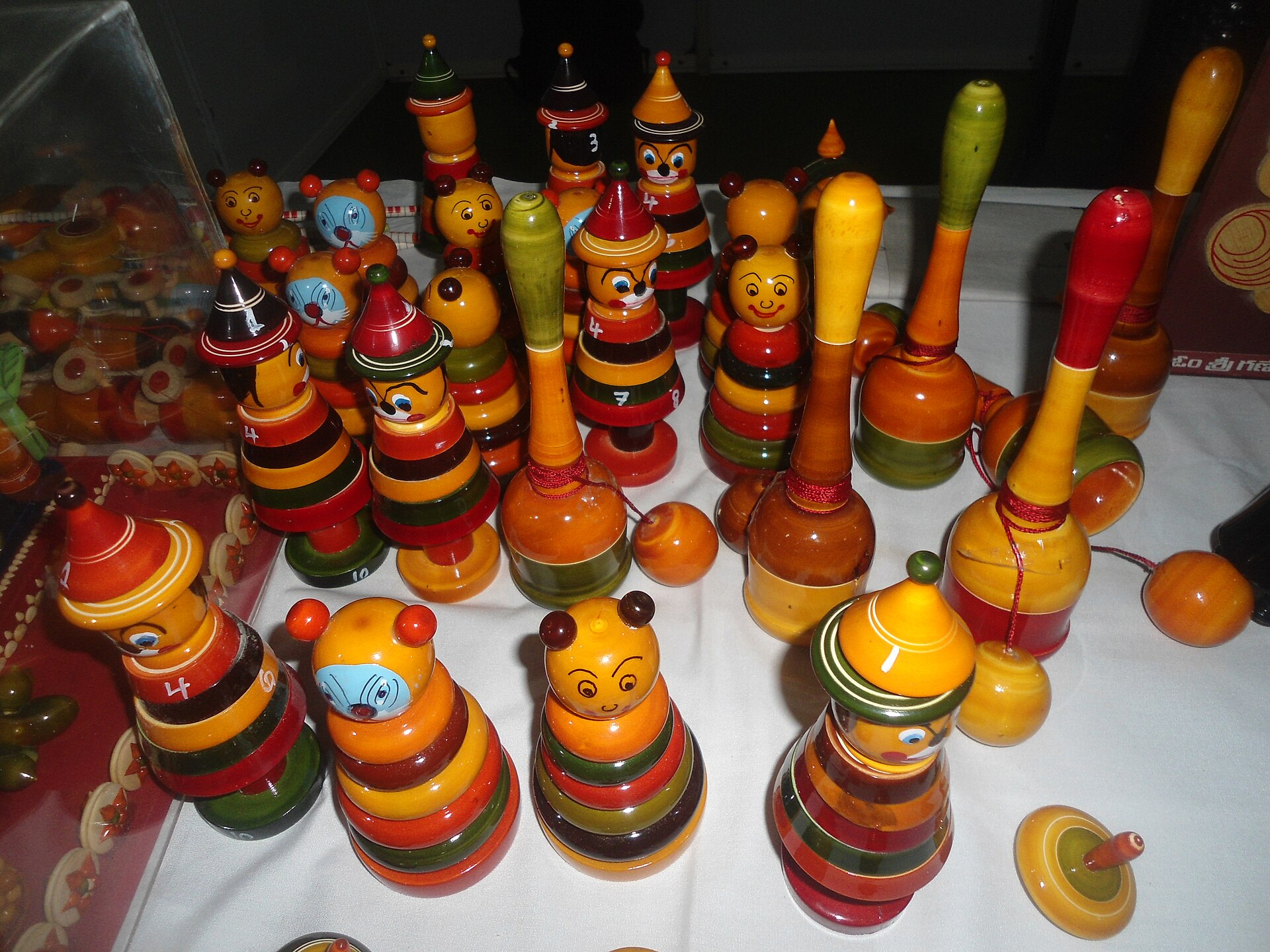
Etikoppaka is a village on the Varaha river in Anakapalli district, Andhra Pradesh, about 800 kilometres in a straight line from Channapatna, Karnataka's better-known toy town. Its artisans turn soft wood on a lathe and colour it with lac, making spinning tops, rattles, boxes, figurines and small sets of dolls. The toys hold a Geographical Indication, and much of their reputation rests on the claim that they are coloured with natural dyes. This guide sets out what is documented about that claim, what a buyer can check, and where to buy from an accountable seller.
What an Etikoppaka toy is made of
The wood is Ankudu (Wrightia tinctoria), which WIPO's magazine describes as a soft ivory wood. The National Innovation Foundation (NIF), which documented the craft in 2002, calls it the wood most suitable for making toys. The colour is carried in lac. In NIF's account, lac pellets are heated slowly over an open oven and the dye is worked into the melted lac until it reaches the shade wanted. The coloured lac is stretched, cooled and cut into sticks, and the artisan presses a stick against the toy while it spins on the lathe. Dried leaves of mogali (Morinda citrifolia) are used for the final polish.
The dyes have not always been natural. According to C. V. Raju and older artisans quoted by NIF, the colours before 1910 came from the divi-divi tree (Caesalpinia coriaria), which gave only shades of red. Synthetic dyes arrived after 1910, and the artisans used them from then on. When some buyers rejected toys over the lead content of the synthetic dyes, Raju, an agriculture graduate from a landowning family in the village, began experimenting with plant dyes that could be mixed with lac, and he set up a cooperative of artisans, Padmavati Associates. NIF records that the Crafts Council of India had his dyes tested and that "most of these dyes proved to be lead-free". Raju was named among the Padma Shri awardees for 2023 for this work.
The plant sources vary by colour. NIF gives the seeds of Bixa orellana as the source of red and orange. The craft archive Gaatha lists turmeric and annatto seeds for yellow and indigo for blue. The WIPO article describes the dyes as coming from seeds, resin, bark, roots and leaves.
Sellers and government bodies describe the toys as safe for children because of these dyes. The Department of Science and Technology's note on Raju's award says the toys are "made using natural dye colours. This makes them safe, even for kids." That is a general statement about the dyes, made in a press note. We found no published test of toys currently on sale, and the next section explains why a buyer cannot assume that every toy sold under the name uses natural dyes.
The range is domestic. The WIPO article lists spinning tops, rattles, decorative boxes and figurines, and says the toys are given as gifts at birthdays and weddings and displayed during Bommala Koluvu, the doll festival. Lepakshi's online catalogue adds counting dolls, sets of musicians, bridal sets, figures of Krishna, toy scooters and pen holders. WIPO notes the toys' rounded edges. Small pieces can still be a choking risk, so check the sizes on a listing before giving one to a child who puts things in their mouth.
The GI status and why it matters
GI status
Etikoppaka Toys is GI application No. 482, filed on 1 May 2014 by the Andhra Pradesh Handicrafts Development Corporation, the state undertaking that sells as Lepakshi. It was published in GI Journal No. 97 on 22 June 2017 and registered with certificate No. 299, dated 24 October 2017. The registration was renewed in December 2023 and is valid to 30 April 2034. On 6 October 2026 the registry listed one authorised user, the Hyderabad regional office of TRIFED, the federation behind Tribes India.
A GI protects the name. It tells a buyer that a toy sold as Etikoppaka should come from the registered area and makers. It says nothing about which dyes a given toy was coloured with. Two facts make that matter.
In July 2023 the Deccan Chronicle reported that Raju had said in an interview that some artisans in Etikoppaka were using artificial colours containing lead and cadmium, and enamel paints containing barium. Other toymakers objected, and a toy factory owner told the paper, "We use natural dyes as well as artificial colours. Natural dye toys are a bit costly." Both kinds of toy are made in the village.
In December 2020 the commerce ministry announced an amendment to the Toys (Quality Control) Order that exempts toys made and sold by the registered proprietor and authorised users of a GI from the Indian toy standards and from the compulsory BIS Standard Mark. A GI-tagged Etikoppaka toy from Lepakshi need not carry the Standard Mark, and the safety statements on its listing are the seller's own.
Natural dye or synthetic colour
Most of the home tests for natural dyes that circulate online, such as smelling the toy or rubbing it with a damp cloth, have no published basis that we could find, so we have left them out. These checks rest on a source or on the listing itself.
- Look at the colour. In NIF's account, natural dyes mixed with lac give a transparent colour with better lustre, while synthetic colours have to be mixed with titanium dioxide, which NIF suggests is what dulls them. The same account says the natural dyes give a wide range of shades except white and pink. Gaatha's list does include a pink, from a source it calls chavalakundi, so treat a flat, opaque colour as a reason to ask questions. It proves nothing on its own.
- Read the listing. Lepakshi's listings state natural vegetable dyes, and some add "non-toxic, safe for children". These are the seller's statements. None of the listings we read cited a test.
- Ask what the colours are made from. A seller who can name the source of each colour has at least thought about it. A seller who can only say "all natural" has told you nothing you can check.
- Buy from the registered names. The GI proprietor, which sells as Lepakshi, and its authorised user TRIFED are the two sellers the registration makes answerable for the name.
- Expect small variations. Lepakshi's listings say that each piece is turned and coloured by hand, so colour, finish and detail vary a little between pieces.
Where to buy and what it costs
Lepakshi, the GI proprietor, sells Etikoppaka toys online and listed 48 items in its Etikoppaka category on 6 October 2026. On the first page of that category, prices ran from ₹378 for the Rollu Rokali to ₹4,967 for a sari set, with counting dolls at ₹420 and bridal sets from ₹840 to ₹1,785.
Two other craft sellers, Tribes India and iTokri, had no Etikoppaka toys when we searched their sites on 6 October 2026. Marketplaces such as Amazon carry many listings under the name. If you buy there, apply the checks above and look for the maker's name and the village or district on the listing. Buying in Etikoppaka itself lets you watch the lathes at work, though the Deccan Chronicle report shows that shops there sell toys coloured both ways, so the same questions apply.
For a first purchase, buy one small piece from Lepakshi, look at its colour in daylight against the checks above, and use it as a reference for anything you buy later.
Specific picks
Three pieces, each checked on 6 October 2026 for price, stock and what the listing claims. All three come from Lepakshi, because the other sellers we checked had nothing under the name.
For a child, the counting dolls are the obvious place to start, since the listing describes them as a children's toy and states the dyes. The Sannai set, a procession of six musicians, is a display piece. The Rollu Rokali is the cheapest way to see the colour and finish in hand.
Top pick · Counting dolls
Lepakshi Etikoppaka Joker Counting Dolls
via Lepakshi (APHDC) · Lathe-turned, 2 × 2 × 8 in, 150 g · Listing states 100% natural lac and vegetable dyes and "non-toxic, safe for children"; no test cited · In stock
Display piece · Sannai set
Lepakshi Etikoppaka Sannai Set, 6 dolls
via Lepakshi (APHDC) · Six figures of a musical procession, 14 × 7 × 6 in · Listing states Ankudu wood, natural vegetable dyes and the Etikoppaka GI · Sold as decor · In stock
Starter · Small toy
Lepakshi Etikoppaka Rollu Rokali
via Lepakshi (APHDC) · 4 × 2.5 × 6.5 in, 100 g · Description names Etikoppaka village and natural lac and vegetable dyes; the specifications list it as decorative and give the origin only as Andhra Pradesh · In stock
Looking after them
Lepakshi's listings give no care instructions, and we found none published by the makers, so this is general advice for a lac finish.
- Keep them dry. Wipe them with a dry or barely damp cloth. Do not soak them or put them in a dishwasher.
- Keep them away from heat. Lac is applied by heating it until it flows, so keep the toys away from stoves, radiators and hot windowsills.
- Buff a dull piece with a soft, dry cloth.
- Store sets together. Keep counting dolls stacked and small pieces in a cloth bag so they do not knock against harder objects.
The hero image is a representative photograph of the craft from Wikimedia Commons. Product cards link to current listings, checked on 6 October 2026.