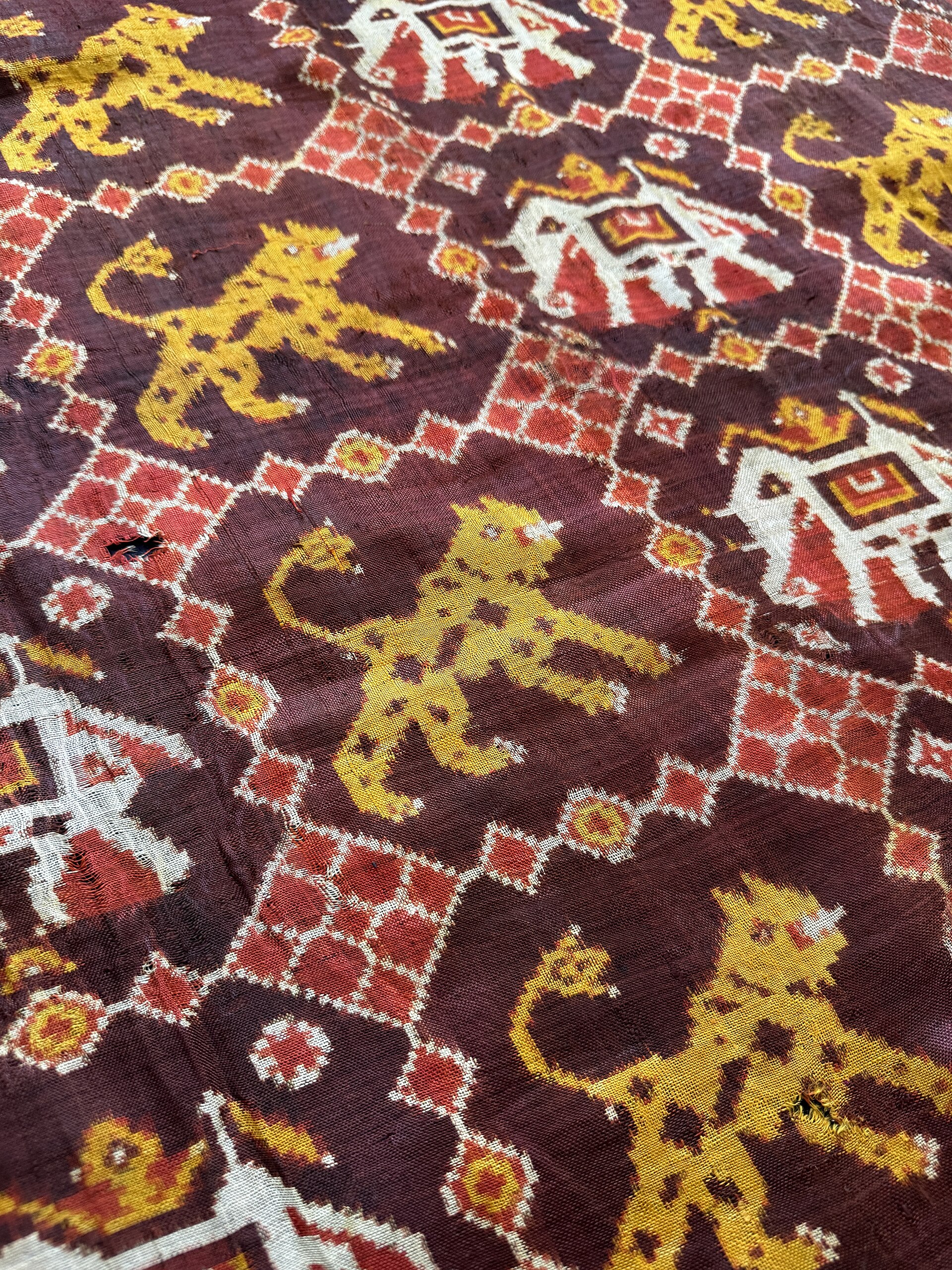
A Patan patola is a silk sari with its pattern dyed into the thread before the cloth exists. Both the lengthwise threads (the warp) and the crosswise threads (the weft) are tied and dyed to the design, then lined up on the loom so each motif forms where they cross. Cloth made this way is called double ikat. Patan, in north Gujarat, holds the Geographical Indication for it, and the weavers belong to the Salvi community.
It is among the most expensive handwoven textiles in India. Published prices for a real Patan sari run from about ₹80,000 to several lakh, and a single-ikat sari from Rajkot sold under the same word costs roughly ₹8,000 to ₹40,000. This guide covers how the cloth is made, how to check a piece, who weaves it and how to reach them.
What a Patan patola is
The work starts with a design mapped onto a grid, which serves as an instruction sheet for the yarn. The warp and the weft each need their own plan, so the design is worked out twice. Bundles of thread are tied with resist material at the intervals the design calls for, then dipped in a dye bath. Every colour needs its own bath, and the threads are retied between baths to protect the colours already laid down. A five-colour warp therefore needs five dyeing stages, and the weft needs the same number.
Weaving happens on a hand-operated harness loom of bamboo and rosewood, set at a slant. Before each pass of the shuttle the weaver checks that the dyed weft sits against the dyed warp, and a misalignment cannot be corrected afterwards. The silk is mulberry silk, which a Salvi weaver told Gulf News is imported from China. Robb Report India lists the dyes as indigo, cochineal, madder root, pomegranate skin, marigold and turmeric. The same Gulf News profile says weavers elsewhere who copied the technique use chemical dyes.
Published time estimates vary with the design and with whether dyeing counts. The Print gives three to six months per six-yard sari, two weavers finishing 8 to 9 inches a day. Robb Report India says two weavers need six months to a year. SilverKris, in October 2025, says four weavers may work six months or more on one sari.
How to tell a real one from a copy
GI tag status
Patan Patola is registered under the Geographical Indications of Goods Act, application number 232, filed on 9 March 2011 by the Patan Double Ikat Patola Weavers Association, with certificate No. 195 dated 9 September 2013, shown on the registry as valid to 8 March 2031. The registered goods are handicrafts in classes 24 and 25, for the area of Gujarat. Robb Report India notes that the tag protects the name and does not oblige anyone to keep weaving.
- Look at the back. The defining feature of double ikat is a design with equal intensity of colour on both sides. Single ikat dyes only one set of threads.
- Study the edges. Rahul Salvi, profiled by Gulf News in 2019, said each square and line has to be perfect with no hazy edges. Robb Report India describes slightly feathered motif edges, from alignment by hand, as a sign of authenticity. No source gives a measurable threshold, so compare two pieces side by side before buying.
- Weigh it. A full-length sari weighs close to 450 grams. Salvi said anything above 500 grams is fake. That figure is one weaver's rule, and a seller should be able to show the weight.
- Ask the price. SilverKris puts a real Patan patola at ₹1,50,000 to ₹6,00,000 depending on the design. Robb Report India gives about ₹80,000 to ₹3,00,000 or more, and the Salvis told ANI in 2022 that a genuine sari starts at ₹1.5 lakh and reaches about ₹6 lakh. The sources disagree, but all of them sit far above the price of a Rajkot sari or a digital print.
- Ask who wove it. The cloth comes from Salvi families in Patan. A seller should be able to name the family and the workshop.
Who weaves it, and since when
The founding story is a legend. King Kumarpal of the Solanki dynasty, ruling from Patan in the 12th century, is said to have brought about 700 patola-weaving families from Jalna, in present-day Maharashtra, to the city. Most of those families moved into other trades. Robb Report India says the Salvi family kept the full double-ikat technique, and the craft has been dated variously to the 10th, 11th and 12th centuries in different accounts.
Reports disagree on how many families still weave. Gulf News in 2019 named two men. Curious Indian says fewer than five families, and SilverKris in October 2025 says three. Robb Report India says one. The shared point is that the number is very small, and that the craft is not licensed and, as Robb Report India describes the Salvi family, not taught beyond the family.
The cloth travelled. SilverKris quotes the textile collector Dr Preeti Mehta saying that in Bali patolas were draped on temple walls and used as burial shrouds, and reports that in Thailand, Malaysia and Indonesia they were considered sacred power cloths.
Where to buy
The most direct route is Patan itself. The Salvi family runs the Patan Patola Heritage Museum, open 10am to 6pm, with a loom demonstration of the family's double-ikat weaving. Patan is about 125 km from Ahmedabad airport, and an intercity bus from Ahmedabad takes around three and a half hours. Rani ki Vav, the 11th-century stepwell, is in the same town, and the motifs on many saris echo its stone panels.
Online, the word patola returns a large and mixed set. iTokri's search for it returned 1,002 results on 26 October 2026. A listing deserves attention only if it says Patan, says double ikat, names the maker and gives a weight. Several Salvi workshops sell directly through their own sites and showrooms. Check any listing against the questions above.
Patola by Nirmal Salvi sells online with prices and says its sarees are GI-tagged (read on 26 October 2026). The registry's list of authorised users for application 232 includes a Nirmal Ashokbhai Salvi of Salviwado, Patan, as entry 4. We matched the name only and cannot confirm that the shop is run by that person. Two dupattas show what the labels mean in rupees. The double ikat piece costs ₹33,975 after the shop's 10 per cent discount, and the single ikat piece ₹3,600. The titles say which is which. Neither listing gives a weight, which the checks above ask for, so request one before you order.
Top Pick · Double ikat
Double ikat Patan Patola Dupatta
via Patola by Nirmal Salvi · Double ikat silk · Listed at ₹37,750, shown at 10 per cent off · No size or weight on the listing · Dispatch in 2 to 3 business days
Budget · Single ikat
Single ikat Patola Dupatta
via Patola by Nirmal Salvi · Single ikat silk, not double ikat · Listed at ₹4,000, shown at 10 per cent off · No size or weight on the listing · One piece in stock
Care and what to expect
Colour sits inside the thread. Rahul Salvi told Gulf News that a Patan patola may tear over time but will not lose its colour. The same report says a Patan patola can be washed by hand, while chemically dyed saris must be dry cleaned.
Supply is small. A single piece takes months to make, so a seller with several in stock at modest prices has questions to answer.
Hero image is a representative photo via Wikimedia Commons.