Pattachitra takes its name from Sanskrit, where patta means cloth and chitra means painting. In Odisha the word covers paintings on a prepared cloth base, built up in mineral and vegetable colours, together with the related etchings on palm leaf. A painting done this way takes days of work before the first line goes down. A printed copy can look much the same in a photograph, so this guide sets out how the real thing is made, what the GI registration covers and what to check before you pay.
What Pattachitra is
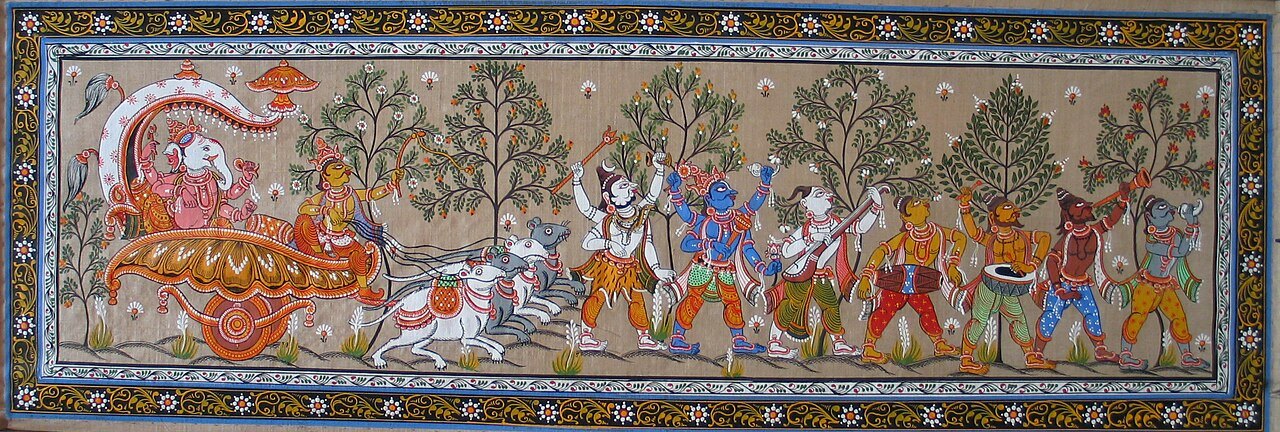
The tradition grew up around the Jagannath temple at Puri. Its usual subjects are Jagannath and the Vaishnava stories around him, the Dashavatara and episodes from the Ramayana and the Mahabharata. The Government of Odisha's description notes that painters complete the borders of a painting first, so a decorated border is part of the form.
The base is prepared before any painting starts. In the account of the poet Shanta Acharya, quoted in the journal Global InCH (2020), tamarind seeds are soaked, ground and cooked into a glue that sticks two layers of cloth together, cotton or tussar. The surface is then coated with a fine stone or chalk powder, dried in the sun, cut and polished with a stone and then a smooth pebble or piece of wood, and she writes that the canvas takes five days. Painters draw straight onto it with the brush, in light red or yellow, without a pencil sketch. The flat colours go in next and fine black lines finish the work. The colours come from hingula (cinnabar red), haritala (yellow stone), lamp soot for black, conch shell for white and indigo for blue. Brushes are made from keya root, and the finest are mouse hair set in a carved wooden handle. At the end the painting is held over a charcoal fire and coated with lacquer, which the Odisha government's description says makes it water resistant and gives it its shine.
Cotton is the older base. The Global InCH article dates the wider use of tussar silk in place of burnished cotton to the early 1980s. In Acharya's account both bases are glued and prepared in the same way, so the choice between them comes down to the look you prefer.
Why Raghurajpur is the name to know
Raghurajpur is a village 14 km from Puri that Odisha Tourism describes as India's first heritage crafts village, where almost every household works at some traditional art. The Global InCH article names Puri, Raghurajpur and Bhubaneswar as the main clusters of painters. A piece that comes with the painter's name and village can be traced. A listing that says only "Odisha handicraft" cannot.
Raghurajpur is also the birthplace of the Odissi dancer Kelucharan Mohapatra and of the Gotipua dancer Maguni Charan Das, and the village still performs Gotipua. Its craftspeople also make palm-leaf etchings (tala pattachitra), stone carving, wooden toys and masks.
GI status
Orissa Pattachitra is GI application No. 88, filed on 9 April 2007 and registered on 10 July 2008 under certificate No. 70. The registry names the applicant as the Orissa State Co-operative Corporation Limited of Rasulgarh, Bhubaneswar, and shows the registration valid to 8 April 2027. It lists 25 authorised users, several of them painters at Raghurajpur, and the public search at search.ipindia.gov.in shows their names. A separate GI, Bengal Patachitra (application No. 564, registered in 2018), covers the scroll painting of West Bengal and was applied for by Chitrataru of Naya village in Paschim Medinipur. The two are different traditions. This guide is about the Odisha one.
Telling a painted scroll from a print
A listing photograph cannot show whether a piece was painted or printed. These checks work once the piece is in your hands, or on a video call with the seller:
- Turn it over. A cotton patta is two layers of cloth glued together and coated, so the back is stiff and often uneven. A print on thin fabric or paper is flat and uniform on the reverse.
- Look at the linework under a magnifier. Brushed lines vary in thickness and stop and start by hand. A printed line breaks up into a regular pattern of dots.
- Compare repeated motifs. Flowers, leaves and figures painted by hand differ slightly from one to the next. A print repeats them exactly.
- Check the price against the work. The base alone takes days to prepare. The hand-painted pieces checked for this guide cost ₹3,000 to ₹6,000 for small and medium sizes in October 2026, so a large "hand-painted" scroll for a few hundred rupees deserves a second look.
- Ask about the colours. Some painters still grind stone and shell colours, and some use bought paints. The MeMeraki listing for a Jagannath triad by Pravat Maharana gives the medium as fabric colours, while its listing for Purusottam Swain's work gives natural colours. Both are hand-painted. A seller should be able to tell you which you are buying.
Where to buy
There are three sensible routes, in rough order of how much you learn about the painter:
- Direct from Raghurajpur painters. Odisha Tourism's page on the village says visitors can watch artists at work and buy from them directly. Buying this way gives you the name and village with the piece.
- Government channels. Tribes India lists hand-painted Pattachitra on tussar silk from its Odisha store. The listing checked for this guide gives the base and the region and does not name the painter.
- Art sites that name the artist. MeMeraki puts the painter's name in its Pattachitra listing titles and gives the medium and size, and most pieces are made to order. On open marketplaces, look for the words "hand-painted", a named painter and a stated base, and be wary of anything described only as "Pattachitra style".
iTokri's Pattachitra listings checked on 6 October 2026 were paintings on handmade paper, painted wooden trays, rakhis and painted steel kitchenware, with no cloth scrolls. For a first buy, a small or medium piece by a named painter gives you the technique at a modest price. Save the large narrative scrolls for when you have seen more of a painter's work.
Specific picks
Three listings, each checked on 6 October 2026. Two name the painter and their village, and one gives the base and the region of origin.
The top pick is a medium-sized painting by a named Raghurajpur painter whose listing states natural colours. The tussar-silk piece from Tribes India is the cheapest cloth painting here. The palm-leaf etching is the related Raghurajpur craft, etched with a stylus and filled with black, and it costs less than the paintings.
Caring for a scroll
A painting on a glued, lacquered cloth base needs simple care:
- Hang it out of direct sunlight. Framing under glass keeps dust off the surface.
- Store it flat or rolled loosely. The coated base is stiff, so if you have to roll it, roll it loosely with the painted side out and a sheet of soft paper against the paint.
- Keep it dry. A dry, ventilated wall or cupboard is better than a damp one.
- Dust it dry. Tribes India's care note for its tussar pieces says to remove surface dust with a dry soft cloth. Do not use water or cleaners.
- Keep the paperwork. Store the painter's name and village with the piece. MeMeraki says it emails a certificate signed by the artist a few days after delivery.
Top pick · Named Raghurajpur painter
Panchmukhi Ganesha by Purusottam Swain
via MeMeraki · Painter named on the listing, from Raghurajpur · Listing gives the medium as natural colours and the size as 19 by 13 in · Made to order, frame not included
Tussar silk · Government store
Hand-painted Pattachitra on tussar silk, unframed
via Tribes India · Sold by its Odisha store · Listing states hand-painted on pure tussar silk · Painter and size not stated on the listing
Palm leaf · Raghurajpur
Talapatra palm-leaf etching by Apindra Swain
via MeMeraki · Raghurajpur artist named on the listing · Strips of palm leaf etched with an iron stylus, filled with black and stitched together so the piece folds · 13 by 13 in · Made to order
The hero photograph is a representative piece. Product cards link to current listings, checked on 6 October 2026.