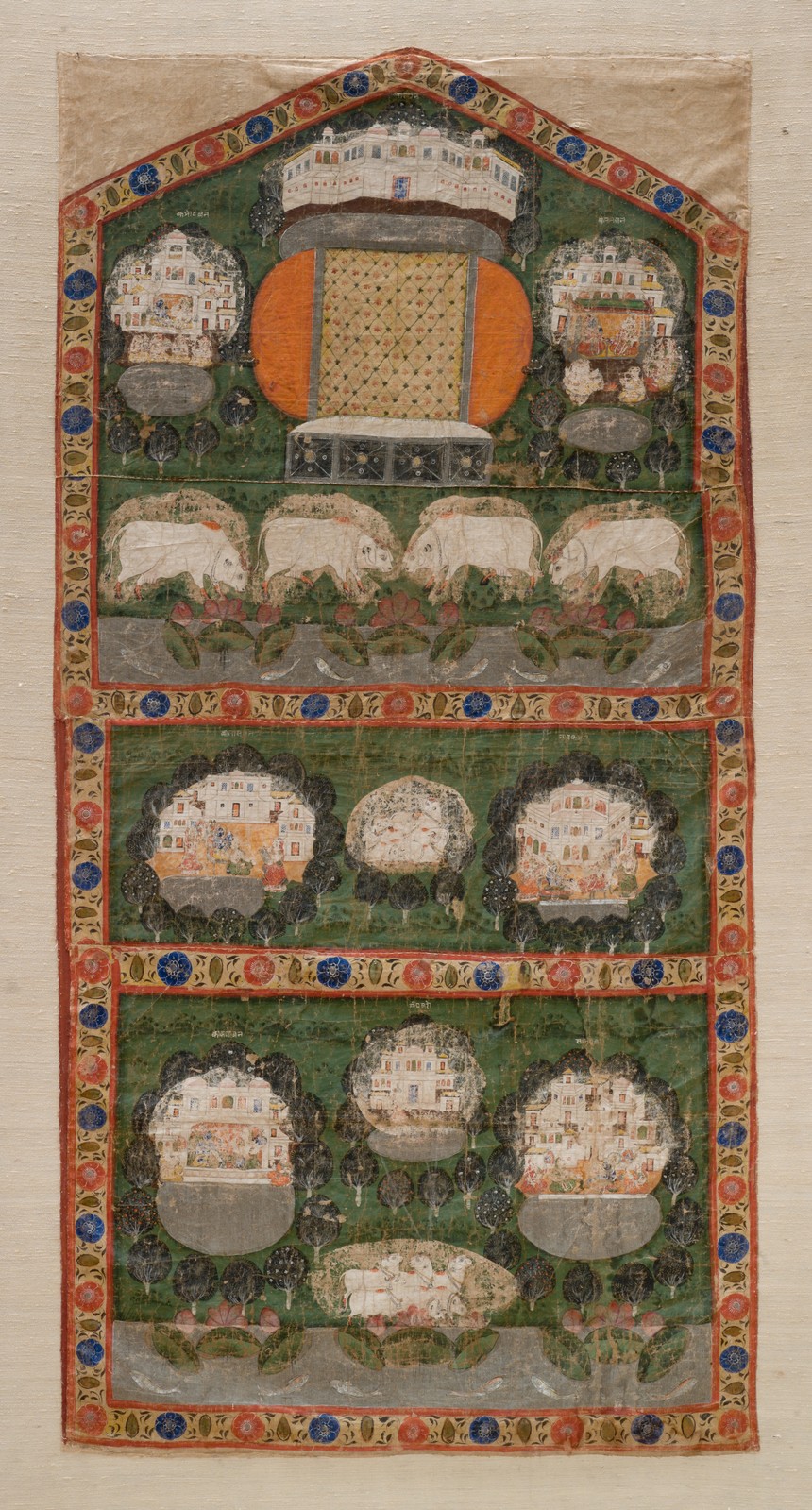
A pichwai is a large painted cloth that hangs behind the image of a deity. The word comes from Sanskrit and means roughly "that which hangs from the back". The tradition belongs to the Pushtimarg, the Vaishnava community founded by Vallabhacharya, and the cloths are made mainly for its temples. The most famous pichwais hang behind Shrinathji, a form of Krishna worshipped at the Shrinathji temple in Nathdwara, Rajasthan, which Wikipedia dates to 1672.
The same word now covers three different things in a shop listing: a temple cloth, a hand-painted work made for sale, and a digital print of a pichwai design on canvas or fabric. They cost very different amounts, and a listing rarely says which one it is. This guide sets out what the evidence says about the first two and how to find out about the third.
What a pichwai is
In the temple a pichwai is part of daily worship. The Wikipedia entry on pichhwai notes that the deity is viewed eight times a day and that the hangings change with the season, the festival and the ritual. Festivals shown include Govardhan Puja, Sharad Purnima, Raslila and Holi. A long article on the tradition in Homegrown adds that painted pichhwais are never hung in winter and appear only in the warmer months, when the cloths show greenery, shady caves and lotuses in the Yamuna, and that the shrine uses other kinds of hanging in the cold months.
The Victoria and Albert Museum holds a Nathdwara pichwai of Shrinathji dated to the 19th or early 20th century, painted on cotton cloth and estimated at 180 cm tall. Shrinathji stands at the centre in dark blue, lifting Mount Govardhan, and 28 smaller panels in the margins show his festival appearances through the year. The museum suggests it may have been made for Annakut. An iTokri essay on the art says traditional compositions have 24 boxes around the central figure, so the number of panels varies from cloth to cloth.
The Metropolitan Museum of Art holds two older examples. One, "Pichhwai for the Festival of Cows", is dated to the late 18th century and attributed to the Deccan, possibly Aurangabad. It is painted on indigo-dyed cotton with gold and silver leaf and opaque watercolour. The other is a border panel of 1800 to 1825 from the western Deccan, worked in painted and stamped mordant and resist dyes with gold. Both show that the form was made outside Nathdwara and with textile techniques as well as paint.
Who paints them and how
Wikipedia names three artisan communities in Nathdwara, the Adi Gaur, the Jangirs and the Mewaras, who live in neighbourhoods called Chitron ki gali and Chitrakaron ka mohallah. The Ministry of Textiles' handicrafts record credits the work to the Chitere community, including Adi Gaur, Joshi and Jangid artists. Cloths were traditionally made on commission from the temple's chief priest. Homegrown reports that hereditary artists have worked in Nathdwara since the 17th century, that only a handful of them are left painting pichwais, and that many work in a group under a master artist. It also notes that the hereditary leader of the sect, the tilkayat, commissioned some cloths to record occasions, and that the craft needs new patrons.
Materials are described mostly by sellers and craft bodies. The iTokri essay lists saffron, gold, silver, zinc, coal and indigo among the natural colours, and says some artists now use synthetic dyes because natural ones are hard to find. The AIACA craft profile lists handwoven cotton or silk as the base, mineral colours and vegetable dyes, real gold and silver leaf, and brushes of goat and squirrel hair. A seller's FAQ on MeMeraki adds that the cloth is primed with white chalk and that tourist copies use synthetic paint and simplified motifs. These are descriptions by people who sell or promote the work, and we found no independent technical study to check them against.
Time is the figure sellers quote most. AIACA gives 10 to 45 days per piece, painted by 2 to 5 artists. Rupasya, a seller, says a single large pichwai takes 20 to 60 days. Neither is a measurement, and both agree that a cloth takes weeks.
Hand-painted or printed
No registry or standard separates the two, so the checks come from sellers and dealers, and each has limits. None of them proves anything alone.
- Magnify the image. Seller guides say a machine print shows a regular dot pattern or pixelation, and a painted line shows brush marks and slight differences in thickness.
- Look for repetition. AstaGuru's guide says mechanical repetition points to printed or mass-produced copies. If the same cloth appears in dozens of identical listings, the seller is describing a print or a workshop copy.
- Check the gold. The same guide says real leaf sits on ornaments, crowns, jewellery and architecture and ages to a soft patina, while metallic paint looks overly shiny and uniform. Ask the seller whether the metal is leaf, gold paint or printed.
- Check the cloth. AstaGuru says originals are traditionally on handwoven cotton or handmade paper with some texture and uneven edges, and that a perfectly smooth, laminated or canvas surface suggests a modern adaptation.
- Expect no signature. The same guide says authentic works are often unsigned, so ask for the maker's name and the family workshop in writing.
- Ask how long it took. Sources above put a hand-painted cloth at weeks of work, so a large piece priced far below the ranges in the next section needs an explanation.
GI status
Nathdwara Pichhwai Painting is a registered Geographical Indication. The registry record (application No. 748) names Mewad Art and Craft Sansthan of Nathdwara, Rajsamand, as the applicant, in handicrafts, Class 16. It was filed on 12 April 2021, the certificate (No. 488) is dated 31 July 2023 and it is valid to 11 April 2030. NABARD's GI page also gives 2023. The GI covers the Nathdwara painting. A printed dupatta sold as "pichwai-inspired" falls outside it, and a GI label on a listing is worth checking against the registry.
Where to buy and what it costs
The most reliable source is a seller who names the painter and the workshop and shows the stages of work. Marketplaces and craft retailers list pichwai-style pieces at every level, so apply the checks above to each listing and ask for a close-up of the gold.
Prices vary by size, base, amount of gold and the painter. Rupasya says its handmade pichwais start at ₹7,100 and run to ₹2,50,000. Exotic India lists pichwai paintings in US dollars. Read from a US address on 27 October 2026, its 24 by 18 inch pieces were $167 and a 60 by 48 inch Krishna Leela on cotton by the painter Dheeraj Munot was $1,323. The titles of the $167 listings do not say whether the pieces are hand-painted or printed, and Exotic India's prices change with the viewer's location. Compare a listing with those ranges and ask why it sits far below them.
Two pichwai listings on MeMeraki, a craft retailer, read on 26 October 2026. They show how far apart two listings called pichwai can be. Both are made to order, unframed and sold with a certificate of authenticity from MeMeraki, and both name the painter. One is painted in natural colours on cloth. The other is acrylic on canvas. Neither listing says the painter works in Nathdwara. The MeMeraki page for Shehzaad Ali Sherani describes him as an artist from Kishangarh, a different school, so ask where a piece was painted before you treat it as Nathdwara work.
Top Pick · Natural colours on cloth
The Vibrant Nature: Kamal Talai in Pichwai by Dinesh Soni
via MeMeraki · 12 x 9 in · Natural colours on cloth · Made to order, about 2 weeks to paint · Sold unframed
Acrylic on canvas
Mothers Love In Pichwai by Shehzaad Ali Sherani
via MeMeraki · 12 x 12 in · Acrylic colours on canvas · Made to order, delivery estimate 15 to 17 weeks · Sold unframed · Painter described as from Kishangarh
Looking after a pichwai
We found no care routine written for owners of pichwai, so none is given here. Ask the seller in writing how they recommend hanging, cleaning and storing the piece, and whether the paint and any leaf can be wiped.
Hero image is a representative photo via Wikimedia Commons.