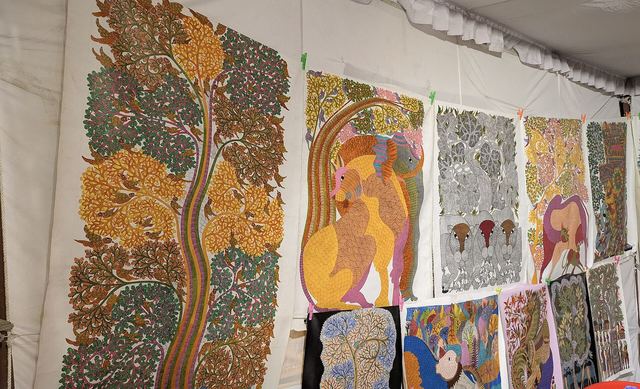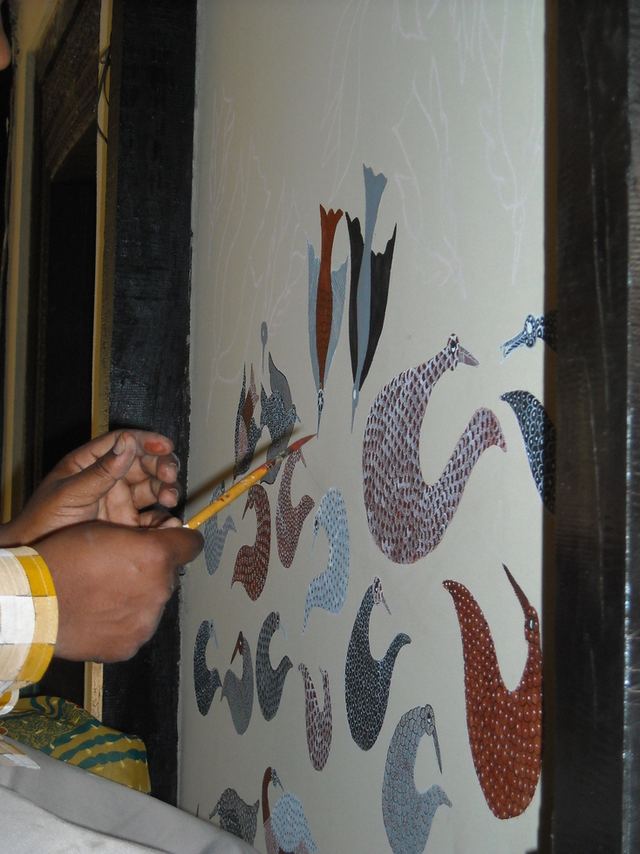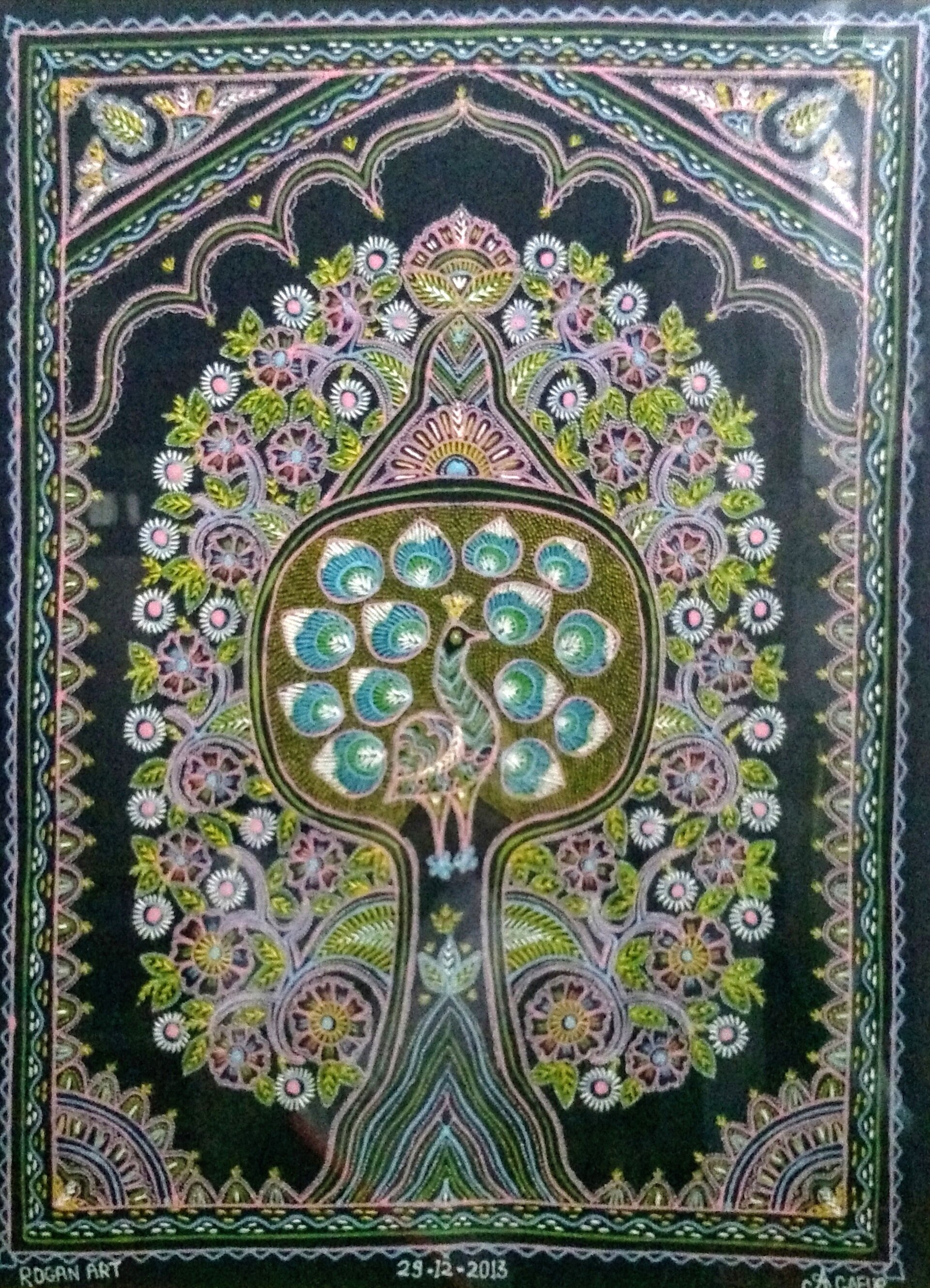
Rogan is a way of painting on cloth with a thick castor-oil paste. The painter warms a lump of paste in the palm, draws it into a thread on the tip of a metal stylus, and lays the thread on the fabric without touching it. The cloth is usually dark, the colours stand out from it, and a design is often painted on one half and pressed onto the other half by folding the cloth. The craft is practised in Kutch, Gujarat, and the villages people name are Nirona and Madhapar, both close to Bhuj.
Several accounts, including a 2014 Times of India report, describe rogan as the work of a single family. The Geographical Indications Registry lists 13 authorised users, and the first ten names on it come from two villages, Nirona and Madhapar. This guide covers how rogan is made, who holds the GI, how to check a piece before buying, and what listings cost on 26 October 2026.
What rogan is
The name is usually given as Persian for oil. Open magazine writes it that way, while the Kansara family's own history page derives it from a Sanskrit word for colouring. Most accounts place the craft's origin in Persia. How long it has been in Kutch depends on the source: Open and Outlook Traveller say about 400 years, and two other accounts say about 300.
To make the paint, castor seeds are simmered to extract the oil, and the oil is boiled down until it is thick. The accounts differ on the time. Outlook Traveller describes 12 to 14 hours a day over two days, Open says 12 hours, and the Kansara family's history page says many hours. The hot oil is mixed with cold water, which turns it into a slimy gel, and the gel is ground with colour using a pestle. Artisans keep the paste under water so it stays soft. Chalk is added. The Kansara family's history page names orange, yellow, green, blue and white as the traditional five colours.
The painter works on cloth laid flat, with no pencil sketch. A mistake cannot be corrected. In the mirror method the painter fills one side of the cloth, folds it over and presses, which prints a reversed copy of the design on the other side. A second technique, called nirmika, applies the paste with brass stamps called biba. A third, called varnika, adds shiny materials such as mica or zari. Sources differ on drying. One craft retailer gives six to seven hours in sunlight and the Kansara page says at least 24 hours in the sun.
Who makes it, and what the GI covers
By 1980 only four families in Nirona still practised rogan, according to Open, because machine-made textiles had cut the demand and the work paid little. In 1984 the grandfather of Abdul Gafur Khatri wrote to him in Mumbai asking him to return, as Outlook Traveller reports, because no one else in the family would carry the craft on. He went back to Nirona. He began teaching women in 2010, and the family's website says more than 400 girls have been trained. He received the Padma Shri in 2019.
A Times of India report of October 2014, reprinted by The Daily Star, said Prime Minister Narendra Modi gave President Barack Obama "a couple of exquisitely handcrafted Rogan paintings", with the artist named as Gafoorbhai Khatri. Open says the Tree of Life design took about one and a half years to make. Open also reports that in 2023 eight artists painted a 100-metre rogan piece in 21 hours in Gandhinagar, with 580 motifs, as a world record for India's G20 presidency.
The other household on the registry is in Madhapar. Ashish Kansara's studio there runs workshops and sells through roganart.com, where he is described as having received an honorary doctorate in 2026. The Khatri family runs demonstrations for visitors and the Kansara studio teaches classes.
GI status
Kutch Rogan Craft is registered as application No. 718, in classes 24 and 25, for handicraft from Gujarat. The applicant is the Rogan Hastkala Charitable Trust, Nirona, Nakhatrana, Kutch. It was filed on 9 November 2020. The certificate, No. 566, is dated 1 March 2024 and the registration is valid to 8 November 2030. The registry lists 13 authorised users. Each has a number in the form AU/xxxxx/GI/718/n, and the registry page gives each user's name and village.
How to check a piece
No source we read describes a test that separates hand-drawn rogan from a printed imitation, so these checks rest on how the craft is made and on the registry. None is proof.
- Ask for the maker's name and look it up on the GI registry page. A seller who names a registered authorised user, such as a Khatri of Nirona or a Kansara of Madhapar, can be checked. A listing that names nobody cannot.
- Ask which technique was used. Freehand work is drawn line by line, and a mirrored piece is made by folding, so its two halves match. Nirmika work is stamped with brass biba, so motifs repeat. All three are recognised techniques, and a seller should be able to say which one made your piece.
- Ask about the colours. Some listings say "organic and natural". A craft retailer that sells rogan lists naphthol among the colour ingredients and says artists also use commercial pigments, so ask what was used on your piece.
- Check the price. A small panel from the Nirona families starts at around ₹1,800 according to Open. Framed prints in the same Amazon results sell at ₹498 to ₹1,649, so a rogan at that price needs an explanation.
- Read the listing details. The 19 by 16 inch Ethnics of Kutch listing files its item type under "Wall Stickers", and one GI-labelled canvas listing gives no artisan and no certificate number. Neither proves anything, and both are reasons to ask the seller more.
Where to buy and what it costs
The most direct route is the maker. On 26 October 2026 roganart.com listed four new Tree of Life canvases by Ashish Kansara at ₹2,550 each and says it ships worldwide with DHL. The Khatri family's site at roganartnirona.com lists no prices and takes visits by appointment on WhatsApp. Nirona is about 40 km from Bhuj, according to the craft retailer Memeraki, and Outlook Traveller gives September to March as the working season. Open reports that smaller panels from the village start at ₹1,800 and intricate paintings can sell for several lakh.
Amazon had several rogan listings on 26 October 2026. Prices were ₹7,699 to ₹8,999 for Garvi Gurjari handmade rogan paintings in different colours, ₹4,350 for a 12 by 10 inch framed painting from Ethnics of Kutch, ₹7,830 for 18 by 14 inches and ₹11,750 for 19 by 16 inches, and ₹2,100 for a Ganpati painting. A GI-labelled 18 by 22 inch framed canvas on gitagged.com cost ₹6,305.
iTokri lists 14 rogan pieces from a vendor it calls Rogan Art Painting by Jabbar Khatri, among them stoles, bags and wall hangings (read on 26 October 2026). Two are shown here. Both listings name the maker as Jabbar Khatri of Nirona. The registry's list of authorised users includes a Mahamad Jabbar Arab Khatri of Nirona, and we could not confirm that the listing's Jabbar Khatri is the same person. Neither listing says whether the piece was drawn freehand, mirrored or stamped, so ask iTokri before you order.
Top Pick · Wall hanging
The Tree of Life Traditional Rogan Art Painted Wall Hanging by Jabbar Khatri (18 x 14 in)
via iTokri · 45 x 35 cm, about 165 g · Rogan art painted on silk and cotton · Maker named as Jabbar Khatri of Nirona
Budget · Shoulder bag
Blue - Traditional Rogan Hand Painted Mashru Shoulder Bag
via iTokri · 25 x 26 cm with a 58 cm strap, about 140 g · Rogan hand painted on mashru, which the description calls cotton and the title calls silk · Maker named as Jabbar Khatri of Nirona · Dry clean only
Looking after a rogan painting
The makers' sites we read give no care instructions. The Ethnics of Kutch listing says "clean with brush". General guidance for oil paintings is a useful guide, and the online gallery U Gallery advises avoiding long exposure to bright sunlight, treating dampness as an enemy, dusting with a dry soft cloth or soft brush, and avoiding chemical cleaners and even water. Rogan is a castor-oil paste on cloth, so ask the maker before you try anything beyond dusting.
Hero image is a representative photo via Wikimedia Commons.