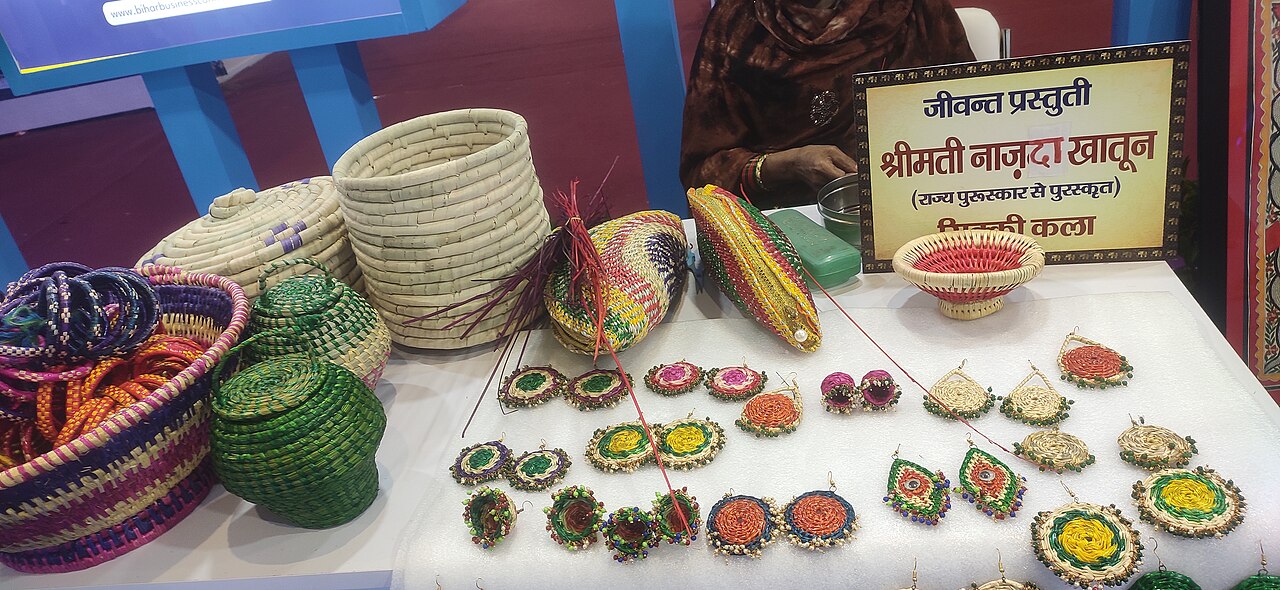
Sikki is a golden grass that grows in the wet, marshy ground of north Bihar. Women in the Mithila region coil it into boxes, baskets, toys, bangles and figures of gods. The craft holds a Geographical Indication, and sellers describe it as natural, biodegradable and ethical. This guide sets out what the GI record, news reports and three listings (prices as of 9 November 2026) support, and where the claims run ahead of the evidence.
What sikki is
The registry lists the goods as handicraft in class 20. The statement of case filed with the GI logo application spells them out as containers, boxes, baskets, bangles, coasters, hand fans, bowls, figures of deities, temples and trays. It names Sitamarhi, Madhubani and Darbhanga districts as the production area and lists nine craft villages in Madhubani district. It gives Raiyam as the village where the craft began, with about 100 families practising there when the statement was written.
The same statement says the women of the household make sikki work, mostly in spare hours, and that men take it up occasionally for large orders or in exhibition season. Brides-to-be traditionally made pieces they carried to their husband's home, and Gaatha, a craft documentation site, describes pauthi baskets exchanged as gifts at weddings. The statement adds that Sailesh puja, a festival of the Musahar community, uses a wide range of coloured sikki objects. Wikipedia, citing Nepali sources, records that Tharu women in the plains of southern Nepal have woven sikki baskets for centuries and use them in rituals from birth to death.
How a piece is made
Sikki is cut near its base in the rainy season and dried in the sun. The flowering top is thrown away and the rest is split into fine strips. Traders sell the strips at weekly village markets by the fistful, and the statement of case puts the price at ₹8 for a fistful of 60 to 70 pieces.
A cheaper, stiffer grass called munj or khar is bent into the shape of the object. The maker dampens the sikki to make it pliable and coils it around that core with a takua, a six-inch metal needle set in a lac head. The application says no thread or cord is used, and Gaatha says the coils are packed so closely that the core cannot be seen.
Colour comes from boiling the strips in dye. The application lists red, yellow, green, violet and navy chemical colours bought at the local market at ₹1,000 a kilogram, which makers mix to produce other shades. The dye needs its own question. iTokri's sikki pages describe the golden colour as natural, which does not tell you what was used on the red, pink and blue pieces, and no listing we read names a dye for the coloured work.
Reading a listing
We found no report that documents a specific counterfeit of sikki work, so these checks come from how the GI application describes the product.
- Ask what the core is. The application describes a munj or khar core wrapped in sikki. Close, continuous coils over a grass core match that description.
- Look for gaps. Gaatha says the coiling hides the core completely. Gaps where the core shows are worth a question to the seller.
- Ask about the dye. The application lists chemical colours. A seller who claims natural dyes should say which.
- Look for size and weight. iTokri's fish box listing gives 25 x 23 x 10 cm and about 120 g, which lets you compare pieces.
- Ask for the place and the maker. Madhubani, Sitamarhi and Darbhanga districts are the GI area. A listing that names no region leaves the origin open.
- Ask who the authorised user is. The registry lists 30 authorised users, and a seller who cites the GI tag can name the one that made the piece.
GI status
Sikki Grass Products of Bihar is a registered GI (application No. 75, handicraft, class 20), filed on 21 September 2006 by the Development Commissioner (Handicrafts), Ministry of Textiles. It was advertised in Journal 18 on 3 August 2007, and the certificate (No. 46) is dated 23 November 2007. The registry lists 30 authorised users, and the first ten are societies, cooperatives and similar organisations. A separate registration covers the GI logo (application No. 536, certificate No. 291, dated 29 April 2017). The registry shows the original registration valid to 20 September 2026 and the logo registration to 27 December 2025. Both dates have passed. The pages we read show no renewal document for the original after 2016, and a renewal notice dated 26 November 2024 on the logo file. We could not confirm that either has been renewed, so check the registry before treating a GI claim as current.
Where to buy and who is paid
We checked iTokri, which sells sikki pieces from several makers and names its partner organisation, Dastkar, on some listings. Tribes India has a Sikki Grass category page, and its product list loads by script and we could not read it. We found no Amazon India listing we could verify.
The economics are thinly documented. The statement of case says few people are active in the craft because of a lack of new design, and that sales and income have fallen. A Hindustan Times report of August 2021 on two special postal covers issued by the Darbhanga postal division quotes the postal superintendent calling it a "dwindling trade". We found no published figure for what a maker earns on a finished piece, and none of the listings gives one. Naming the maker and the partner organisation tells you who made the piece. The price paid to the maker stays unknown.
One maker the press has named is Meera Thakur, born in Umri in Bihar. Wikipedia says she received UNESCO's Seal of Excellence for Handicrafts in 2005. We could not find the original report from that year, so we cannot say which object won it. In March 2022 The Tribune listed her among the Nari Shakti Puraskar recipients from Mohali, Punjab, and said her organisation, Hastakala Vikas Kendra, has trained more than 400 underprivileged women in Punjab.
Looking after sikki
- Wipe with a soft dry cloth. The iTokri listings say to keep sikki away from water and other liquids.
- Keep it dry. Makers dampen sikki to make it pliable, which is a reason to keep a finished piece from getting wet.
- Line food boxes. Sellers list roti boxes and containers. We found no test of sikki dyes in contact with food, so a cloth lining is a sensible precaution.
- Treat "biodegradable" as a seller's claim. The grass and the core are plant fibre, and the dyes are chemical according to the application. We found no study that measures how a dyed piece breaks down.
Specific picks
Three pieces from iTokri, priced as shown on 9 November 2026. Sikki stock moves in single pieces, so check availability before you plan a purchase. None of the listings states the dye or the price paid to the maker, so ask before you buy. All three describe the grass as natural and the pieces as biodegradable, which this guide could not confirm.
Top pick · Storage box
Handmade sikki grass fish decorative multipurpose box
via iTokri · 25 x 23 x 10 cm, about 120 g · Woven sikki over a munj base · Dye not stated on the listing
Gift for a child
Handmade sikki grass owl money bank
via iTokri · 13 x 4 x 11 cm, about 70 g · A hole to remove stored coins · Dye not stated on the listing
Jewellery
Handmade sikki grass necklace set
via iTokri · Necklace 48 cm with a 9.5 cm pendant, plus earrings · About 30 g · Several colours
Hero image is a representative photo via Wikimedia Commons. Product cards link to listings with prices as of 9 November 2026.