Toda embroidery is worked by women of the Toda community on the Nilgiri plateau in Tamil Nadu, in red and black thread on white cotton. The community's own name for it is pohor. Other writers give pugur or pukhoor, and the spellings differ from source to source. Poothkuli names the embroidered shawl, not the embroidery. The traditional piece is a shawl, and the work is done by counting the threads of the cloth. It carries a Geographical Indication, and it is copied by machine and by print on a scale that makes buying a hand-worked piece harder than it should be. This guide covers how it is made, what the people who make it are paid, how to check a piece, and where the sources we read say to buy.
What it is and how it is made
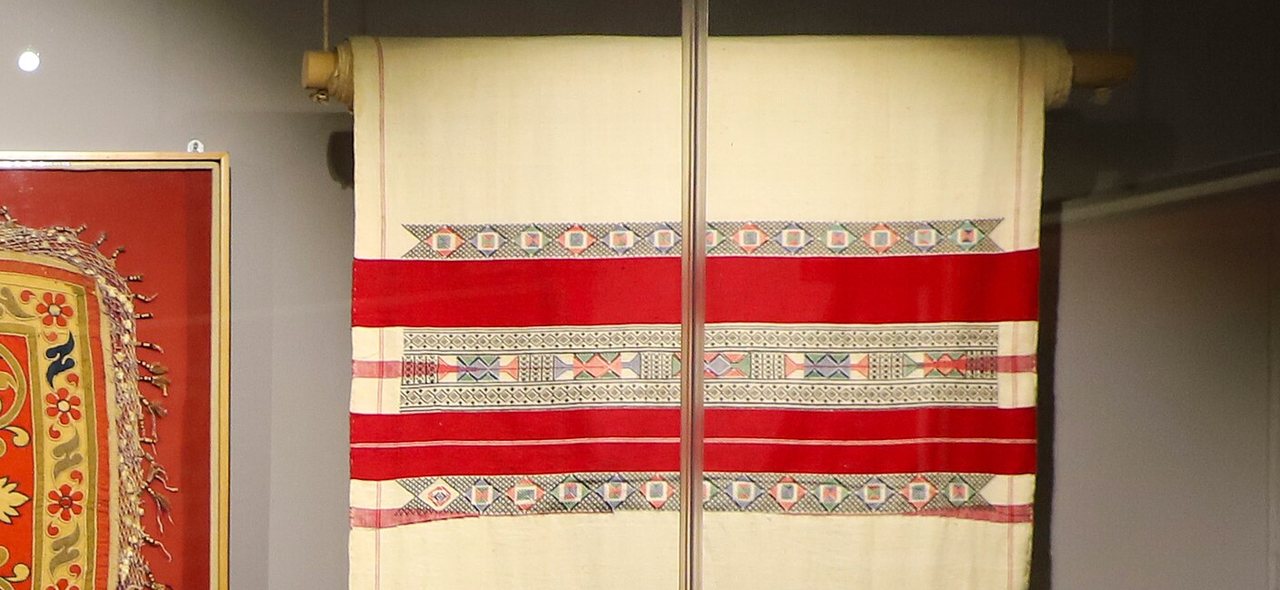
The base is a coarse, off-white cotton cloth with red and black bands woven in, about six inches apart. The embroidery fills the white space between the bands. According to the same source, the cloth was historically woven for the Todas by the Kolas, another Nilgiri tribe, who bartered it for buffaloes, bulls or calves and now sell it for cash. The thread is red and black, with blue used occasionally. The same report says thread was traditionally cotton and most artisans now use wool, which is cheaper and quicker to work.
There is no drawn pattern. The embroiderer counts the warp and weft threads of the cloth and uses them as a grid, and the only stitch is a darning stitch worked from the back. The pattern comes up on the face of the cloth as a raised, slightly looped texture, and the Todas treat that rough side as the front. The work is reversible, so a shawl can be worn either way.
The motifs have names. The buffalo horn is the most important, since the Todas venerate the buffalo. The same page lists a small box motif, a motif named after an ancient Toda priest, and motifs named after wild flowers. A 2021 article counts more than 15 traditional motifs, among them pairs of patterns, which it calls one of the oldest, and peacock, vulture, butterfly, Nilgiri wild rose and snake designs.
Who makes it, and what it pays
Only Toda women do this work, and girls learn it from older women. The 2011 Census counted 2,002 Todas in 538 households across about 125 hamlets. Reports put the number of women who embroider at roughly 250 to 300. The Union Ministry of Tribal Affairs lists the Todas among Tamil Nadu's Particularly Vulnerable Tribal Groups, according to a 2026 field report by two Banaras Hindu University researchers.
The work is slow. The People's Archive of Rural India reported that a six-metre saree takes at least six weeks, and that the work is fine enough that an embroiderer can manage only three to four hours a day. It quotes a hand-worked saree at no less than ₹7,000, of which about ₹5,000 goes to the artisan, and puts the average monthly earnings of experienced artisans at ₹4,000-16,000. In the 2026 field report, an embroiderer who had spent 25 days on a shawl and expected at least 15 more said the cooperative would pay her around ₹4,000-5,000 for it, while tourists paid ₹11,000-13,000 for a finished shawl. The same report records back, shoulder and neck pain and weakening eyesight among the women, who often work in poor light and fit the embroidery around housework and the care of children and older relatives.
GI status
Toda Embroidery is a registered Geographical Indication. The registry record (application No. 135) was filed on 11 September 2008 by the Keystone Foundation and the Toda Nalavaazvu Sangam (the registry's spelling). The certificate, No. 187, is dated 4 March 2013 and the registry shows it valid to 10 September 2028. The People's Archive of Rural India names three co-owners, Poompuhar (the Tamil Nadu Handicrafts Development Corporation), the Keystone Foundation and the Toda Nalavaazhvu Sangam. The registry page names only the last two as applicants. The Archive also says that under the GI, embroidery made outside the Nilgiris district, or by any method other than hand, is an infringement. The 2026 report concludes that the tag gave the craft official recognition without raising the artisans' incomes.
Telling hand work from copies
The People's Archive of Rural India traced several copies. A saree sold online by a large retailer for ₹2,500 was machine-embroidered, with a strip of cloth sewn over the back to hide the loose threads. At a Jaipur exhibition, a stall sold woollen shawls with Toda-style patterns stamped on them at about half the price of hand-embroidered ones. A kurta from a major brand that advertised Toda embroidery carried a print. Vasamalli K., a veteran embroiderer and member of the Tamil Nadu Tribal Welfare Board, told the reporter that copying the designs and using the community's name is wrong.
- Turn it over. Hand-worked pieces have no wrong side. Both faces are finished neatly, and the front shows small loops of thread. A back covered with a strip of cloth is a warning.
- Look for traced lines. The hand work follows the cloth's own weave. Pattern lines that do not follow the threads, or a printed look, mean a stamp or a print.
- Look at the cloth. Authentic pieces sit on a coarse cotton ground with woven red and black bands. A smooth fabric with an embroidered border is a different product.
- Compare the price with the hours. A six-metre saree needs at least six weeks of work. A saree at ₹2,500-3,000 cannot pay that, according to the Rural India report.
- Ask who made it. A seller who can name the group or cooperative the piece came from is easier to trust than one who cannot.
Where to buy
The best-documented outlet is Shalom Ooty, which sells from Claremont Club Road in Ooty. According to 30 Stades, its founder opened a store in 1992, and it became a social enterprise in 2005. The People's Archive reports 220 Toda women on its rolls, and a 2021 article says about 250. The enterprise buys the cotton, cuts it into shawls, cushions and bedcovers, and gives the embroiderers a layout without changing their patterns. The article says about 10 per cent of its products go to tourists and most of the rest are sold through exhibitions and fairs, with TRIFED and Crafts India as the largest buyers, and that online sales had started recently. We did not verify a current online shop.
The article gives some prices. Key chains and small purses cost ₹100, and sarees and bedcovers about ₹25,000. Those figures sit well above the ₹7,000 minimum for a saree quoted in the other report, and a large saree or bedcover takes much longer than a purse, so ask what a piece contains before comparing. On the large marketplaces we could not find a listing that we could confirm as made by Toda women. If you buy there, read the description for the maker, the thread and the stitching, and ask the seller the questions above. iTokri is a partial exception: it lists 15 pieces under a vendor named Oormonnipoof Toda Embroidery.
Two of iTokri's Toda listings, read on 9 November 2026. Each title says hand embroidered and names the vendor, and the listings carry no description, so they do not say who stitched the piece, what thread was used or how it was worked. We did not check whether the vendor is among the 349 authorised users on the registry list. Ask iTokri for the maker's group and the thread before you order.
Top Pick · Cushion cover
Toda Hand Embroidered Cushion Cover (16 x 16 in) 03
via iTokri · 16 x 16 in · Cotton · Vendor listed as Oormonnipoof Toda Embroidery · No description of the thread or stitching
Budget · Cotton muffler
Toda Hand Embroidered Cotton Muffler 01
via iTokri · Cotton · Vendor listed as Oormonnipoof Toda Embroidery · No description of the thread or stitching
Looking after a piece
None of the sources we read gives washing instructions, so ask the seller or the maker's group how a particular piece should be cleaned. Most current pieces use wool thread on cotton cloth, so ask about both fibres before you wash anything.
Hero image is a representative photo via Wikimedia Commons.