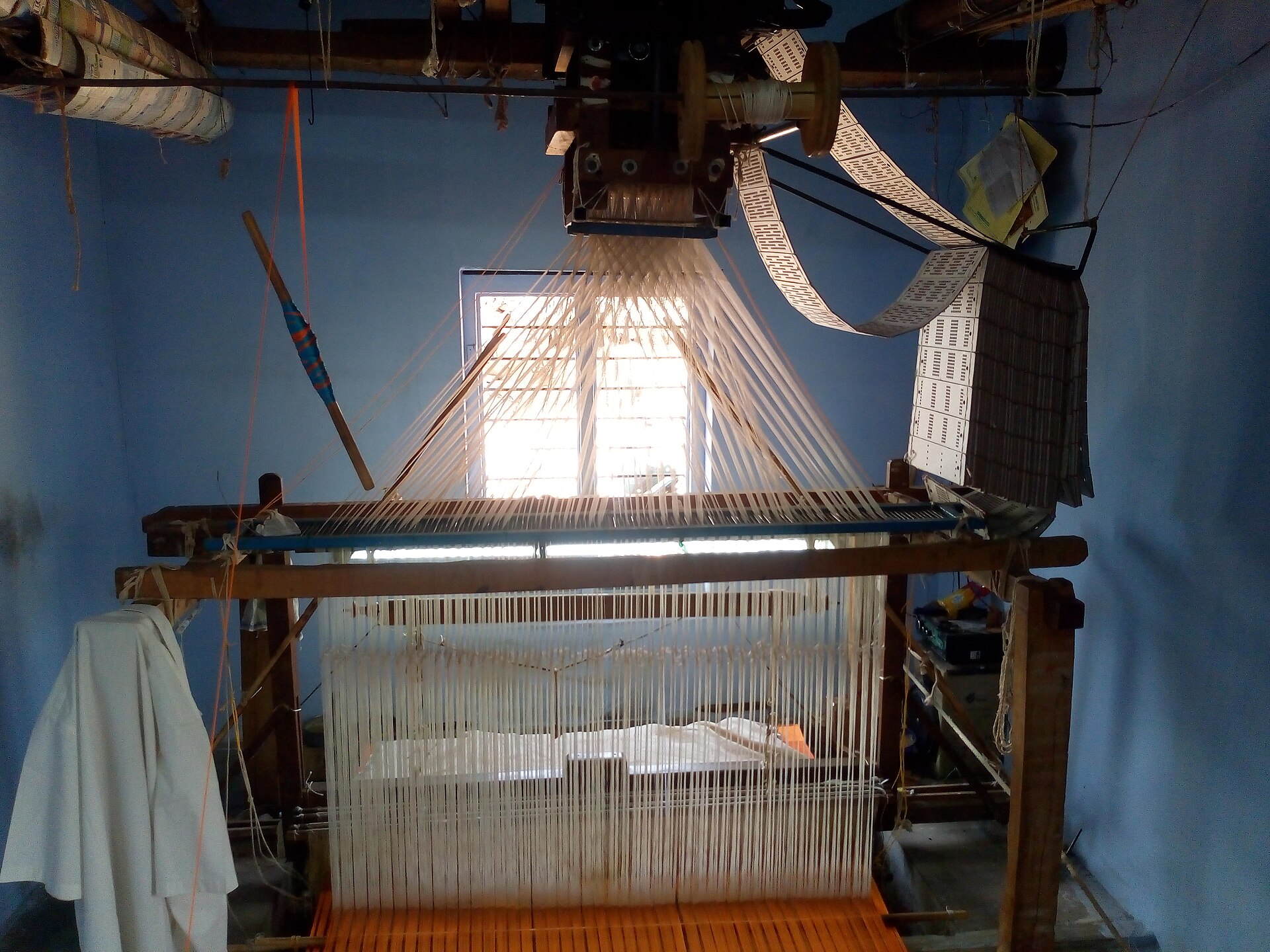
Pick up a silk sari in a good shop and you may find two small labels stitched to the fall: a Silk Mark and a Handloom Mark. Buyers tend to read them as one reassurance — this is the real, proper thing — and move on. They are not one reassurance. They are two different claims made by two different government bodies, and a piece can carry one without the other. Knowing which label answers which question is most of the skill of reading them.
This essay is a companion to the one on what a GI tag covers. A GI tag answers a question about place and method — is this from the named region, made the named way. The Silk Mark and the Handloom Mark answer two others: what the thread is made of, and whether it was woven by hand.
The Silk Mark: the fibre, nothing else
The Silk Mark is run by the Silk Mark Organisation of India (SMOI), a body set up by the Central Silk Board under the Ministry of Textiles. Its one job is to certify that a product is pure natural silk — not art silk, not polyester, not a silk-and-synthetic blend. The United States Department of Labor, describing the scheme in its own records, calls it an assurance label meant to protect consumers from traders selling spurious silk. Each genuine label carries a unique number, and newer ones add a QR code you can scan to check the label against SMOI's database.
What the Silk Mark does not say is just as important. It says nothing about how the cloth was woven. A Silk-Mark sari can be woven on a powerloom in a factory; the mark still applies, because the thread is genuine silk. It says nothing about the region, the design, or the quality of the weaving. 'Pure silk' and 'handwoven' are separate claims, and the Silk Mark makes only the first one.
A Silk Mark is a statement about the thread, not about the hands. It tells you the fibre is real silk. It does not tell you a weaver sat at a loom to make it.
The Handloom Mark: the loom, not the fibre
The Handloom Mark answers the other question. According to the Press Information Bureau, it was launched in 2006 to give handloom products a collective, distinctive identity; it is a scheme of the Office of the Development Commissioner (Handlooms) in the Ministry of Textiles, administered through the Textiles Committee. Its job is to certify that a product was genuinely woven on a handloom rather than a powerloom or a mill.
And it, too, is silent on everything else. A Handloom Mark says nothing about the fibre — the cloth under it may be cotton, silk, wool or a blend. It says nothing about how fine or how flawed the weaving is; it is a yes-or-no on the loom, not a grade. So the two marks are genuinely independent: a cotton sari can carry a Handloom Mark and no Silk Mark, a powerloom silk can carry a Silk Mark and no Handloom Mark, and a handwoven pure-silk sari can — and ideally does — carry both.
The India Handloom Brand: a quality bar on top
There is a third label, newer and less common, that people confuse with the Handloom Mark: the India Handloom Brand (IHB). The Ministry of Textiles' own annual report and the Press Information Bureau both date it precisely — it was launched by the Prime Minister on 7 August 2015, the first National Handloom Day. Where the Handloom Mark only certifies that a piece is handwoven, the India Handloom Brand sits above it as a quality standard: registered products are meant to be defect-free, made to defined specifications of yarn and finish, with assurances on both authenticity and quality. Far fewer products carry it, and it is applied for by producers who can meet the bar.
Why 7 August
National Handloom Day falls on 7 August, the date the Swadeshi Movement was launched in 1905 to promote indigenous goods. The India Handloom Brand was introduced on the first National Handloom Day in 2015; the Handloom Mark predates it by nearly a decade (2006).
Three labels, three questions
Line them up and they stop being interchangeable:
- Silk Mark — is the fibre pure natural silk? (Says nothing about the loom.)
- Handloom Mark — was it woven on a handloom? (Says nothing about the fibre or the quality.)
- India Handloom Brand — is it handwoven and made to a defined quality standard?
- GI tag — is it from the named place, made the named way? (See the GI-tag essay.)
Read that way, the common traps are obvious. A 'Silk Mark certified' sari at a handloom-silk price may be powerloom — the label never promised otherwise. A 'Handloom' tag on a cheap sari tells you the loom and nothing about whether the fibre is the silk you think you're paying for. Neither mark is a GI, so neither guarantees that a 'Banarasi' or a 'Kanjeevaram' is actually from Banaras or Kanchipuram.
How to use them as a buyer
The labels are worth having and worth reading precisely. Three habits make them useful:
- Match the claim to the price. Don't pay a handwoven-silk price for a sari that carries only a Silk Mark; ask for the Handloom Mark too, and treat the India Handloom Brand as the stronger signal where it appears.
- Use the number. Where a label offers a unique number or a QR code, check it — an unverifiable label is just a printed tag.
- Then judge the piece itself. A label narrows a question; it doesn't close the sale. For the physical tells of handwork, see how to check whether a craft piece was made by hand, and for specific textiles the guides to eri silk, Chikankari and Kalamkari.
A Silk Mark, a Handloom Mark and an India Handloom Brand are three answers to three questions. Reading them precisely means never letting one of them answer for the others.
Hero image is a representative photo via Wikimedia Commons.