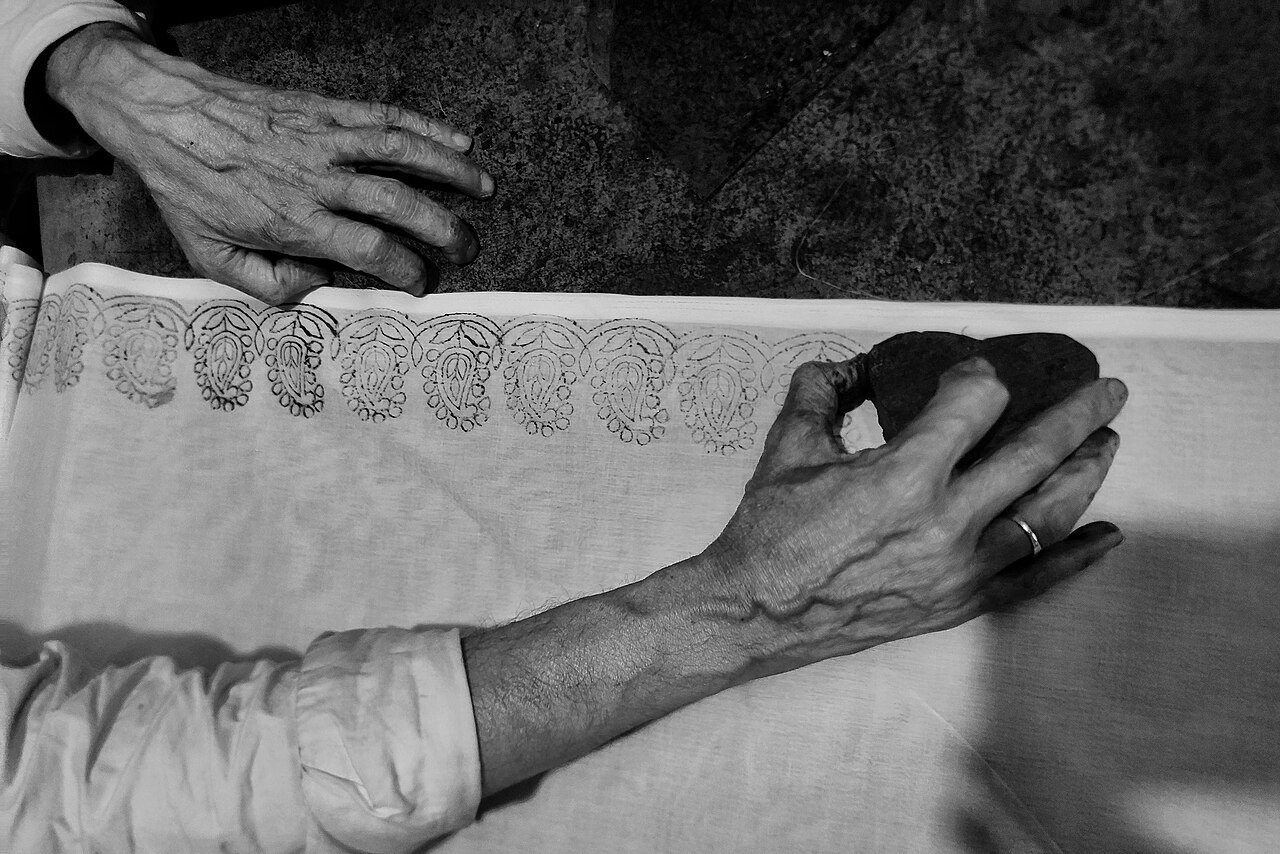
Most advice about buying Indian craft comes as a list, such as twelve ways to spot fake pashmina or eight signs of real Bidri. The lists are often accurate, and they are hard to remember for a craft you buy once a year.
One question covers most of them. Ask of the object where it shows that a person made it. Hand work leaves traces that machine production removes, and most of the reliable checks in buying guides, ours included, are particular cases of that idea. Once you know the idea, you can work out what to look for in a craft you have not read about.
Variation, in the right places
Mass production has taught buyers to read evenness as quality, so a perfectly repeated motif can look like the better piece. Sellers of hand work tell buyers to expect variation. iTokri's listing for a hand block-printed Kalamkari saree from Pedana says "you may notice slight variations in color, mild pigment smudges, or irregular dye patterns, these are not defects", and its listing for a hand-painted Kalamkari dupatta says the same of the painting. A screen print puts the same image down at every repeat. Our Kalamkari guide sets out how to tell the three kinds apart.
Variation is worth looking for, and some crafts aim for evenness. The GI Journal for Kutch Bandhani says the quality of tie-dye "can be judged by the contours or kaff of the dots formed, as well as by the uniformity of their size and spacing". A good bandhani maker is aiming for even dots. The same journal gives a surer check than any amount of looking. It says tie-dyed cloths "are often sold with knots still tied, in order to indicate that they are not printed but indeed tie-dyed".
It also matters where the variation sits. Variation in the making is a sign of the hand. A hem that wanders or a lid that does not sit flat is poor finishing, and a handmade label does not excuse it. Look for small differences in how the piece was formed, and expect the edges, seams and fittings to be finished with care.
Turn it over
The back of an object is usually less staged than the front, and checking it takes a few seconds in a shop.
On a painting on paper, the back can carry the painter's name. A Madhubani painting by Shanti Devi in the Sainsbury Centre's collection is annotated in ink on the back with her name, her village of Laheriya Ganj and its title, and carries the stamp of the Master Craftsman's Association of Mithila in Jitwarpur. On a Kolhapuri chappal the sole shows how the pair was made, and our Kolhapuri guide describes the line of stitches that runs round the edge of a hand-stitched pair.
The back does not settle every case. Our bandhani and Kutch embroidery guide found retailers contradicting each other about whether a print shows through to the back of the cloth, so for bandhani it treats the back as proof of nothing.
On a painting, look at the front at an angle. The Traditional Fine Arts Organization, in its guide to telling originals from reproductions, says an original watercolour "will have a rough surface when looked at from an angle; a reproduction will have a flat and even surface". Under a jeweller's loupe, many machine-made reproductions show "microscopic colored dots in a pattern". The same guide warns that a giclée inkjet print "has extremely small pixels of color, with no perceptible dot pattern", that some reproductions are embossed to copy the brush marks of the original, and that a giclée may carry dabs of paint added by the artist. A sheet with no dots still needs the other checks, which our Madhubani and Pattachitra guides set out.
Material and weight
Some crafts are defined by a material that is costly or hard to work, and a copy usually swaps it for a cheaper one. Weight helps with some of them and misleads with others.
- Bidriware. The body is a zinc alloy with a little copper. Susan La Niece of the British Museum describes the craft as "a cast zinc alloy", inlaid and blackened, and the Salar Jung Museum says the silver is "hammered into the pattern" and the piece polished. Silver that sits on top of the surface, painted or printed, has not been inlaid. The black should be matt, which La Niece puts down to fine particles that absorb light. Do not judge a piece by its weight, because the Salar Jung Museum notes that "the heavier ones have more lead in them". Do not scratch it either. La Niece measured the black layer at "three to ten micrometres" thick, so a scratch on a real piece goes through to pale metal and leaves a permanent mark.
- Jaipur blue pottery. The body is mostly ground quartz and glass. The recipe recorded by D'Source is 40 kg of quartz powder, 7 kg of scrap glass and 1 kg each of Multani mitti, katira gond and saaji, so the only clay, the Multani mitti, is about 2 per cent of the dough. Avyaan, a blue pottery seller, says a quartz piece is "distinctly lighter than a clay ceramic of the same size", lets a little light through when held up to a strong lamp, and that clay imitations are "denser, heavier, and completely opaque when held to light".
- Pashmina. Pashmina is graded by the fineness of its fibre. The Ministry of Textiles says Ladakh's Changthangi goats give the finest grade, between 12 and 15 microns, and in 2019 the Bureau of Indian Standards published a standard for identifying and labelling Pashmina products to certify their purity. Neither the ring test nor burning a thread measures fibre diameter. Ask the seller whether the shawl is certified under that standard.
- Kansa. Bell metal is copper and tin, and brass, the usual substitute, is copper and zinc. Weight will not separate them, because Engineering ToolBox's tables put cast brass at 8,400 to 8,700 kg/m³ and tin bronze at 7,400 to 8,900 kg/m³. The classical texts summarised in a 2024 review in the Journal of Ayurveda and Integrated Medical Sciences prefer kansa that is "slightly grayish" with a "sharp sound", and reject metal that is "yellow in colour" or "makes a low sound when struck". Tap the rim and look at the colour. A dull note or a yellow body is a reason to ask questions, and neither check tells you whether the metal contains lead. Our kansa guide covers that.
The price has to pay for the process
The price check needs no expertise.
Work backwards from the labour the craft requires. Gaatha's documentation of Ajrakh says the cloth goes through "upto sixteen steps of manual processing". In double-ikat Patola both the warp and the weft are resist-dyed to the pattern before weaving, and Robb Report India, writing about the Salvi family of Patan, says "a single saree can occupy two weavers for six months to a year". If a piece is offered at a price that could not pay for that work at any wage you would defend, either the process was not followed or somebody in the chain was paid very little. In Chanderi, the People's Archive of Rural India found that weavers "typically earn about 20-30 per cent of the wholesale price of a product", so the maker is already the smallest share of what a buyer pays.
A high price on a handmade piece can still be an overcharge, which you can judge by comparing sellers. A very low price on a piece sold as handmade is a claim about how it was made, and it is the one to question. Avyaan says blue pottery offered at ₹150 to ₹200 is "a clay-body machine-made piece". Our essay on why handmade costs what it does works through the arithmetic for handwoven cloth.
Using the question when you cannot hold the object
Online you lose weight, sound and texture, and you are left with what the listing chooses to show. Treat that choice as evidence too.
Ask the seller for a photograph of the back, a close view of the surface at an angle, the join or the rim, and pictures of two pieces from the same batch. Ask for the maker's name and village. A seller who works with makers can usually send these. A seller who has never seen the maker or the stock cannot. A reply with a stock photograph, or a reply that changes the subject, is worth noting.
A GI tag answers a different question, about a name and a place, which our essay on GI tags covers.
Sources
- iTokri, Pedana hand block-printed natural-dyed cotton Kalamkari saree, listing checked 6 October 2026
- GI registry, Kutch Bandhani of Gujarat, application No. 756. The quotations come from the GI Journal filed with it.
- Sainsbury Centre, Shanti Devi, "A bull"
- Traditional Fine Arts Organization, on telling an original from a reproduction
- Susan La Niece, "Bidri ware and its black patina", 2015
- Salar Jung Museum, "Quaint Elegance: The Craft of Bidri", Google Arts & Culture
- D'Source, Blue Pottery of Jaipur, making process
- Avyaan, buying authentic Jaipur blue pottery
- PIB, Ministry of Textiles, "Pashmina Products Receive BIS Certification", 2 August 2019
- Engineering ToolBox, metal and alloy densities
- Review of Kansya in the classical Ayurvedic texts, Journal of Ayurveda and Integrated Medical Sciences, 2024
- Gaatha, Ajrakh printing, Ajrakhpur
- Wikipedia, Patola cloth and Robb Report India, on the Salvi family of Patan
- Mohit M. Rao, "MP weavers hanging by a Chanderi thread", People's Archive of Rural India, 6 May 2020