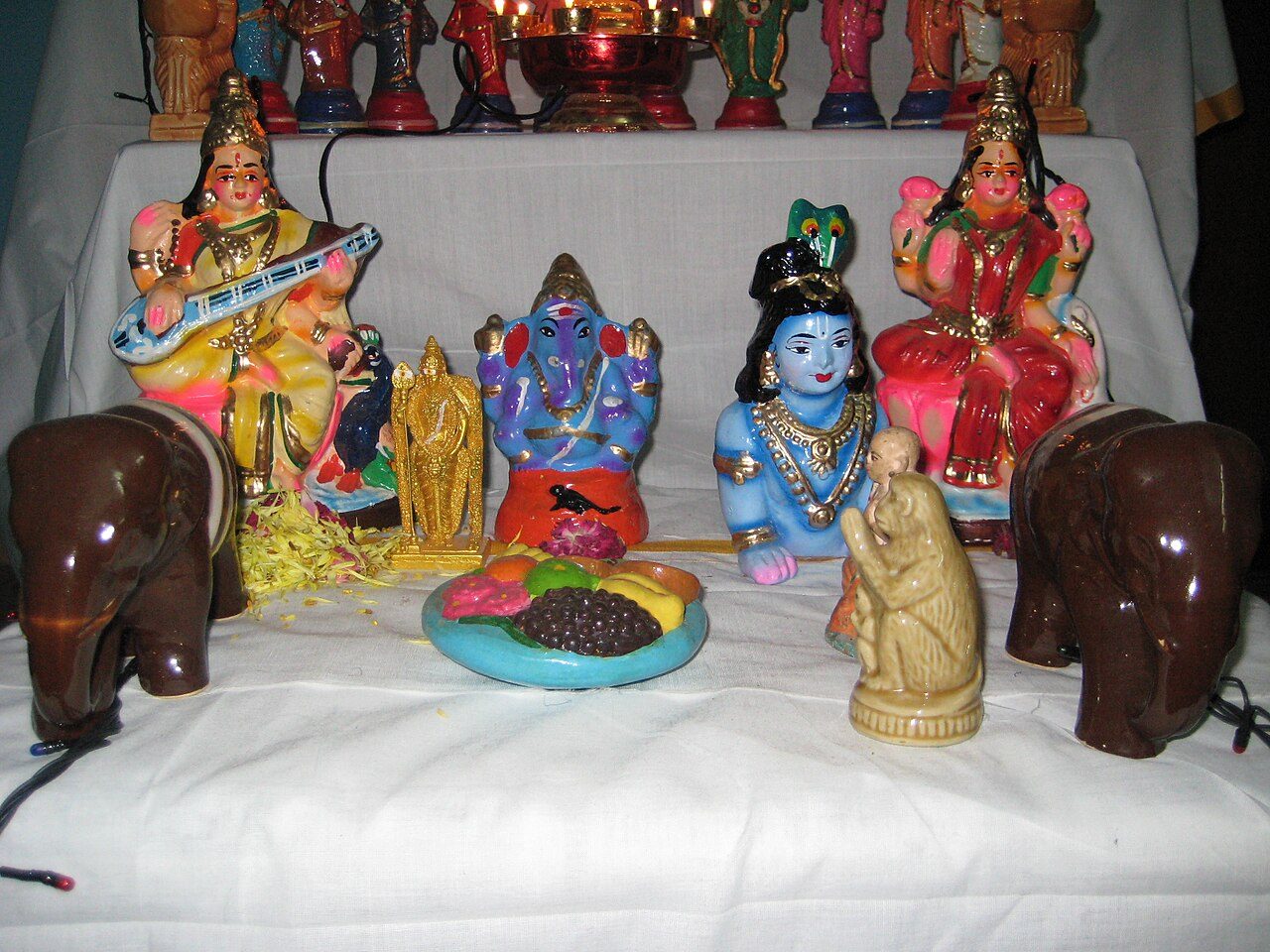
For the nine nights of Navratri, from Sunday 11 October this year, households across the south set up steps and fill them with dolls. In Tamil it is Bommai Kolu or Golu, in Telugu Bommala Koluvu, in Kannada Gombe Habba, in Malayalam Bommakkolu. The steps come in odd numbers, usually three, five, seven, nine or eleven, with the deities at the top and the dolls arranged by size below. Women visit each other's displays through the nine nights.
What makes Golu different from most festival buying is that the dolls are kept. They come out of trunks every year, and families hand them down; a marapachi couple, the wooden bride and groom, is traditionally given to a daughter when she marries so that she can start her own steps. In Mysuru, the Deccan Herald reported in 2024, the raja and rani dolls are "generally passed on as gifts from parents, spanning generations". A Golu doll should therefore be bought to last for decades, and how long it lasts depends on what it is made of.
What the dolls are made of
Clay. Kosapet in north Chennai, which The Hindu calls "the city's clay doll capital", takes its name from Kuyavampettai, a settlement of potters. Work there starts in late January and the painting around May. Its makers now face less clay and a ban on firing, so many now source figures from Puducherry and Kancheepuram. In Vandipalayam near Cuddalore, mould-makers make the clay masters from which, The Hindu reported, "thousands of dolls are made", some for buyers in the US, Singapore, Canada and Malaysia. Clay dolls are heavy. Poompuhar lists a 13-inch clay Perumal and Thayar pair at 6.9 kg.
Papier-mâché. A family of makers in Villianur, Puducherry, told The Hindu that their dolls are "limestone, Porbandar chalk powder, and paper" poured into plaster of Paris moulds. The dolls come out hollow and light, which is why buyers abroad prefer them. A 9-inch papier-mâché dancing doll on Poompuhar weighs 1.1 kg.
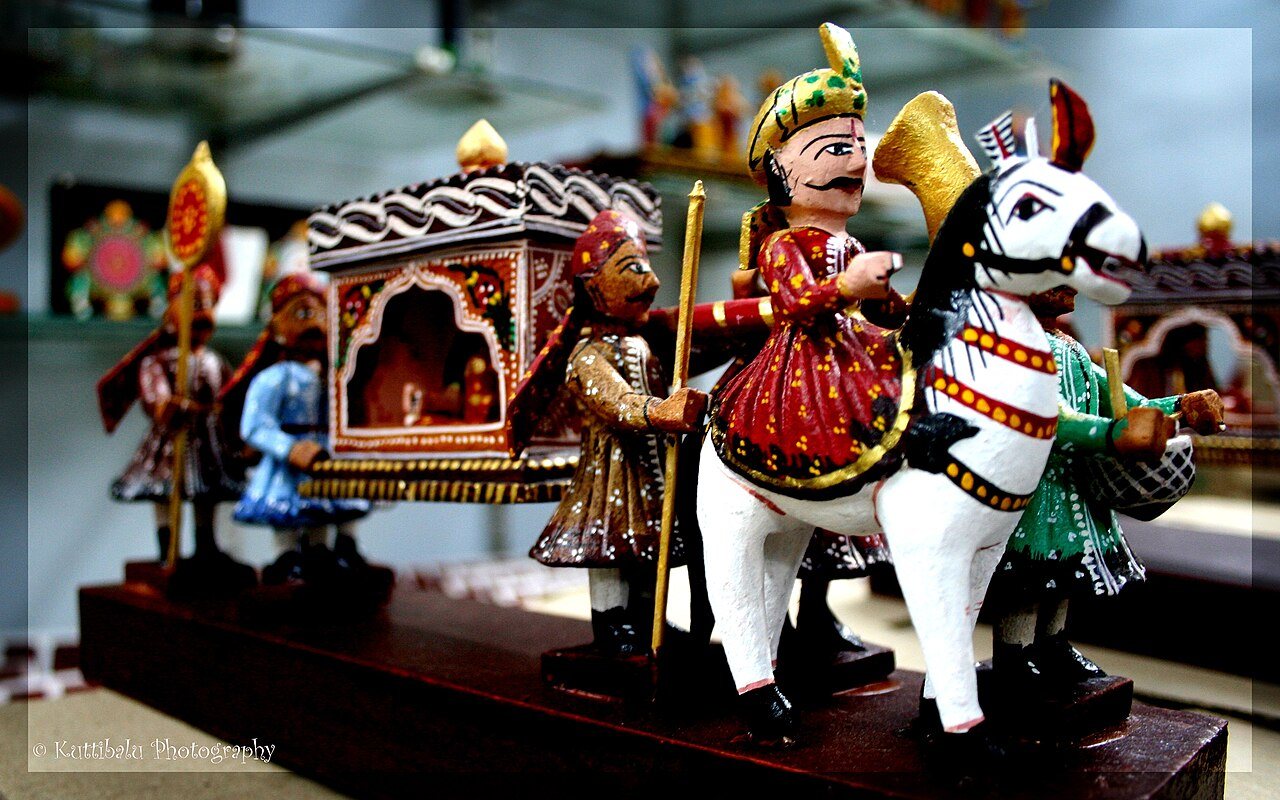
Thanjavur dolls. The thalaiyatti bommai is the doll whose head nods, usually a king and queen; its cousin is the tilting gundu chatti doll. The Deccan Herald lists their materials as "sago, plaster of Paris, wood pulp and papier mache". Plaster of Paris is one of a Thanjavur doll's listed materials, so finding it tells you nothing about whether the doll is authentic.
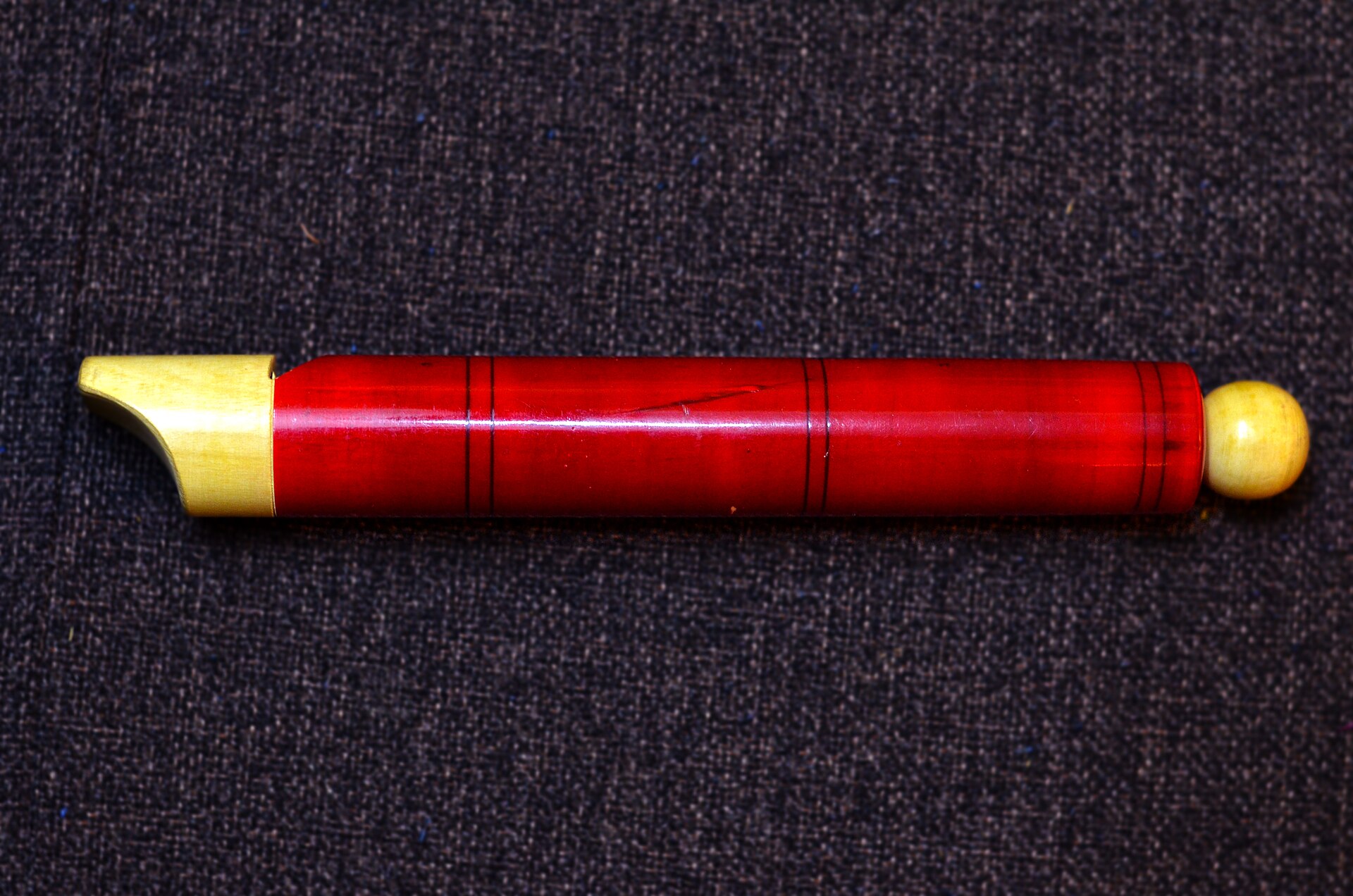
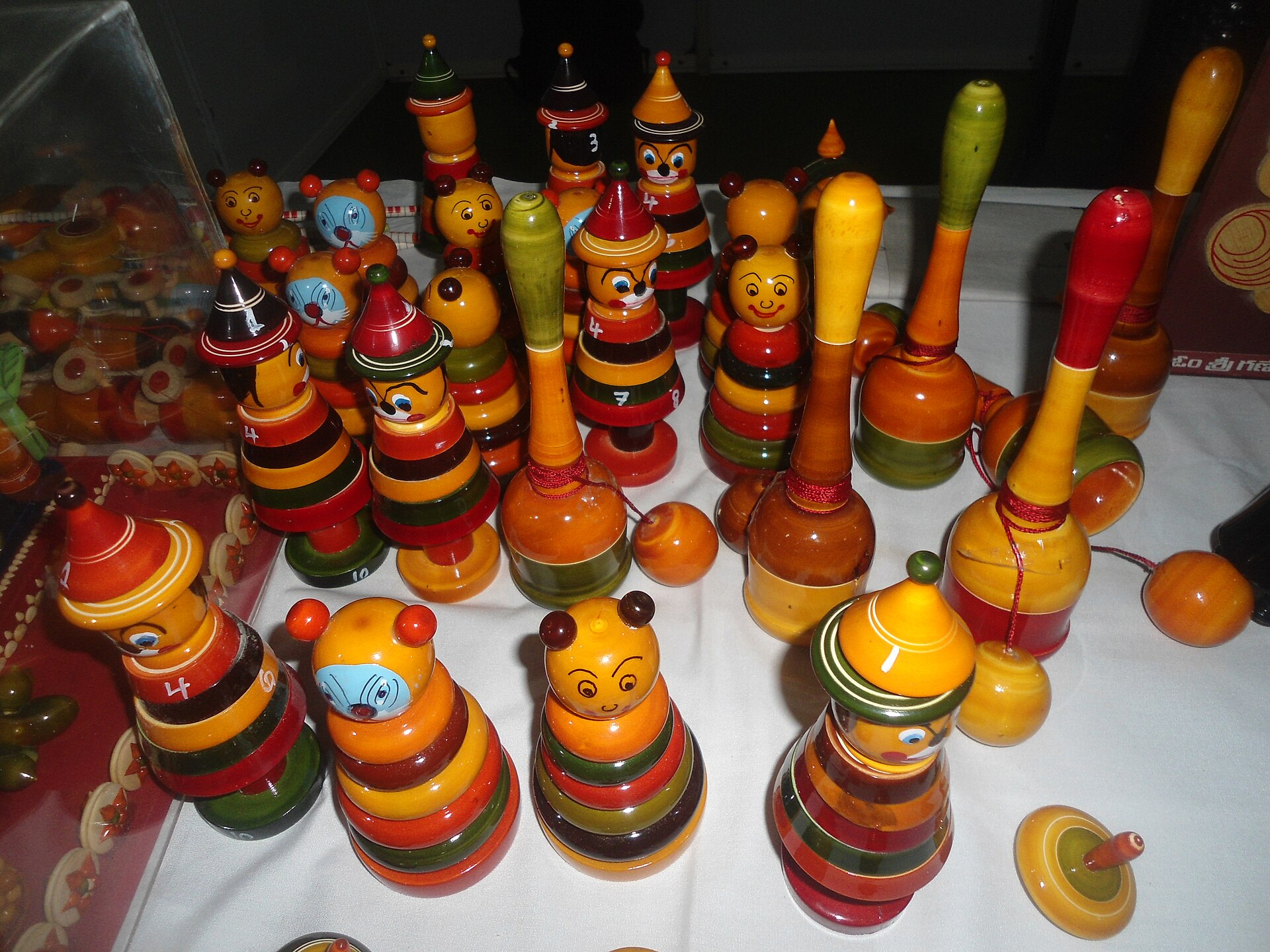
Wood. Kondapalli, near Vijayawada, carves its figures from tella poniki, a light softwood, and joins the parts with tamarind-seed paste; its Dasavatharam sets are a Golu staple. Channapatna in Karnataka turns its toys and dolls from aale mara, Wrightia tinctoria, though rubber wood and other timbers are now common. The marapachi couple is wood as well.
GI status
Thanjavur Doll: application No. 96, certificate dated 9 September 2008, held by the Thanjavur Chamber of Commerce, valid to 17 May 2027. Do not confuse it with the Thanjavur Art Plate. Kondapalli Bommallu: No. 44, held by LANCO Institute of General Humanitarian Trust and the Kondapalli wooden toy makers' cooperative. The registry dates the certificate 12 January 2006, which is earlier than its own journal date of 18 September 2006, and the press reported the grant in 2007. Channapatna Toys and Dolls: No. 23, certificate dated 30 January 2006. Etikoppaka Toys: No. 482, certificate dated 24 October 2017. There is no GI for Golu dolls as such, or for the marapachi.
What a new marapachi is made of
Older marapachi dolls are often described as red sandalwood, red sanders, Pterocarpus santalinus. That wood is now listed in CITES Appendix II, India allows exports only of red sanders from cultivated land, and the IUCN put it back in its Endangered category in 2021. A new marapachi couple sold online is almost certainly made of another wood. Of the two Amazon marapachi listings we checked, both named Channapatna makers as the manufacturer, which suggests Channapatna-style softwood, and neither claimed red sanders.
A marapachi made in Channapatna is a hand-turned wooden doll and worth buying, and a softwood pair spares an endangered tree. Avoid paying an antique or red-sanders price for a new softwood pair. Antique pairs start at about ₹44,800 at one dealer we checked; the two new pairs we found cost ₹899 and ₹1,999.
How to buy dolls that will last
- Know what you are holding. Weight tells clay from papier-mâché at once. Clay is the older material and heavy; papier-mâché is lighter and easier to ship.
- Read "Kondapalli" carefully. A "Kondapalli" Dasavatharam set we found on Amazon said it was made of aale wood, which is the wood of Channapatna and Etikoppaka; Kondapalli uses tella poniki. Either the listing is wrong or the set was made somewhere else. A seller who sells Kondapalli work should be able to say it is tella poniki.
- Buy from the people who make or commission them. Poompuhar, the Tamil Nadu government's handicrafts corporation, runs Golu exhibitions every year; its 2025 Chennai show priced dolls from ₹50 to ₹85,000, and its Coimbatore exhibition of work by 20 artisans runs to the end of October 2026. The Golu bazaar on North Mada Street in Mylapore is the other place to see a range in one afternoon.
- On plaster of Paris. The Central Pollution Control Board's idol-immersion guidelines of 2020 ban PoP idols because they are put into rivers and lakes. Golu dolls go back into the trunk after Navratri, so that reason does not apply to them, and in a Thanjavur doll PoP is part of the craft.
- Prices. At Mylapore in 2019 the Mylapore Times found artisans' figures from ₹250 and a one-foot papier-mâché Athi Varadar at ₹1,600. In Tiruchi in 2025 private shops ranged from ₹100 to ₹8,000. Large sets cost a good deal. Poompuhar's Tiruchi showroom had a 250-piece Ramayana set at ₹1,22,000.
The steps go up on the first day, 11 October. Anything ordered now will arrive partway through Navratri at best. A doll that arrives late can still go on this year's steps for the last nights, or wait for next year's.
Specific picks
Four dolls across the four materials, each checked on 6 October for price, stock and what the listing claims.
Top pick · Clay, government-sourced
Clay Perumal and Thayar, 13 inch
via Poompuhar · Tamil Nadu Handicrafts Development Corporation · Natural clay, 6.9 kg · In stock
GI craft · Thanjavur
Thanjavur thalaiyatti bommai, raja and rani, yellow
via iTokri · Papier-mâché, hand-painted (the listing says with Asian Paints), Thanjavur · 22 cm, 430 g · Few left
Marapachi · Wooden couple
Marapachi bommai, wooden pair, 12 inch
via Amazon · Wood; the listing names Channapatna artisans as makers and makes no red-sanders claim · In stock
Dasavatharam · Wood
Dasavatharam set of 10, 3 inch, hand-painted
via Amazon · The listing claims tella poniki softwood, Kondapalli's wood, but does not say the set was made in Kondapalli · In stock
Sources
- Deccan Herald, "Dolled-up displays", 10 October 2024
- The Hindu, on Kosapet, 6 September 2024 and New Indian Express, on Kosapet, 5 September 2018
- The Hindu, on the Cuddalore mould-makers, 29 September 2016 and on the Villianur papier-mâché makers
- Deccan Herald, on Thanjavur dolls, 2 March 2013 and on Kondapalli, 17 April 2010
- Institute of Wood Science and Technology, on Channapatna woods
- Down To Earth, on red sanders and the IUCN, 2021
- The Hindu, Poompuhar Chennai exhibition, 12 September 2025, Tiruchi, 18 September 2025 and Coimbatore, 25 September 2026
- Mylapore Times, the Golu bazaar on North Mada Street, 17 September 2019
- CPCB revised guidelines for idol immersion, 12 May 2020, as reported in Millennium Post, "Plastic, plaster of Paris, thermocol to make idols banned", 14 May 2020
- GI registry: Thanjavur Doll, No. 96, Kondapalli Bommallu, No. 44, Channapatna, No. 23, Etikoppaka, No. 482
The hero photograph is a household display. Product cards link to current listings, checked on 6 October 2026.