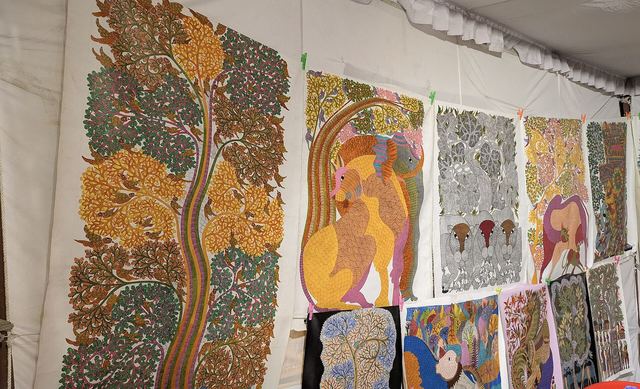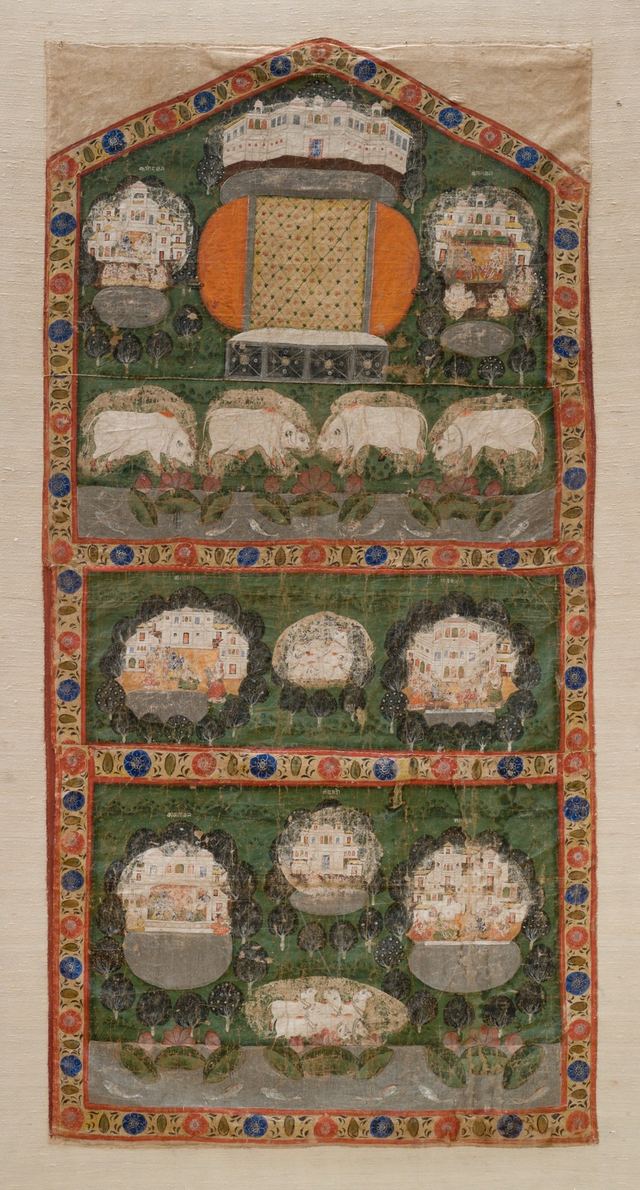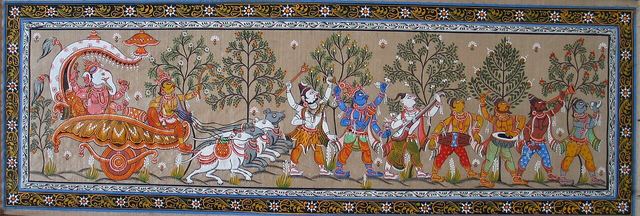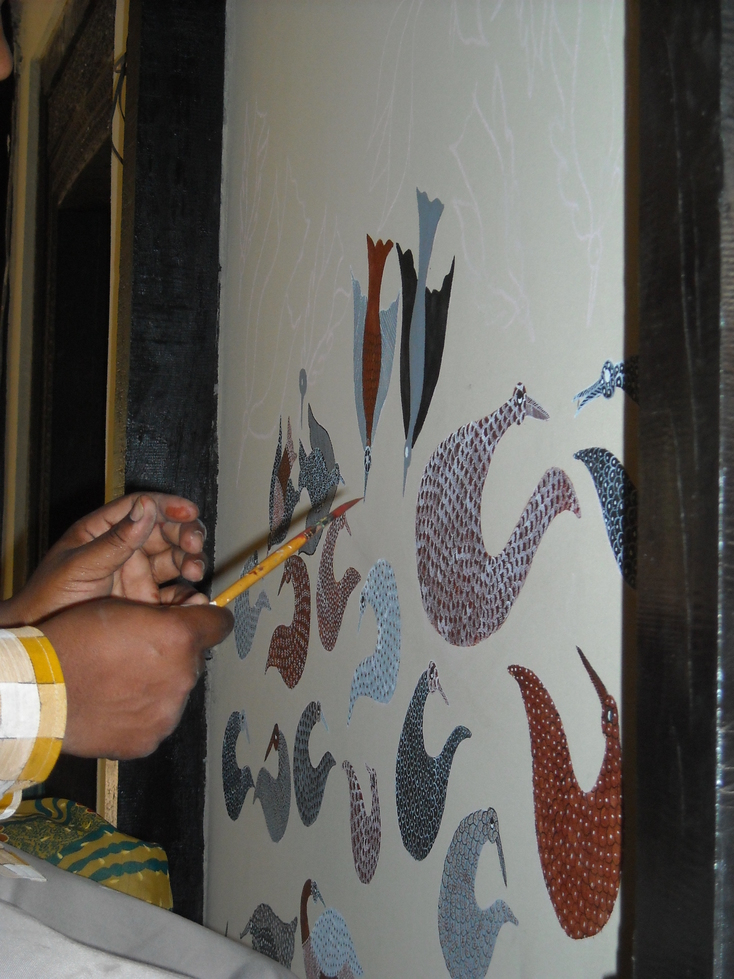
Gond painting is made today mostly by Pardhan Gond artists in and around Patangarh, a hilltop village about 50 km from Dindori town in Madhya Pradesh. The outline of a tree, a deer or a deity is filled with lines, dots and small repeated marks, and each painter keeps a personal stock of fills. Painting on paper and canvas is young, with the first examples dating from the 1980s, while the wall tradition behind it is older. Prices run from about ₹2,000 for a small canvas to a reported ₹4,00,000 for one painting by Bhajju Shyam. This guide covers where the style comes from, what the 2023 GI registration covers, how to check a listing, and three pieces we looked at on 26 October 2026.
What Gond painting is
The Pardhans are, in the words of the Gaatha craft archive, the story keepers of the Gonds, priests and storytellers who carry the community's history in songs. Bhajju Shyam told Mongabay in March 2024 that about 15 singers of the bana, the instrument that accompanies those songs, are still practising in the region, and that he began reviving the form about 15 years earlier.
Painting began on walls. Walls were plastered with soil, cow dung and straw, coated with a white soil called pidor, and painted with a brush of beaten bark fibre called a koochi. Gaatha lists the colours as charcoal, coloured soils, plant sap, leaves and cow dung. Digna, the geometric patterns drawn on house walls and floors, belongs to the same household tradition. Listings and press pieces give the age of the tradition as 1,400 years or nearly 2,000 years, and none we opened cites a source for either number.
The move to paper has a date and a name. In October 1981 talent scouts from Bharat Bhavan in Bhopal approached Jangarh Singh Shyam, a young Pardhan Gond from Patangarh, and he met the museum's first director, the artist Jagdish Swaminathan. His first sample paintings were shown at the Bharat Bhavan opening exhibition in February 1982. His work was shown in Paris in Magiciens de la Terre in 1989, and his 1988 painting Landscape with Spider sold for $31,250 at Sotheby's New York in 2010. He died in Japan in 2001, aged 39. The school he started is called Jangarh Kalam, and some critics question the label 'tribal art' for it. Other painters from Patangarh followed, among them Bhajju Shyam, who received the Padma Shri in 2018 and whose The London Jungle Book was published by Tara Books in 2004.
Gaatha notes that a painter's individuality shows in how the outlines are filled, with dots for some and curves, rainbows or circles for others. That makes one painter's hand recognisable across several works, which helps when you compare listings.
GI tag status
Gond Painting of Madhya Pradesh is registered as a Geographical Indication (application 701, goods: handicrafts). The Indian GI registry shows it filed on 8 September 2020, with certificate number 439 dated 22 February 2023, valid to 7 September 2030. The applicants are Bhopal Yuva Paryavaran Shikshan Evam Samajik Sansthan, Bhopal, and Tejaswani Mekalsuta Mahasangh Gorakhpur Samiti, Dindori. The record lists 306 authorised users, each with a number and a village. Press reports from April 2023 quoted the Dindori collector saying the tag means the authority has accepted Dindori district as the original source.
How to check what you are buying
A GI registration covers place and a list of authorised users. Who made a given painting falls outside what it certifies, and the list is shorter than the community of painters, since Mongabay counts over 250 skilled artists in Patangarh alone. Treat it as one check among several.
- A named painter. Ask who painted the piece and in which village. iTokri names Gariba Singh Tekam on its listings, while the Tribes India canvases we checked name nobody. The registry record for application 701 is public at search.ipindia.gov.in and lists authorised users with their villages, so a seller who gives a name can be checked against it, though a name missing from the list proves nothing alone.
- A stated medium. Mongabay reports that after fatal accidents during soil collection the government banned it, and Bhajju Shyam says artists now rely on synthetic colours. Acrylic on paper or canvas is therefore the usual answer, and a listing that promises all-natural colour should be asked how the pigments were sourced.
- Brushwork under a loupe. This is general art-appraisal advice from an appraisal site, and we found no Gond-specific test. Hold a torch at a low angle across the surface: paint leaves ridges that cast shadows and printed ink lies flat. Under a 10x loupe, inkjet prints resolve into scattered dots and offset prints into rosettes, while paint shows continuous colour with brush edges. A signature settles nothing, since prints can be signed.
- A price that fits. In March 2024 Champi Bai Shyam's A4 canvases were priced at ₹2,000 to ₹4,000, and Bhajju Shyam put the usual range for Gond art at ₹2,000 to ₹60,000, sometimes ₹1,00,000 or more. A large canvas described as hand-painted at a few hundred rupees is well below that range, and the buyer should ask who painted it.
- Attribution wording. One iTokri listing says the work comes from Bhopal 'from the family of' the named artist. That phrase leaves open who held the brush, so ask the retailer to confirm.
Where to buy
The most direct route is the artist. Gaatha reports that Patangarh has no shops and that paintings are sold in towns along State Highway 22, and Mongabay reports that many village artists have moved to Bhopal. Online, two of the retailers this site links to carried Gond paintings when we looked. None of the listings below says what share of the price reaches the painter, so a buyer who wants that answer has to ask the retailer.
Books are another way to pay the same artists. Tara Books publishes The Night Life of Trees by Bhajju Shyam, Durga Bai and Ram Singh Urveti, a screen-printed book listed at $70 and now in its 15th English-language edition. The publisher's page does not say how royalties are shared.
Specific picks
Prices and stock were read from the listings on 26 October 2026 and change often. Sizes are the dimensions each listing gives, and neither shows a certificate.
Top pick · Black ink
Original Gond painting by Gariba Singh Tekam, 14 x 11 in
via iTokri · Acrylic on art paper, 35.5 x 27.5 cm · Listing says 'from the family of' the named artist
Entry level · Canvas
Gond canvas painting, 14 x 10 in
via Tribes India · Canvas · No painter named on the listing · Listed at ₹2,100
Looking after a Gond painting
- Keep it out of direct sun. iTokri's notes say some fading is natural over years of direct sunlight and advise against a spot where harsh afternoon sun hits.
- Frame under glass. The same notes say most Gond works are ready for framing and that glass protects from dust and moisture.
- Keep unframed paper dry. Unframed paintings on paper, cloth or wood need a dry wall.
- Dust with a soft dry cloth. iTokri advises keeping water and other liquids away from the painted surface.
Hero image is a representative photo via Wikimedia Commons. Product cards link to listings with prices as of 26 October 2026.