Durga Puja in Bengal runs from Maha Shashthi on Saturday 17 October to Vijaya Dashami on Wednesday 21 October this year, by the West Bengal government's holiday list, a day after Dussehra in most of the north. UNESCO added Durga Puja in Kolkata to its Representative List of intangible heritage in December 2021. Most of what visitors photograph at a pandal is clay, paint and cloth. The white lace of the goddess's crown and ornaments, on the images that still use it, is shola.
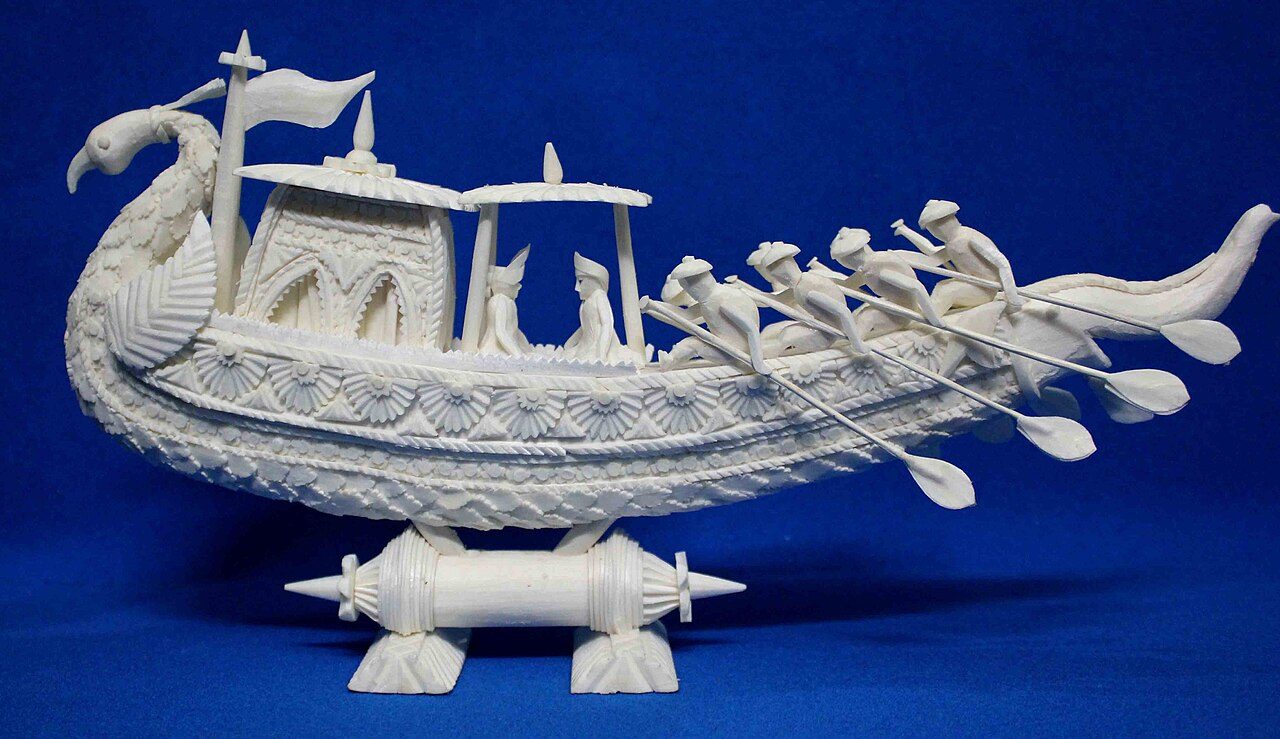
Shola is the stem of a plant that grows wild in marshes and waterlogged paddy, cut and carved by hand into ornaments as fine as paper. The same craft makes the topor, the conical headdress a Bengali groom wears, as well as birds, flowers and the carved peacock boats sold as showpieces. It is fragile, and thermocol imitations of it are common.
What shola is
Two species of Aeschynomene supply it: A. aspera, called bhat shola, and A. indica, kath shola. They grow in West Bengal, Odisha and Assam and are most plentiful in September and October. Sahapedia's account of the craft describes the plants being uprooted, mostly by women, cut into lengths with a crescent sickle called a hansuli, and dried in the sun for three or four days until the skin turns brown. Peeled, the stem shows a milky white, spongy core. Makers slice it with a thin steel knife, the kat, which comes in five or six shapes, and with scissors, and join the pieces with adhesive.
It is usually called pith in English, and botanists dispute the word, because the usable part is the soft wood of the stem, and the pith is a different tissue. "Spongy inner stem" is the safest description.
In Bengal the makers are traditionally the Malakar community, whose name means garland-maker. One documented cluster, Bankapasi village in Mangalkot block of Purba Bardhaman, has 171 artists, 117 of them full-time. In Assam the craft is kuhila shilpa, centred on Goalpara and Dhubri. In Puri, PARI found Upendra Kumar Purohit making the shola tahia, the headdress of Odissi dancers, at ₹1,500 to ₹2,000 a piece and no more than two a day.
GI status
Sholapith Craft of West Bengal is GI application No. 1023, filed on 6 December 2022 by the Patent Information Centre of the West Bengal State Council of Science and Technology. The registry shows it as registered, with a certificate dated 27 March 2026 (GI Journal No. 210). Some websites still describe it as only advertised, which is out of date. An earlier application for the sholapith crafts of Birbhum district (No. 448) was refused. There is no GI for the sholapith work of Odisha or Assam.
Daker saaj, and the thermocol years
The classic shola ornament of a Durga image is called daker saaj. The story usually told is that dak means post, and that the silver foil and tinsel for these ornaments once came by post from Germany. We found it in lifestyle writing and in no historical source, so treat it as a story.
Shola lost ground twice. Theme pujas with bigger budgets moved to beads, stone and zari, as Business Standard reported in 2011. Cheaper decoration moved to thermocol, which is expanded polystyrene. That second shift was reversed by law. The Plastic Waste Management (Amendment) Rules, 2021 banned polystyrene for decoration from 1 July 2022. Artists told PTI that September that the ban had come just before the pujas and that shola was much costlier than thermocol.
The image-makers have their own troubles this year. Kumartuli, the potters' quarter on the Hooghly in north Kolkata, settled by potters from Krishnanagar in Nadia about three centuries ago, depends on river clay. A crackdown on illegal mining in May 2026 cut off its supply of nauka maati, and the idol-makers' association petitioned the state.
Shola or thermocol
- Colour and surface. Shola is ivory or milky white, with a fine, even texture and a soft lustre where it has been cut. Thermocol is a flat, bright white, and on a cut edge or up close you can see the round beads it is made of.
- Feel. Shola is very light and slightly spongy, and its cut edges are clean. Thermocol is light too, but sheds beads when scratched. These two tests are our own observations. We found no published standard for them, though both are easy to do in a shop.
- Read the listing's tags as well as its title. One online shop we found files a ₹14,500 "Maa Durga Family Shola Work" under both "Sholapith Artwork" and "Thermoco Art". Ask before you pay.
- A Durga face is often two materials. Many Durga wall pieces sold as shola have a clay face and a shola crown, and the honest ones say so. That is a legitimate piece, and it should be priced as clay with shola trim.
- Price. A groom's topor costs about ₹1,250, a topor-and-mukut set about ₹4,000, a carved wall relief by a named artist ₹3,500, and the largest pieces several times that.
Shola needs little care beyond handling it as little as possible. It dents and soils easily, so keep a piece in a frame or a glass case if you can, dust it with a soft dry brush, and keep it away from damp and kitchen smoke. That is our advice; we found no maker's published care guide.
Durga Puja starts on 17 October. Anything ordered now is more likely to arrive in time for Bijoya greetings or for Diwali.
Specific picks
Four pieces, each checked on 6 October for price, stock and what the listing says it is made of. The West Bengal government's own shop, now at artisans.org.in, had only one shola item and it was out of stock.
Top pick · Named artist
Contrasting Designs in Sholapith, by Maya Rani Haldar
via MeMeraki · West Bengal sholapith wall relief, hand-carved, signed to the artist · In stock
Durga · Clay and shola
Durga Maa, clay and sholapith wall hanging
via Bongoniketan · Clay face with a sholapith crown, which the listing states · Bengal · In stock
Wedding · Groom's topor
Classic sholapith groom's topor, 14 × 24 inch
via Karukarjo · Sholapith, hand-made · The listing does not name the place of origin · In stock
Wedding · Full set
Artha topor and mukut set
via Shola Ghar · Shola (the listing says "aquatic plant") · Topor 16 in, mukut 6.5 in, with shola peacock and stick · In stock
Sources
- Sahapedia, Sreya Mukherjee, "Sholapith: herbal ivory of Bengal" and on the Malakar community
- Naturally Bengal, on the Bankapasi cluster
- Abhijna e-Museum, on kuhila shilpa in Assam, 5 March 2026
- PARI, "The tahia maker of Puri", 7 May 2023 and "Journey through Kumartuli", 12 September 2016
- Business Standard, on daker saaj losing ground, 2011
- PTI via Devdiscourse, on the thermocol ban, 10 September 2022
- The Federal, on the Kumartuli clay crisis, 31 May 2026
- UNESCO, Durga Puja in Kolkata, 2021
- West Bengal government holidays 2026
- GI registry: Sholapith Craft of West Bengal, No. 1023 and Solapith Crafts of Birbhum District, No. 448
The hero photograph is a representative piece. Product cards link to current listings, checked on 6 October 2026.